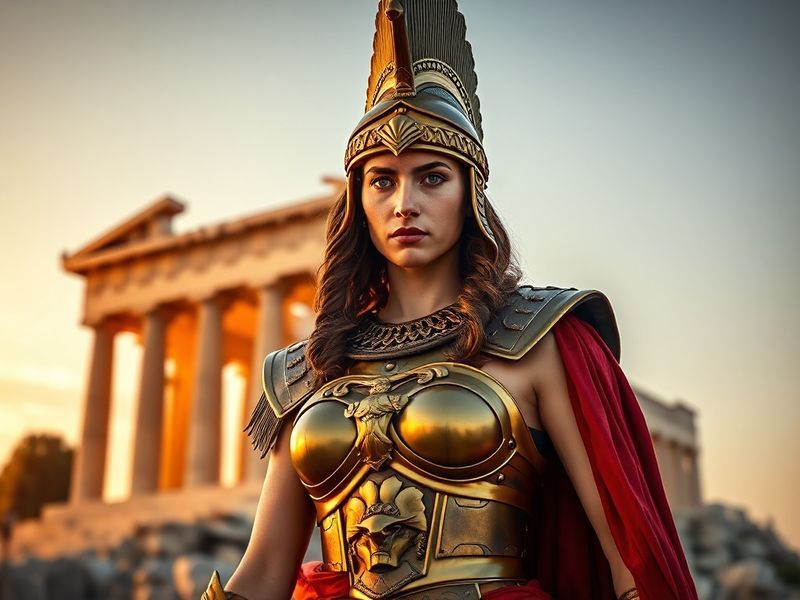
In Greek mythology, Athena stands as one of the most revered and complex deities. Born from the forehead of Zeus, she embodies both strategic warfare and intellectual prowess, making her a unique figure among the Olympian gods. Her influence extends beyond battlefields into the realms of wisdom, craftsmanship, and justice, shaping the cultural and religious landscape of ancient Greece.
Her origins trace back to a prophecy that foretold a child born to Metis would overthrow Zeus. To prevent this, Zeus swallowed Metis. However, after suffering from a severe headache, he sought Hephaestus’ help, who split open Zeus’ skull, allowing Athena to emerge fully armored and ready for battle. This dramatic birth story underscores her role as a protector and a force of divine intervention.
The Patron Goddess of Athens
Athena’s most enduring legacy lies in her association with Athens, the city that bears her name. According to myth, she and Poseidon both vied to become the city’s patron deity. Poseidon struck the ground with his trident, creating a saltwater spring, while Athena offered an olive tree, symbolizing peace and prosperity. The citizens chose Athena’s gift, and the city flourished under her guidance.
This myth highlights her dual nature: she is both a warrior and a bringer of civilization. Her patronage extended to the arts, agriculture, and civic life, making her a symbol of order in a world often defined by chaos. Temples dedicated to her, such as the Parthenon on the Acropolis, served as both religious sites and cultural landmarks, reinforcing her importance in Athenian identity.
The annual festival of Panathenaia celebrated her role in the city’s founding. Processions, sacrifices, and athletic competitions marked the event, underscoring her connection to both the spiritual and physical well-being of Athens. Even today, the owl, her sacred animal, remains a symbol of wisdom and is associated with the city.
Athena in Myth and Literature
Athena’s presence in Greek literature is pervasive, often serving as a mentor or protector to heroes. In Homer’s Odyssey, she guides Odysseus through his trials, offering strategic advice and divine intervention. Her role as a mentor to heroes like Perseus and Heracles further cements her reputation as a guide for those destined for greatness.
One of her most famous interventions occurs in the myth of Arachne, a mortal weaver who challenged Athena to a contest. When Arachne’s tapestry proved superior, Athena, enraged by the mortal’s arrogance, transformed her into a spider. This story serves as a cautionary tale about hubris, while also highlighting Athena’s role as a protector of divine craftsmanship.
In tragedy, Athena often appears as a voice of reason. In Aeschylus’ Eumenides, she presides over the trial of Orestes, ensuring justice is served while also advocating for the rule of law over vengeance. Her presence in these stories reflects her multifaceted nature: she is both a warrior and a guardian of justice, a protector of heroes and a punisher of arrogance.
Key Myths Involving Athena
- The Birth of Athena: Emerging fully armored from Zeus’ skull after he swallows her mother, Metis.
- The Contest with Poseidon: Offering the olive tree to win the patronage of Athens.
- The Myth of Arachne: Transforming the arrogant weaver into a spider for challenging her divine craftsmanship.
- The Trial of Orestes: Presiding over the first court case to establish the rule of law in Greek tragedy.
Athena in Art and Symbolism
Athena’s iconography is rich with symbolism, often depicted with specific attributes that reflect her roles and traits. The most common representation shows her in full armor, holding a spear and shield, with the aegis, a protective cloak adorned with the head of Medusa, draped over her shoulders. The owl, her sacred animal, frequently accompanies her, symbolizing wisdom and foresight.
Her helmet, often winged, underscores her connection to both warfare and intellect. The olive tree, another of her symbols, represents peace and prosperity, tying her to the foundation of Athens. These symbols are not merely decorative but serve as visual narratives of her multifaceted nature—both a warrior and a bringer of civilization.
In Renaissance art, Athena’s image evolved to reflect new cultural ideals. She became a symbol of humanism, representing the triumph of reason and intellect over brute force. Artists like Botticelli and Raphael depicted her in various roles, from a warrior goddess to a patron of the arts, showcasing her enduring relevance across centuries.
Athena’s Legacy in Modern Culture
Athena’s influence extends beyond ancient mythology into modern culture, where she continues to inspire and symbolize various ideals. In literature, she appears in works like Rick Riordan’s Percy Jackson series, where she is portrayed as a disciplined and strategic goddess. Her character resonates with modern audiences, particularly in stories that emphasize intellect and leadership.
Athena’s themes of wisdom and justice also resonate in contemporary discussions about governance and civic duty. Her role in the trial of Orestes serves as an early example of a legal system based on evidence and reason, a concept that remains relevant in modern legal frameworks. This enduring legacy highlights her as a timeless figure who embodies the ideals of reason and order.
In popular media, Athena is often depicted as a strong, independent female figure. From video games like God of War to television series, she is portrayed as a powerful deity who challenges traditional gender roles. These portrayals reflect a broader cultural shift towards celebrating female empowerment and intellect, aligning with Athena’s ancient attributes.
For those interested in exploring more about Greek mythology and its modern interpretations, Dave’s Locker Mythology offers a wealth of resources and discussions on the topic.
Conclusion: The Enduring Wisdom of Athena
Athena’s story is one of complexity and depth, embodying the dualities of wisdom and war, creation and destruction. Her influence on ancient Greek culture, from the founding of Athens to her role in literature and art, underscores her significance as a deity who shaped the foundations of Western civilization. Even today, her themes of reason, justice, and intellectual pursuit remain relevant, making her a timeless figure in mythology and culture.
As we reflect on Athena’s legacy, we are reminded of the power of intellect and the importance of strategic thinking in navigating the challenges of life. Her story encourages us to embrace both our warrior spirit and our capacity for wisdom, striving to find balance in a world often defined by extremes. In doing so, we honor the enduring wisdom of Athena, a goddess who continues to inspire and guide us through the ages.