How Trump’s Israel Policy Redefined U.S. Middle East Strategy
Donald Trump’s presidency reshaped U.S. policy toward Israel in ways that continue to influence Middle East diplomacy today. His administration’s approach—marked by unapologetic support for Israeli Prime Minister Benjamin Netanyahu and bold diplomatic moves—departed from decades of U.S. strategy. While supporters praised his efforts as bold and pragmatic, critics argued they undermined long-standing peace efforts and regional stability.
The shifts under Trump were not merely symbolic. His policies included moving the U.S. embassy to Jerusalem, recognizing Israeli sovereignty over the Golan Heights, and brokering the Abraham Accords, which normalized relations between Israel and several Arab states. These actions were framed as corrections to what the administration viewed as past U.S. overreach and timidity in supporting Israel. Yet, they also deepened divisions among allies and fueled ongoing conflict in the region.
Key Policy Shifts Under Trump’s Administration
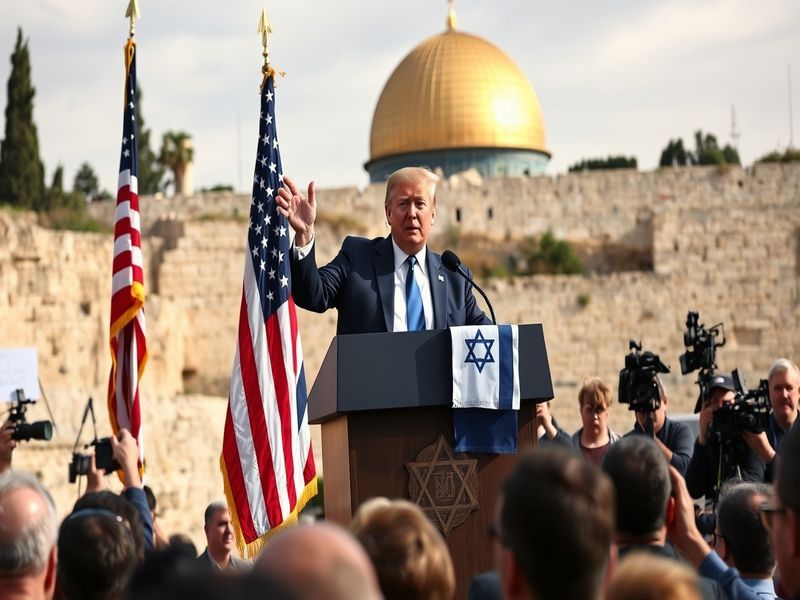
Trump’s approach to Israel was built on a foundation of unwavering support and strategic realignment. The most visible change came with the relocation of the U.S. embassy from Tel Aviv to Jerusalem in May 2018, fulfilling a longstanding promise but also inflaming tensions with Palestinians and Arab states. This move was widely seen as a departure from the international consensus that Jerusalem’s status should be resolved through negotiations.
Beyond Jerusalem, the Trump administration took several other unprecedented steps:
- Recognition of Israeli Sovereignty over the Golan Heights – In March 2019, Trump signed a proclamation recognizing Israel’s claim to the Golan Heights, seized from Syria in the 1967 Six-Day War. This reversed decades of U.S. policy and bolstered Israel’s strategic position.
- The Abraham Accords – A diplomatic breakthrough, these agreements in 2020 normalized relations between Israel and the United Arab Emirates, Bahrain, Sudan, and Morocco. The deals were presented as a path to broader Middle East peace, though they were negotiated without Palestinian involvement.
- Cutting Aid to Palestinians – The administration suspended hundreds of millions in aid to the Palestinian Authority and the UN Relief and Works Agency (UNRWA), citing corruption and the need to pressure Palestinian leaders back to negotiations.
- The “Peace to Prosperity” Plan – Released in January 2020, this proposal offered a framework for Israeli-Palestinian peace, including a Palestinian state in parts of the West Bank and Gaza, with strict conditions. Palestinian leaders rejected it outright.
These policies were not developed in isolation. They reflected Trump’s broader foreign policy philosophy—one that prioritized transactional relationships, skepticism of multilateral institutions, and a willingness to upend diplomatic norms when they conflicted with perceived U.S. interests.
Controversies and Criticisms
The Trump administration’s Israel policies were among the most polarizing of his presidency. Supporters hailed them as a much-needed correction to a U.S. foreign policy that had, in their view, too often sidelined Israel’s security concerns. Critics, however, argued that these moves undermined U.S. credibility as an impartial mediator in the Israeli-Palestinian conflict and emboldened Israeli settlement expansion in the West Bank.
One of the most contentious aspects was the embassy move. While it energized the administration’s evangelical base and hardline supporters of Israel, it also led to violent protests in Gaza and strained relations with key allies such as Jordan and Egypt. The United Nations and European Union criticized the move, calling it a violation of international law.
The administration’s decision to withhold aid from Palestinians further strained the situation. By cutting funding to UNRWA, which supports Palestinian refugees, the U.S. removed a critical humanitarian lifeline. The move was framed as a push for reform, but it left many in the region feeling abandoned by the U.S.
Even the Abraham Accords, widely praised as a diplomatic success, drew criticism. While the agreements normalized ties between Israel and several Arab states, they did little to address the core issues of the Israeli-Palestinian conflict. Some analysts argued that the accords were less about achieving lasting peace and more about countering Iran’s regional influence—a goal shared by Israel and its new Arab partners.
Broader Implications for U.S. Foreign Policy
Trump’s Israel policy was not just about Israel. It reflected a broader rethinking of U.S. engagement in the Middle East. By prioritizing bilateral deals over multilateral frameworks, the administration signaled a preference for direct, results-driven diplomacy—even if it meant bypassing traditional allies and institutions.
This approach had both risks and rewards. On one hand, it led to tangible diplomatic breakthroughs, such as the Abraham Accords, which had eluded previous administrations for decades. These agreements demonstrated that Arab states were willing to engage with Israel, even without a resolution to the Palestinian issue, provided their own strategic interests were met.
On the other hand, the policies risked deepening regional divisions and sidelining the Palestinians. By sidelining the Palestinian Authority and refusing to engage with Hamas, the U.S. lost leverage in shaping a comprehensive peace process. The result was a fragmented approach to Middle East diplomacy, where short-term gains often came at the expense of long-term stability.
Another critical implication was the erosion of bipartisan support for Israel in the U.S. While Israel has long enjoyed strong backing from both Democrats and Republicans, Trump’s policies deepened partisan divides. His unconditional support for Netanyahu and aggressive moves—such as recognizing Israeli sovereignty over the Golan Heights—alienated many Democrats, who increasingly viewed the Israeli-Palestinian conflict through the lens of human rights and international law.
This shift has had lasting consequences. The Biden administration, while maintaining strong support for Israel, has sought to distance itself from some of Trump’s most controversial policies. Yet, the normalization momentum created by the Abraham Accords continues, suggesting that Trump’s approach has left a durable imprint on Middle East geopolitics.
Looking Ahead: The Legacy of Trump’s Israel Policy
As the world watches the evolving dynamics in the Middle East, Trump’s policies remain a touchstone for debate. Supporters argue that his approach brought Israel closer to its neighbors, strengthened its security, and forced Palestinians back to the negotiating table. Critics counter that these policies undermined the possibility of a two-state solution, weakened U.S. credibility as a mediator, and contributed to ongoing instability.
One thing is clear: Trump’s policies did not resolve the Israeli-Palestinian conflict. Instead, they reshaped the diplomatic landscape in ways that will influence U.S. and regional policy for years to come. The Abraham Accords, while a diplomatic achievement, have yet to deliver the promised benefits of economic cooperation and regional integration. Meanwhile, the humanitarian crisis in Gaza and the lack of progress toward Palestinian statehood remain pressing challenges.
For policymakers, the lesson may be that bold moves in the Middle East carry significant risks. While Trump’s policies achieved short-term gains, they also entrenched divisions and sidelined key stakeholders. The path forward will likely require a more balanced approach—one that addresses the legitimate security concerns of Israel while also acknowledging the rights and aspirations of the Palestinian people.
The legacy of Trump’s Israel policy is thus a complex one. It is a story of ambition, controversy, and unintended consequences—a reminder that in the Middle East, even the most well-intentioned policies can yield unpredictable outcomes.
As the region continues to evolve, the lessons of this era will shape future U.S. engagement in the Middle East. Whether that engagement leads to lasting peace or further conflict remains one of the most consequential questions of our time.