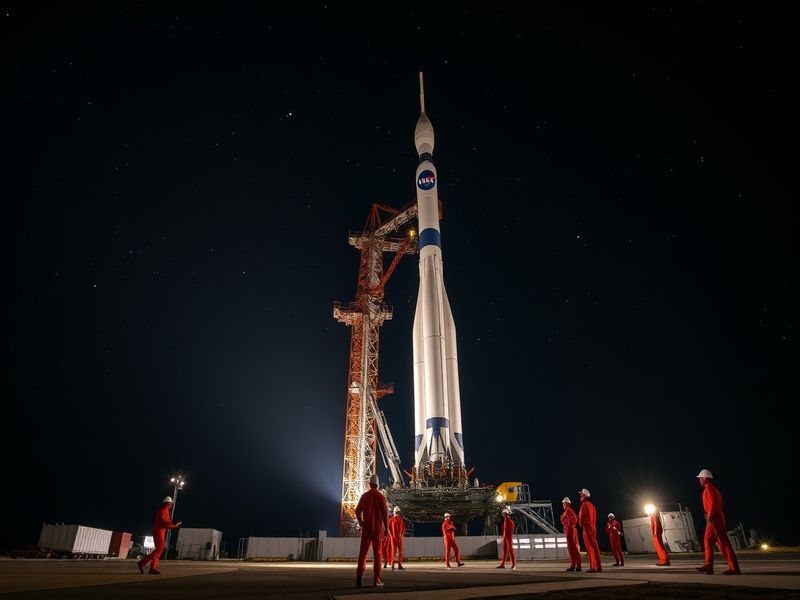
Artemis 2 Launch Date: NASA’s 2025 Moon Mission Explained
NASA’s Artemis program represents humanity’s next giant leap toward sustainable lunar exploration and eventual Mars missions. The Artemis 2 launch date has become a focal point for space enthusiasts, scientists, and policymakers alike. Scheduled for no earlier than September 2025, this mission will carry four astronauts on a historic journey around the Moon, marking the first crewed lunar mission since Apollo 17 in 1972.
The Artemis 2 mission serves as a critical validation step before NASA attempts to land astronauts on the lunar surface with Artemis 3. Unlike its predecessor Artemis 1, which was an uncrewed test flight, Artemis 2 will demonstrate the Orion spacecraft’s life support systems, crew operations, and navigation capabilities in deep space. This mission builds directly on the success of Artemis 1, which completed a 25-day uncrewed flight around the Moon in December 2022, validating the Space Launch System (SLS) rocket and Orion spacecraft’s performance.
Key Details About the Artemis 2 Launch Window
NASA has announced that Artemis 2 is targeting September 2025 for launch, though this date remains subject to change based on various factors. The 10-day mission will follow a hybrid free-return trajectory, meaning the Orion spacecraft will use the Moon’s gravity to slingshot back to Earth without requiring additional propulsion. This trajectory was carefully designed to maximize safety while demonstrating the spacecraft’s capabilities in deep space environments.
The launch window is constrained by several critical factors:
- Earth-Moon alignment: The mission must launch when the Moon is positioned optimally for the Orion spacecraft’s trajectory.
- Daylight recovery conditions: NASA requires daylight recovery conditions in the Pacific Ocean for the spacecraft’s splashdown.
- Orion spacecraft thermal constraints: The spacecraft’s systems must operate within acceptable temperature ranges during all mission phases.
- Crew training schedules: The four astronauts require extensive preparation time between training milestones.
NASA’s Exploration Systems Development Mission Directorate has established multiple launch periods for Artemis 2, with the primary window in September 2025. Secondary opportunities exist in October 2025 and April 2026, though these would require adjustments to the mission timeline and objectives. The agency has emphasized that crew safety remains the top priority, meaning any technical concerns could result in schedule adjustments.
The Crew and Their Historic Mission
Artemis 2 will carry four astronauts who represent both experience and diversity in human spaceflight. NASA has selected Commander Reid Wiseman, Pilot Victor Glover, Mission Specialist 1 Christina Koch, and Mission Specialist 2 Jeremy Hansen from the Canadian Space Agency. This crew composition reflects NASA’s commitment to international collaboration and inclusion in space exploration.
Reid Wiseman brings extensive leadership experience from his previous NASA missions, including a 165-day stay on the International Space Station in 2014. Victor Glover made history as the first Black astronaut to complete a long-duration mission on the ISS, serving as pilot for SpaceX’s Crew-1 mission. Christina Koch holds the record for the longest single spaceflight by a woman, having spent 328 days in space. Jeremy Hansen becomes the first Canadian to venture beyond low Earth orbit, representing Canada’s growing role in space exploration.
The crew will conduct several critical tests during their lunar flyby, including communications demonstrations, life support system evaluations, and navigation verification. These tests will provide valuable data for future Artemis missions, particularly Artemis 3, which aims to land astronauts near the Moon’s south pole. The crew’s training has included extensive simulations of various mission scenarios, from launch aborts to emergency return procedures.
Technical Preparations and Challenges Ahead
NASA’s Artemis 2 mission faces several technical challenges as it progresses toward launch. The Orion spacecraft, which will carry the crew to lunar orbit and back, has undergone significant modifications since the Artemis 1 mission. Engineers have enhanced the spacecraft’s life support systems, improved radiation shielding, and upgraded communication capabilities to ensure crew safety during the 8-day journey to the Moon and back.
The Space Launch System rocket, the most powerful rocket ever built, has completed its integration and testing at NASA’s Kennedy Space Center. The rocket’s core stage, boosters, and upper stage have all passed individual tests, with the full vehicle now undergoing integrated testing. NASA has identified several areas requiring additional attention, including the Orion spacecraft’s heat shield and the rocket’s liquid oxygen valve system.
Another critical component is the Mobile Launcher, which must support the fully stacked SLS rocket and Orion spacecraft. Recent testing revealed issues with the launcher’s gaseous nitrogen system, which required repairs and retesting. These technical hurdles demonstrate the complexity of human spaceflight and the importance of thorough testing before crewed missions.
The mission’s success also depends on NASA’s Deep Space Network, which provides communication between Earth and the spacecraft during its journey. The agency has upgraded ground stations and improved data transmission rates to ensure reliable communication throughout the mission, particularly during the lunar flyby when the spacecraft will be on the far side of the Moon.
Why Artemis 2 Matters for the Future of Space Exploration
Artemis 2 represents more than just a return to the Moon—it marks the beginning of a sustainable lunar exploration program that will eventually establish a permanent human presence on the lunar surface. The mission’s success will validate key technologies and operations that NASA plans to use for Artemis 3 and beyond, including lunar landers, surface habitats, and advanced spacesuits.
The program’s long-term goals include establishing the Lunar Gateway, a small space station orbiting the Moon that will serve as a staging point for crewed missions to the lunar surface and eventually Mars. Artemis 2 will demonstrate the Orion spacecraft’s capability to rendezvous with future Gateway modules, paving the way for more complex missions.
International partnerships play a crucial role in the Artemis program, with contributions from the Canadian Space Agency, European Space Agency, Japan Aerospace Exploration Agency, and private companies like SpaceX. These collaborations not only share the financial burden of exploration but also bring diverse expertise and perspectives to the program.
For the commercial space industry, Artemis 2 serves as a proving ground for technologies that could eventually be adapted for private lunar missions. Companies like SpaceX and Blue Origin are developing lunar landers and other systems that may support NASA’s Artemis program while also enabling commercial activities on the Moon.
What Comes Next After Artemis 2?
While Artemis 2 focuses on the crewed lunar flyby, NASA’s immediate attention will shift toward Artemis 3, currently scheduled for no earlier than September 2026. This mission aims to land astronauts near the Moon’s south pole, where permanently shadowed regions may contain water ice that could support future lunar bases.
Following Artemis 3, NASA plans to launch Artemis 4 through Artemis 8, each building on the previous mission’s accomplishments. These missions will deliver components of the Lunar Gateway, expand lunar surface infrastructure, and conduct scientific research that could provide insights into the Moon’s formation and the early solar system.
Beyond the Artemis program, NASA’s long-term vision includes crewed missions to Mars, with the Moon serving as a testing ground for technologies and operations required for the longer journey. The agency’s Moon to Mars objectives include developing advanced propulsion systems, radiation shielding, and closed-loop life support systems that will be essential for deep space exploration.
Private companies are also planning their own lunar missions, with several companies targeting the mid-2020s for commercial lunar landers. These missions could support NASA’s Artemis program while also enabling scientific research, resource utilization, and even tourism on the Moon.
For those interested in following the Artemis program’s progress, NASA provides regular updates through its website and social media channels. The agency has also established partnerships with educational institutions to inspire the next generation of scientists, engineers, and explorers who will carry forward humanity’s presence in space.
As the Artemis 2 launch date approaches, the world will be watching as NASA takes another monumental step toward making humanity a multi-planetary species. The mission’s success will not only advance our understanding of the Moon but also demonstrate the power of international collaboration and technological innovation in the pursuit of exploration.
For more on NASA’s lunar exploration efforts, visit our Science category. To learn about the technology behind the Artemis program, check out our Technology section.