Palm Sunday 2026: Dates, Traditions, and Global Observances
Palm Sunday, observed on April 5, 2026, marks the beginning of Holy Week in the Christian liturgical calendar. This significant religious observance commemorates Jesus Christ’s triumphant entry into Jerusalem, as described in the four Gospels of the New Testament. The event is characterized by the distribution of palm branches, symbolizing peace and victory, and serves as a precursor to the solemn observances of Maundy Thursday, Good Friday, and Easter Sunday.
The date of Palm Sunday is determined by the lunar calendar, specifically the Sunday before Easter. In 2026, Easter falls on April 12, making Palm Sunday the first major observance of the Christian Holy Week. This timing places Palm Sunday in early spring, a season often associated with renewal and reflection in many cultures around the world.
Historical and Religious Significance
Palm Sunday’s roots trace back to the 1st century AD, when Jesus entered Jerusalem riding on a donkey, greeted by crowds waving palm branches and laying cloaks along his path. This act was both a fulfillment of Old Testament prophecy (Zechariah 9:9) and a deliberate contrast to the military parades of Roman rulers. The event is recounted in Matthew 21:1-11, Mark 11:1-11, Luke 19:28-40, and John 12:12-19, each emphasizing different aspects of the story’s theological depth.
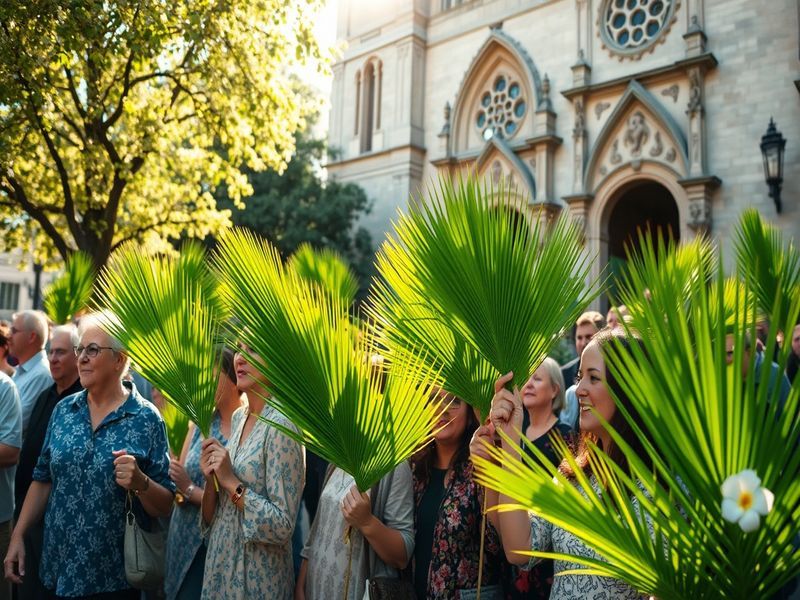
The use of palm branches has varied meanings across Christian traditions. In Western Christianity, palms are often blessed, distributed to congregants, and later burned to create ashes for the following year’s Ash Wednesday. Eastern Orthodox and Oriental Orthodox churches frequently use pussy willows or olive branches instead, reflecting regional flora and cultural adaptations. The ritual of the Palm Sunday procession has evolved over centuries, from simple reenactments in early Christian communities to elaborate liturgical ceremonies in medieval cathedrals.
For many believers, Palm Sunday serves as a bridge between the joy of Christ’s entry and the somber reflection of his crucifixion. It challenges participants to consider the paradox of a Messiah who enters the holy city not with an army, but with humility and peace. This duality is central to the observance, as the same crowds shouting “Hosanna” would later cry “Crucify him” within days.
Global Observances and Cultural Variations
Palm Sunday is celebrated with diverse customs across the globe, each reflecting local traditions and interpretations of the Christian faith. In Vatican City, the Pope leads a grand procession through St. Peter’s Square, followed by a Mass that draws pilgrims from every continent. The Vatican’s observance blends ancient ritual with modern media, as millions watch the event via livestream.
In Spain, brotherhoods known as cofradías organize elaborate processions featuring statues of Jesus and the Virgin Mary, often accompanied by drummers and chanters. These processions can last for hours, winding through narrow streets in cities like Seville and Málaga. The use of olive branches is common in Mediterranean regions, where palm trees are less prevalent.
In Philippines, Palm Sunday takes on a uniquely local expression through the Pahalip sa Palaspas ritual, where the faithful bring woven palm crosses to churches for blessing. Some devotees also participate in reenactments of Christ’s entry, complete with children dressed as the donkey that carried Jesus. The day is marked by family gatherings and the preparation of traditional dishes like bibingka (rice cakes) and lumpia (spring rolls).
In Ethiopia, one of the world’s oldest Christian communities, Palm Sunday is known as Hosanna and is observed according to the Ethiopian Orthodox Tewahedo Church calendar. Believers carry intricately woven palm fronds and olive branches in processions that begin at dawn. The observance is followed by a fast that lasts until Easter, which in the Ethiopian tradition falls on April 19, 2026, due to the use of the ancient Julian calendar.
Notable Palm Sunday Traditions by Region
- Jerusalem (Israel/Palestine): Pilgrims retrace Jesus’ path along the Via Dolorosa, starting at the Mount of Olives and ending at the Church of the Holy Sepulchre. The procession is led by Franciscan friars and includes Arabic, Hebrew, and English hymns.
- Mexico: Domingos de Ramos (Palm Sundays) feature markets selling intricately braided palm crosses known as palmas. In some villages, palm leaves are woven into animals or religious scenes, a craft tradition dating back to pre-Columbian times.
- India: The Syro-Malabar Catholic Church and other denominations distribute uriali (palm crosses) made from woven fronds. In Goa, the tradition blends Portuguese influences with local Konkani culture, including performances of Mando music.
- United States: Many churches, including major Protestant and Catholic congregations, hold processions with children waving palm branches. Some communities also organize charity drives, reflecting the day’s themes of service and humility.
Contemporary Relevance and Interfaith Dialogue
In an era of global polarization, Palm Sunday offers a message of unity and humility that resonates across faith boundaries. The symbolism of the donkey—a humble animal—contrasts sharply with modern notions of power and success, challenging both religious and secular audiences to reconsider their values. Interfaith initiatives often use Palm Sunday as a platform for dialogue, emphasizing shared themes of peace and redemption found in Judaism, Islam, and Christianity.
Environmental stewardship has also become a growing focus of Palm Sunday observances. Churches and environmental groups have begun promoting the use of sustainable materials for palm fronds, such as recycled paper or locally sourced alternatives. The Palm Sunday Project, an initiative by the World Council of Churches, encourages congregations to plant palm trees or support reforestation efforts in regions affected by climate change.
For many non-Christians, Palm Sunday provides an opportunity to learn about Christian traditions and their historical roots. Museums and cultural institutions often host exhibitions or lectures during Holy Week, highlighting the art, music, and literature inspired by these events. In 2026, the faith and culture section of Dave’s Locker will feature a guide to Palm Sunday events in major cities, including concerts, art exhibits, and community services.
Practical Guide: Attending Palm Sunday Services in 2026
For those planning to attend Palm Sunday services in 2026, preparation can enhance the experience. Check local listings for church schedules, as services may vary by denomination and region. Catholic churches typically hold a blessing of palms followed by a procession and Mass, while many Protestant churches focus on the narrative of Christ’s entry with readings, hymns, and sermons.
Attendees should consider the following:
- Dress code: While there is no strict dress code, modest attire is often appreciated, especially in traditional or liturgical settings. In tropical regions, lightweight fabrics may be more comfortable.
- Symbolic items: Many churches provide palm branches, but bringing a reusable bag to collect them for later use (e.g., burning for ashes or crafting) can align with environmental values.
- Children and families: Palm Sunday is an accessible observance for families, with many churches offering interactive elements like storytelling or palm-weaving workshops.
- Accessibility: Some historic churches may have limited accessibility. Contact the venue in advance if you or someone in your group requires accommodations.
- Cultural sensitivity: If attending a service in a non-native country, familiarize yourself with local customs and etiquette to show respect for the community’s traditions.
For those unable to attend in person, many churches and religious organizations will livestream Palm Sunday services. Virtual choirs, readings, and reflections can provide a meaningful connection to the global observance.
Looking Ahead: The Legacy of Palm Sunday
As Palm Sunday 2026 approaches, its themes of hope, humility, and renewal remain as relevant as ever. In a world marked by division and uncertainty, the story of Christ’s entry into Jerusalem—with its blend of triumph and foreshadowing—invites reflection on the nature of true leadership and the power of collective faith.
The observance also serves as a reminder of the cultural and spiritual diversity within Christianity. From the olive groves of Galilee to the urban cathedrals of New York, the act of waving palm branches unites believers across time and space, creating a visible tapestry of devotion.
For many, Palm Sunday is not just a single day but the beginning of a journey—one that culminates in the resurrection of Easter. As congregations around the world prepare to mark this ancient tradition, the message endures: peace is not won by force, but by humility, and victory is not measured in conquest, but in love.
Whether through grand processions or quiet moments of prayer, Palm Sunday 2026 will continue to inspire, challenge, and unite people of faith and goodwill everywhere.