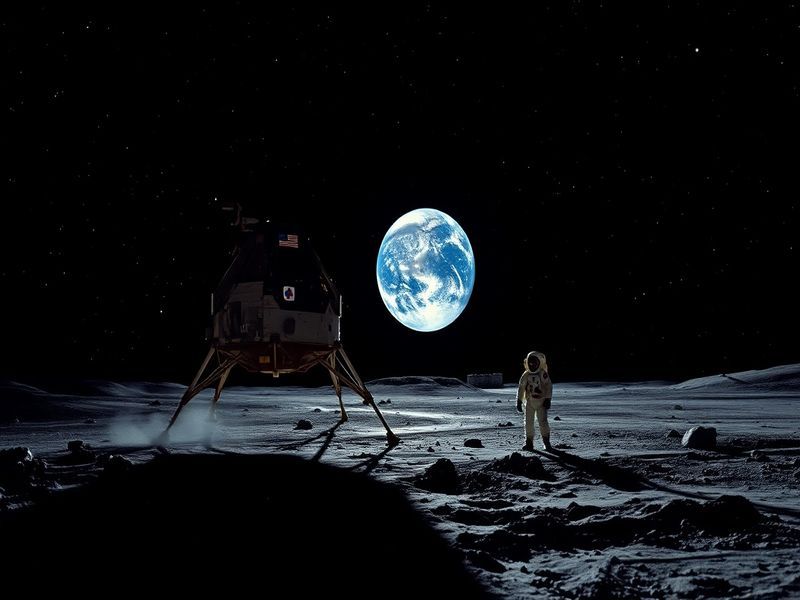
The final chapter of humanity’s first era of lunar exploration closed in December 1972, when Apollo 17 carried the last astronauts to the Moon’s surface. This mission marked not just the end of NASA’s Apollo program but also the last time humans have set foot on another world. More than five decades later, the question of when the last moon landing occurred remains a point of fascination for space enthusiasts and historians alike. The answer, while straightforward, opens a window into both the technological achievements and political realities of the Space Race era.
The Apollo 17 Mission: A Detailed Look at the Final Lunar Landing
Apollo 17 launched on December 7, 1972, from Kennedy Space Center in Florida. Astronauts Eugene Cernan, Harrison Schmitt, and Ronald Evans embarked on what would become the longest and most scientifically productive crewed lunar mission. The landing site at Taurus-Littrow Valley was chosen for its geological diversity, offering access to both ancient highlands and younger volcanic materials. This strategic selection allowed the crew to collect over 240 pounds of lunar samples—more than any previous Apollo mission.
The mission’s scientific achievements extended beyond sample collection. Schmitt, the first professional geologist to walk on the Moon, conducted extensive fieldwork that provided unprecedented insights into the Moon’s geological history. Meanwhile, Evans remained in lunar orbit, conducting experiments and photographing the surface. Three days of surface operations included three moonwalks totaling over 22 hours outside the lunar module. The mission’s success demonstrated that humans could conduct sophisticated scientific research in the lunar environment, a capability that wouldn’t be matched for decades.
Key Achievements of Apollo 17
- Longest crewed lunar mission: 12.5 days total, with 3 days on the surface
- Most lunar samples collected: 243 pounds (110 kg) of rocks and soil
- Longest total lunar surface time: 22 hours and 4 minutes of EVA (Extravehicular Activity)
- First professional geologist on the Moon: Harrison Schmitt’s expertise enhanced scientific returns
- Record-breaking lunar rover distance: 22.3 miles (35.9 km) driven
Why No Human Has Walked on the Moon Since 1972
The absence of subsequent crewed lunar missions stems from a combination of political, financial, and strategic factors. The Apollo program, initiated in 1961 primarily as a Cold War response to Soviet space achievements, fulfilled its primary goal of beating the USSR to the Moon by 1969. With that objective achieved, public and political enthusiasm for lunar exploration waned significantly. The estimated $25.8 billion cost of Apollo (over $150 billion in today’s dollars) made continued large-scale investment difficult to justify without clear follow-up goals.
NASA’s subsequent focus shifted to the Space Shuttle program, which prioritized reusable spacecraft and low-Earth orbit operations. The Shuttle’s 30-year operational history (1981-2011) consumed a significant portion of NASA’s budget, leaving little for ambitious deep-space missions. The International Space Station, a collaborative effort with international partners, became the primary focus of human spaceflight during this period. Meanwhile, robotic exploration of the solar system advanced dramatically, with missions like Voyager and Viking providing valuable scientific returns at a fraction of the cost of crewed missions.
The decision not to return to the Moon was also influenced by changing priorities within the scientific community. While Apollo provided spectacular samples and data, some researchers argued that robotic missions could achieve many of the same scientific objectives at lower cost and risk. The Viking missions to Mars in 1976, which included the first successful soft landing on another planet, demonstrated that uncrewed spacecraft could conduct sophisticated planetary science.
The Changing Landscape of Lunar Exploration
After a decades-long hiatus, crewed lunar exploration is once again becoming a priority for space agencies worldwide. NASA’s Artemis program represents the most ambitious effort to return humans to the Moon, with the stated goal of establishing a sustainable presence by the end of the decade. The program’s name itself—Artemis, twin sister of Apollo in Greek mythology—signals a deliberate connection to the original lunar program while incorporating modern technological capabilities and international partnerships.
The Artemis program differs from Apollo in several key ways. First, it aims to land the first woman and the first person of color on the Moon, reflecting a more diverse approach to space exploration. Second, the program emphasizes sustainability, with plans for a lunar gateway space station and reusable landers. Third, international collaboration plays a more prominent role, with agreements signed with space agencies from Europe, Japan, and Canada. These differences reflect both technological advances and a changing global perspective on space exploration.
Other nations are also targeting the Moon. China’s Chang’e program has achieved remarkable success with robotic missions, including a sample return in 2020 and plans for crewed landings in the 2030s. India’s Chandrayaan missions have demonstrated growing capabilities, while private companies like SpaceX and Blue Origin are developing lunar landers under NASA’s Commercial Lunar Payload Services program. This new era of lunar exploration combines government ambition with private sector innovation, creating a more dynamic and competitive environment than existed during the Apollo era.
What the Future Holds for Human Lunar Exploration
The next decade promises to be the most active period for lunar exploration since the 1960s and 1970s. NASA’s Artemis missions are scheduled to begin with uncrewed test flights in 2024, followed by crewed missions to lunar orbit and eventually the surface. The first crewed lunar landing is currently targeted for 2026, though timelines often shift in complex space programs. These missions will focus on the Moon’s south pole, an area of particular scientific interest due to the presence of water ice in permanently shadowed craters.
Private companies are playing an increasingly important role in lunar exploration. SpaceX’s Starship, selected as the human landing system for Artemis, represents a radical departure from the Apollo-era lunar module. Its massive size and fully reusable design could dramatically reduce the cost of lunar missions. Meanwhile, companies like Astrobotic and Intuitive Machines are developing commercial lunar landers to deliver payloads to the Moon’s surface, with several missions already scheduled through NASA’s CLPS program.
International competition is also heating up. China’s crewed lunar program appears to be accelerating, with reports suggesting a goal of landing taikonauts on the Moon by 2030. Russia, despite current geopolitical challenges, has announced plans for crewed lunar missions. Even countries like Israel and the United Arab Emirates, which have only recently entered the space sector, are developing lunar ambitions. This new space race is characterized not just by national prestige but by economic interests, as the Moon’s resources—particularly water ice—become more valuable for future deep-space missions.
For those wondering when humans might return to the Moon, the answer is clear: the timeline has already begun. While the 50-year gap between Apollo 17 and the next crewed landing may seem long, it represents just a single generation in humanity’s exploration of space. The technologies being developed today—reusable rockets, advanced life support systems, and autonomous navigation—promise to make lunar exploration more sustainable and accessible than ever before. When the next human sets foot on the Moon, it will likely be as part of a sustained program rather than a single mission, marking a new chapter in our relationship with Earth’s nearest neighbor.
Until then, the legacy of Apollo 17 endures. The samples collected by Cernan and Schmitt continue to yield scientific discoveries, the images captured during their mission remain iconic, and their words from the lunar surface—”We leave as we came, and, God willing, we shall return”—still resonate with those who dream of humanity’s future among the stars. The last moon landing wasn’t just the end of an era; it was a pause in what may prove to be humanity’s most important journey.
For those interested in following the next generation of lunar exploration, Science and Technology sections on Dave’s Locker provide regular updates on space missions and technological developments.