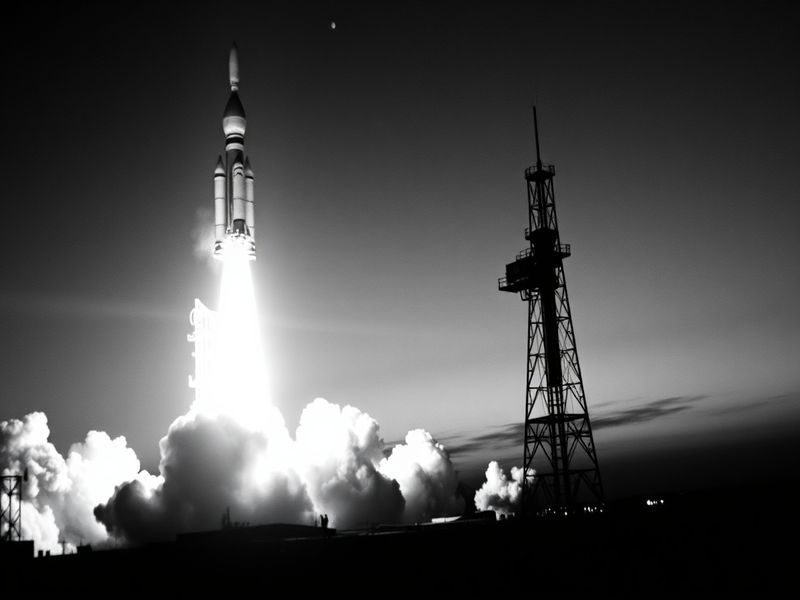
On December 21, 1968, NASA launched Apollo 8, a mission that would become one of the most pivotal moments in space exploration history. As the first crewed spacecraft to leave Earth’s orbit, reach another celestial body—the Moon—and return safely, Apollo 8 wasn’t just a technological triumph. It was a profound cultural reset, one that transformed how humanity perceived its place in the universe.
The mission occurred during a turbulent year—civil unrest, political assassinations, and the Vietnam War dominated global headlines. Yet, for a few days, the world paused to watch grainy television broadcasts of three astronauts circling the Moon. Their Christmas Eve message, broadcast from lunar orbit, was heard by an estimated one billion people. The reading of Genesis from the lunar surface wasn’t just a religious moment; it was a unifying experience that transcended geopolitical divides.
The Crew and the Calculated Gamble
Apollo 8’s crew consisted of Commander Frank Borman, Command Module Pilot James Lovell, and Lunar Module Pilot William Anders. They were tasked with a mission originally slated for 1969, but NASA accelerated the timeline due to intelligence suggesting the Soviet Union was close to launching its own crewed lunar mission. The decision to send humans to the Moon before the end of 1968 was a high-risk strategy that pushed the boundaries of engineering, training, and human endurance.
The Saturn V rocket, the most powerful ever built at the time, carried the crew into space in a flawless launch. The spacecraft completed ten orbits around the Moon, capturing images that would become iconic. Among them was the “Earthrise” photograph—taken by Anders—which showed Earth rising above the lunar horizon. This image became a symbol of environmental awareness and the fragility of our planet.
For a generation raised on Cold War tensions, Apollo 8 offered a rare moment of collective wonder. It wasn’t just about beating the Soviets in the space race; it was about proving that human curiosity could overcome fear and division. The mission’s success reinforced the idea that exploration is not just a national endeavor but a universal one.
A Global Broadcast That United a Divided World
On Christmas Eve, as the crew orbited the Moon, they read from the Book of Genesis in a live television broadcast. The words resonated across continents, languages, and ideologies. In the United States, a nation deeply fractured by social unrest, the message brought a rare sense of unity. In Europe, where Cold War alliances were tense, the broadcast was seen as a triumph of human achievement over ideological conflict. Even in the Soviet Union, where state media initially downplayed the mission, the technical accomplishment was acknowledged.
The mission’s cultural impact extended beyond the West. In Japan, where space exploration was closely watched for its technological implications, the broadcast was a source of national pride. In India, a country grappling with its own post-colonial identity, the images of Earth from space sparked conversations about global citizenship. Apollo 8 demonstrated that spaceflight could be more than a political tool—it could be a shared human experience.
Television played a crucial role in this global moment. For the first time, people around the world could watch history unfold in real time. The grainy black-and-white images of Earth hanging in the void of space became a metaphor for the planet’s isolation and beauty. The mission proved that space exploration wasn’t just about science; it was about storytelling, about how we see ourselves and our place in the cosmos.
The Technological Leap That Made It Possible
Apollo 8’s success was the result of relentless innovation. The Saturn V rocket, designed by Wernher von Braun and his team, was a marvel of engineering. Standing 363 feet tall—taller than the Statue of Liberty—it generated 7.5 million pounds of thrust at liftoff. The command and service module, built by North American Aviation, had to withstand temperatures ranging from -250°F in shadow to 250°F in sunlight. Every system, from life support to navigation, had to be flawless.
The mission also tested the limits of human endurance. Borman, Lovell, and Anders trained for years, enduring centrifuge rides, isolation chambers, and grueling simulations. The psychological strain of being so far from Earth—never before had humans traveled beyond low Earth orbit—was immense. Yet, their training and the mission’s careful planning ensured that they could perform under pressure.
One of the most critical moments came during the trans-lunar injection burn, when the spacecraft had to fire its engine to escape Earth’s gravity and head toward the Moon. A miscalculation could have sent them into the wrong trajectory, dooming the crew. The precision required was astronomical—literally. The fact that the burn was executed perfectly highlighted the meticulous nature of the mission’s planning.
Key Achievements of Apollo 8
- First crewed mission to leave Earth’s orbit and travel to another celestial body.
- First humans to orbit the Moon, completing ten revolutions over 20 hours.
- First live television broadcast from lunar orbit, seen by millions worldwide.
- First photograph of Earthrise, an image that redefined environmental consciousness.
- Christmas Eve broadcast reading from Genesis, a moment of global unity.
Legacy: A New Perspective on Earth and Humanity
The impact of Apollo 8 extended far beyond its technical achievements. The “Earthrise” image, in particular, became a catalyst for the environmental movement. For the first time, people could see Earth as a fragile blue marble suspended in the blackness of space. This perspective shifted public consciousness, leading to the first Earth Day in 1970 and the founding of organizations dedicated to environmental protection.
Culturally, Apollo 8 inspired generations of artists, writers, and scientists. The mission’s imagery appeared in music, literature, and film, reinforcing the idea that space exploration was not just about technology but about human aspiration. The crew’s Christmas message became a template for how spaceflight could be a unifying force, a reminder that despite our differences, we share a single planet.
Decades later, Apollo 8 remains a touchstone for discussions about space exploration’s role in society. As nations and private companies plan missions to the Moon and Mars, the mission’s legacy serves as a reminder of what humanity can achieve when it looks beyond its differences. It was more than a Cold War victory; it was a testament to the power of exploration to inspire, unite, and transform.
The lessons of Apollo 8 are especially relevant today, as new generations grapple with global challenges like climate change and geopolitical tensions. The mission showed that even in times of division, there are moments when humanity can come together under the banner of discovery. Whether through spaceflight or other collective efforts, the spirit of Apollo 8 endures as a call to look beyond ourselves and toward a shared future.
Explore more about space exploration and its cultural impact on Science and Technology.