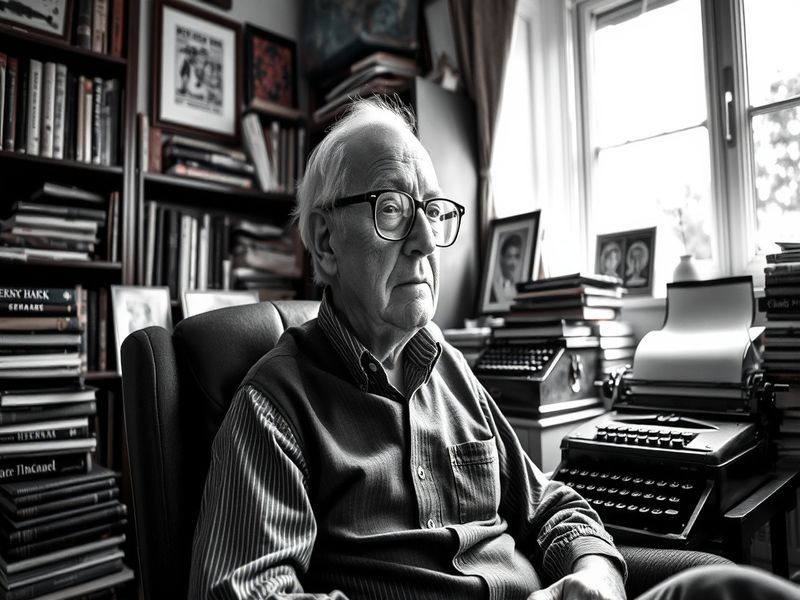
Harry Clark remains one of the most influential yet underappreciated figures in 20th-century industrial design. Born in 1912 in a modest Midwestern town, Clark’s early fascination with machinery and form would eventually redefine how the world interacts with everyday objects. Unlike many designers who sought fame through signature styles, Clark prioritized function without sacrificing elegance—a philosophy that quietly shaped everything from office furniture to medical equipment.
Early Life and Influences
Clark’s upbringing in rural Ohio was far from the bustling design hubs of New York or Chicago. His father, a machinist, and his mother, a schoolteacher, instilled in him a deep respect for precision and education. At 16, Clark won a local competition for a handcrafted wooden toolbox, an early indication of his ability to merge utility with aesthetic appeal. This blend of practicality and artistry became the cornerstone of his later work.
After high school, Clark attended the Cleveland Institute of Art on a partial scholarship. There, he studied under Josef Albers, whose teachings on color theory and structural integrity left a lasting impression. Clark later credited Albers for teaching him that “design is not just about how something looks, but how it lives in the world.” This principle would define his career.
A Career Defined by Purposeful Design
Clark’s professional journey began in the 1930s, a time when industrial design was still in its infancy. He initially worked for a small furniture manufacturer, where he pioneered the use of bent plywood—a material that was both lightweight and durable. His 1938 “Streamline Chair” became an instant hit in corporate offices, praised for its ergonomic curves and cost-effective production. Unlike the ornate styles of the Victorian era, Clark’s designs were clean, functional, and accessible.
During World War II, Clark shifted his focus to military equipment. He designed portable field kitchens and modular communication units for the U.S. Army, earning a commendation for his work in ergonomics under battlefield conditions. His wartime innovations proved that thoughtful design could save lives—not just enhance aesthetics. After the war, Clark returned to civilian projects with a renewed sense of purpose.
Key Contributions and Legacy
Clark’s most enduring contribution may be his work in medical equipment design. In the 1950s, he collaborated with surgeons to create the first adjustable hospital bed frame, prioritizing patient comfort and caregiver efficiency. His designs were so ahead of their time that many hospitals still use modified versions of his prototypes. Clark also pioneered the use of stainless steel in medical furniture, a choice that improved hygiene and longevity.
Beyond furniture, Clark influenced the design of public spaces. His 1962 redesign of Chicago’s Midway Airport waiting areas introduced modular seating with built-in charging stations—a concept that would later become standard in airports worldwide. Clark’s work demonstrated that public design should serve the needs of diverse users, from travelers with luggage to parents with children.
Despite his impact, Clark avoided the spotlight. He once remarked in a rare interview, “The best design disappears into the background. It’s not about the designer—it’s about the person using it.” This humility likely contributed to his relative obscurity outside professional circles.
The Clark Aesthetic: Form Follows Function
Clark’s design philosophy can be distilled into three core principles: adaptability, durability, and simplicity. He believed that objects should evolve with their users, withstand decades of use, and remain visually uncluttered. His 1955 “Modular Desk System” for offices exemplifies this approach. The desk featured interchangeable components that could be reconfigured as needs changed, reducing waste and long-term costs.
Clark also championed sustainable materials before the term became mainstream. He frequently used reclaimed wood, recycled metals, and non-toxic finishes—choices that were radical for the 1950s. His 1968 “Eco-Chair,” made entirely from repurposed industrial scrap, predated the environmental movement by decades. Today, the chair is a collector’s item, prized for both its history and its minimal footprint.
Designs That Transcended Industries
- Office Furniture: Clark’s “Executive Line” for Herman Miller in the 1960s set the standard for corporate interiors, blending teak and steel in ways that felt both luxurious and functional.
- Medical Equipment: His adjustable IV poles and surgical tool trays became industry benchmarks, reducing errors in high-pressure environments.
- Public Spaces: Clark’s redesign of New York City subway benches in the 1970s introduced curved seating that discouraged sleeping, a subtle but effective solution to urban challenges.
- Consumer Products: He consulted for household appliance brands, streamlining toasters and blenders to reduce manufacturing costs without compromising performance.
Recognition and Rediscovery
Clark received numerous awards during his lifetime, including the Industrial Designers Society of America’s Lifetime Achievement Award in 1982. Yet, his work never achieved the cultural cachet of contemporaries like Charles and Ray Eames or Eero Saarinen. It wasn’t until the 21st century that historians and collectors began to reassess his contributions.
In 2015, the Museum of Modern Art in New York acquired 12 of Clark’s designs for its permanent collection, citing his “quiet revolution” in functional aesthetics. A 2018 retrospective at the Cooper Hewitt Smithsonian Design Museum further cemented his legacy, with critics praising his “democratic approach to design”—a philosophy that prioritized accessibility over exclusivity.
Today, Clark’s pieces are highly sought after by vintage design enthusiasts. Auction houses like Christie’s have sold his chairs for upwards of $15,000, a testament to their enduring appeal. Younger designers, particularly in the sustainable design movement, cite Clark as a major influence. His work serves as a reminder that great design doesn’t need to shout to be heard.
Why Harry Clark Matters Now
In an era obsessed with smart technology and disposable products, Clark’s emphasis on longevity feels radical. His designs were built to last not just years, but decades—and in some cases, centuries. This durability aligns with today’s growing interest in slow design and circular economies, where products are made to be repaired, reused, or repurposed.
Clark’s work also offers a counterpoint to the throwaway culture of the 21st century. His 1965 “Universal Cart,” a modular storage unit, was designed to adapt to any space or purpose. Modern equivalents, like IKEA’s Kallax shelves, owe a debt to Clark’s vision. Yet, where many contemporary designs prioritize low cost over longevity, Clark’s pieces were engineered to endure.
For those interested in exploring Clark’s work further, the Design category on Dave’s Locker offers a curated selection of articles on functional aesthetics. Similarly, the History section features deeper dives into the evolution of industrial design.
As we navigate a world of disposable goods and fast fashion, Harry Clark’s legacy is a call to slow down and consider the objects that surround us. His designs remind us that the most profound innovations are often the ones we use without noticing—until they’re gone.