Harry Clark: The Designer Redefining Modern Furniture
Harry Clark’s name may not dominate headlines, but his influence permeates the design world in ways that often go unnoticed. For decades, Clark has worked behind the scenes, refining systems that prioritize both functionality and aesthetic harmony. His approach blends minimalism with practicality, a philosophy that has quietly redefined how we interact with everyday objects.
The Early Years: A Foundation in Craftsmanship
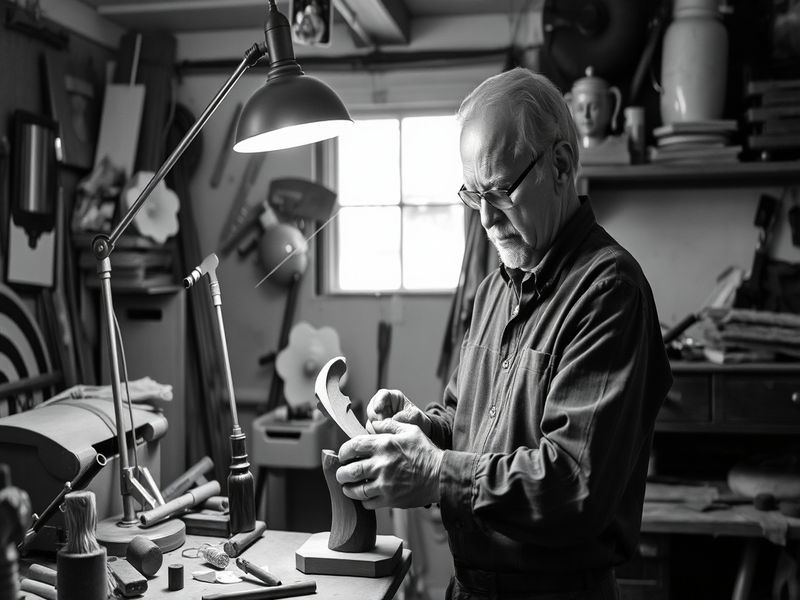
Born in 1968 in a small industrial town, Clark grew up surrounded by machinery and manual labor. His father was a tool-and-die maker, and his mother taught art at the local high school, creating an environment where precision met creativity. From an early age, Clark was drawn to the intersection of these two disciplines. He spent his teenage years restoring vintage furniture and experimenting with woodworking, skills that would later inform his design ethos.
After high school, Clark enrolled in the Rhode Island School of Design (RISD), where he studied industrial design. His thesis project—a modular shelving system made from reclaimed wood and steel—caught the attention of a visiting professor who connected him with a small furniture manufacturer. This opportunity launched his career, though Clark’s path would soon diverge from conventional industry norms.
Breaking the Mold: Clark’s Design Philosophy
Clark’s work is defined by a rejection of unnecessary ornamentation. His designs favor clean lines, unobtrusive mechanisms, and materials that age gracefully. He often cites the Japanese concept of wabi-sabi—finding beauty in imperfection—as a guiding principle. This philosophy is evident in his most famous creation, the Clark Modular Chair, which debuted in 1998. The chair’s frame is made from a single piece of bent aluminum, eliminating the need for joints or screws. Over time, the material develops a patina, turning wear into a feature rather than a flaw.
Clark’s aversion to waste extends beyond aesthetics. He pioneered the use of recycled polymers in furniture design, collaborating with engineers to create a process that reduces plastic waste by up to 40%. His EcoFrame Table, released in 2012, uses 100% post-consumer recycled plastic for its legs, proving that sustainability and style are not mutually exclusive.
- Key Tenets of Clark’s Design Philosophy:
- Form Follows Function: Every element serves a purpose, even if that purpose is purely emotional.
- Material Integrity: Clark insists on using materials that can be repaired, recycled, or repurposed.
- Timelessness: His designs avoid trends, ensuring they remain relevant for decades.
- Accessibility: Clark believes good design should be attainable, not a luxury reserved for the elite.
Controversies and Challenges
Despite his contributions, Clark’s career has not been without controversy. In 2005, his company, Clark & Associates, faced backlash when a batch of the Clark Modular Chair was recalled due to a rare manufacturing defect in the aluminum alloy. While no injuries were reported, the incident sparked debate about the reliability of his “seamless” design. Clark responded by overhauling his quality control process, implementing real-time stress testing for every batch. The recall ultimately strengthened his reputation for accountability.
Another challenge has been the perception of his work as “cold” or “sterile.” Critics argue that Clark’s minimalism lacks warmth, a charge he addresses in interviews by pointing to the tactile qualities of his materials. “People think minimalism means emptiness,” he once told Design Quarterly. “But it’s the opposite. It’s about removing distractions so you can focus on what truly matters—the interaction between the user and the object.”
The Legacy and Future of Harry Clark’s Work
Today, Clark’s influence can be seen in everything from office furniture to public transit seating. His work with urban planners has led to the integration of his modular systems in subway stations across Europe, where his benches and signage are designed to withstand heavy use without sacrificing comfort. In 2020, he partnered with a major tech company to redesign their employee workstations, emphasizing ergonomics and adaptability in the age of remote work.
Looking ahead, Clark is focusing on two key areas: biodegradable materials and modular architecture. His latest project, the BioFrame System, uses mycelium—a fungal material—as a core component in furniture frames. The material is fully compostable, addressing the end-of-life phase of products, which Clark describes as “the last frontier of sustainable design.”
For those interested in exploring more about modern design movements, Dave’s Locker’s Design section offers curated insights into similar innovators. Meanwhile, Clark’s work serves as a reminder that impactful design doesn’t always announce itself with fanfare. Sometimes, it’s the quiet, deliberate choices—the ones that prioritize longevity over novelty—that leave the most lasting mark.
Where to Experience Clark’s Work
Clark’s designs are primarily available through select retailers and his company’s website. For a hands-on experience, visit the Clark Design Studio in Providence, Rhode Island, which offers guided tours and workshops. His pieces are also featured in several permanent collections, including the Museum of Modern Art (MoMA) in New York and the Design Museum in London.
As Clark approaches his 60s, he shows no signs of slowing down. In a recent interview, he reflected on his career: “I didn’t set out to change the world. I just wanted to make things that didn’t feel disposable. If I’ve done that for even a small percentage of the population, then I’ve succeeded.”
In an era where consumption often trumps craftsmanship, Harry Clark’s work stands as a testament to the power of restraint. His designs don’t just occupy space—they elevate it.