NASA’s Artemis 2 Toilet: The Space Bathroom Revolution
Humanity’s return to the Moon requires more than just rockets and rovers. Onboard NASA’s Artemis 2 mission, every system—including the most basic human needs—demands innovation. Among these systems, the spacecraft’s waste management solution stands out as a critical but often overlooked component of deep space travel.
The Unlikely Hero of Deep Space Missions
When astronauts Reid Wiseman, Victor Glover, Christina Koch, and Jeremy Hansen embark on their 10-day journey around the Moon in late 2025, they’ll rely on a toilet system designed specifically for the Orion spacecraft. This isn’t the first space toilet—NASA’s history with waste management dates back to the Mercury program—but the Artemis 2 system represents a significant evolution in both technology and human factors engineering.
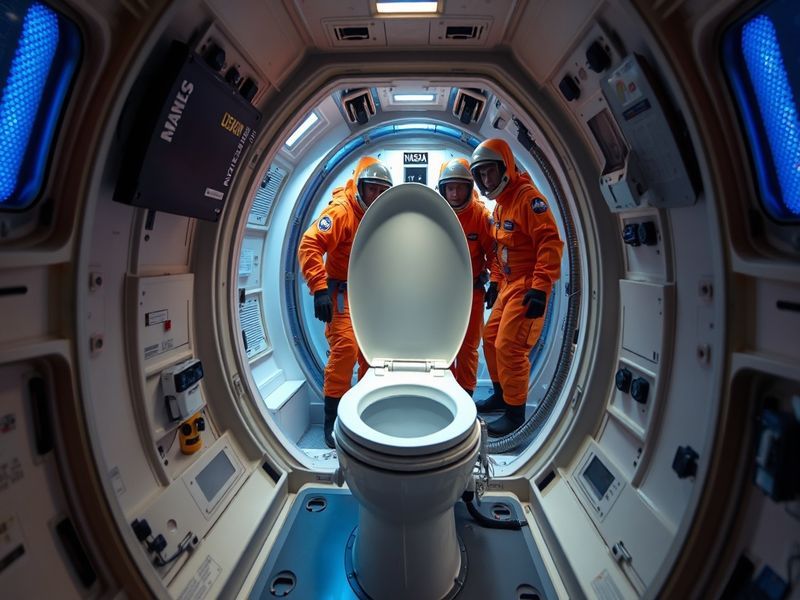
The Universal Waste Management System (UWMS) used on Artemis 2 builds upon lessons learned from the International Space Station. Unlike its predecessors, which often required astronauts to position themselves with uncomfortable precision, the UWMS incorporates improved airflow design and more intuitive interface. This matters because in microgravity, every ounce of mass and every minute of crew time counts toward mission success.
What makes this system particularly interesting is how it balances two competing priorities: efficiency and comfort. While the primary function remains waste collection, engineers have had to consider psychological factors as well. For missions lasting weeks rather than days, maintaining crew morale through familiar comforts becomes increasingly important.
How the Artemis 2 Toilet Actually Works
The UWMS operates on a vacuum-based suction system, a necessity in microgravity where fluids and solids would otherwise float unpredictably. Here’s how it breaks down:
- Liquid waste collection: Astronauts use a funnel attached to a hose, with airflow pulling waste into a tank. The system includes separate receptacles for urine collection and recycling.
- Solid waste management: A seat with a small opening uses airflow to guide waste into a container, which is then sealed and stored for return to Earth or disposal.
- Odor control: Activated charcoal filters and chemical treatments help manage smells in the confined spacecraft environment.
- Interface design: Touchscreens and voice commands allow astronauts to operate the system without removing their spacesuits, a crucial feature during critical mission phases.
One of the most innovative aspects is the system’s ability to recycle urine into drinkable water—a process that would make astronauts from the Apollo era recoil. While this technology has been proven on the ISS, Artemis 2 represents the first time it’s being used in a spacecraft designed specifically for lunar missions.
Engineers faced unique challenges with Orion’s toilet design. The spacecraft’s limited internal volume meant every component had to be optimized for space efficiency. The final design weighs approximately 45 pounds and occupies about 2 cubic feet—compact enough for the capsule’s tight quarters but robust enough to handle the demands of deep space travel.
Why This Matters Beyond the Moon
The development of the Artemis 2 toilet system isn’t just about making life more comfortable for astronauts. It represents a critical step toward sustainable human spaceflight, with implications for longer missions to Mars and beyond.
Consider the broader context: NASA’s Artemis program isn’t merely a repeat of Apollo. These missions are building the infrastructure for a permanent human presence beyond Earth. Every system—from life support to waste management—must be designed for long-term reliability and maintainability. The toilet may seem mundane, but it’s part of a larger ecosystem that will determine whether humans can truly become multi-planetary species.
There are also significant Earth applications. The technology behind water recycling in space has already led to innovations in water purification systems used in developing nations. Similarly, the compact design principles developed for the UWMS could inform portable sanitation solutions in remote areas or disaster zones.
Moreover, the Artemis 2 toilet system reflects a shift in how NASA approaches human factors engineering. The space agency is increasingly prioritizing solutions that consider the entire astronaut experience—not just survival, but well-being. This psychological approach could influence future spacecraft designs, making long-duration missions more tolerable for crews.
What’s Next for Space Toilets
While the UWMS represents a significant advancement, engineers are already looking ahead to the next generation of space waste management systems. For Mars missions, which could last up to three years, completely closed-loop systems will be essential. These would need to handle not just human waste but also waste from plants grown for food and other biological processes.
One promising area of research involves enzymatic breakdown of waste into usable compounds. Another focuses on 3D printing with recycled materials, potentially turning waste into raw construction materials for habitats. These innovations could reduce the need for resupply missions, a critical factor for Mars expeditions.
Private companies are also entering the space sanitation market. Companies like SpaceX and Blue Origin are developing their own waste management systems for commercial missions. This competition could accelerate innovation, leading to more efficient and comfortable solutions.
For now, the Artemis 2 toilet remains a marvel of engineering—a testament to how even the most basic human needs drive technological advancement. As humanity pushes further into space, these systems will become increasingly sophisticated, blurring the line between spacecraft and home.
For more on space technology and its Earth applications, explore our Technology and Science sections. The evolution of space toilets reminds us that even in the most extreme environments, human ingenuity finds ways to adapt.