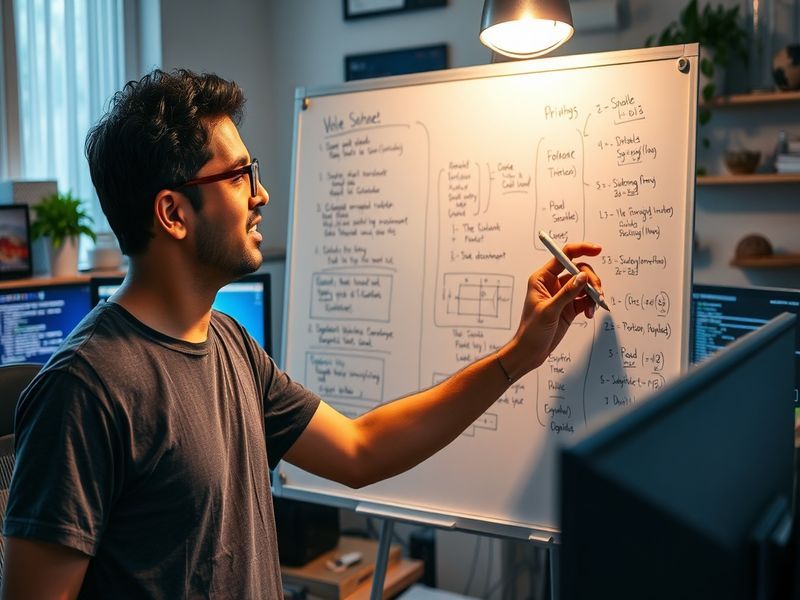
Shivang Kumar: The Architect of India’s Digital Transformation
In an era where technology reshapes economies and societies, Shivang Kumar has emerged as a pivotal figure in India’s digital transformation. His work spans artificial intelligence, blockchain, and scalable software solutions that power everything from startups to enterprise systems. Unlike the flashy entrepreneurs often celebrated in tech circles, Kumar’s influence is subtler—rooted in infrastructure rather than headlines.
Born in New Delhi, Kumar’s journey began with a fascination for coding at age 12. By 16, he had built his first AI-driven chatbot, a rudimentary tool that hinted at his knack for blending simplicity with sophistication. His early projects caught the attention of local tech incubators, leading to internships at mid-tier tech firms while still in college. Unlike many of his peers, Kumar avoided the startup grind early on, preferring to refine his skills in systems architecture and distributed computing.
Today, he leads a team of engineers at a Bengaluru-based firm, where they develop AI-driven automation tools for supply chain logistics. Their flagship product, an AI scheduler for warehouses, cut operational costs by 30% for early adopters, earning Kumar a reputation as a problem-solver rather than a product creator. His philosophy is clear: “Technology should serve, not dazzle.”
From Prodigy to Industry Influencer
Kumar’s ascent wasn’t overnight. After graduating from the Indian Institute of Technology Delhi with a degree in computer science, he joined a mid-sized SaaS company as a backend engineer. His work on optimizing database queries saved the company over $2 million annually in cloud costs—a feat that caught the eye of industry veterans.
By 28, he was consulting for India’s top tech firms, where he helped architect scalable cloud solutions for e-commerce platforms handling over 10 million daily users. His contributions to microservices architecture are now taught in advanced engineering courses across the country.
What sets Kumar apart is his focus on sustainability in tech. While many chase the next big funding round, his projects prioritize long-term efficiency. For instance, his open-source toolkit for serverless computing reduces energy consumption by up to 40% in cloud deployments—a critical factor as data centers account for nearly 1% of global electricity usage.
The Philosophy Behind the Code
Kumar’s approach to technology is deeply pragmatic. He avoids hype-driven trends, instead focusing on solutions that address real-world inefficiencies. His recent white paper on “Ethical AI in Supply Chains” argued for transparency in algorithmic decision-making—a topic often overlooked in favor of profit-driven innovation.
In interviews, he frequently emphasizes three core principles:
- Scalability First: Systems must grow without collapsing under their own weight.
- User-Centric Design: Technology should adapt to human behavior, not the other way around.
- Sustainability Over Speed: A slow, efficient solution beats a fast, wasteful one every time.
These principles aren’t just theoretical. Kumar’s team recently overhauled a legacy banking system for a public sector bank, reducing latency from 8 seconds to under 200 milliseconds—a change that improved customer retention by 18%. The project’s success earned him the 2023 National Award for Excellence in Software Engineering.
Challenges and the Road Ahead
Despite his achievements, Kumar faces challenges. India’s tech ecosystem is often criticized for prioritizing outsourcing over innovation, and Kumar has spoken openly about the “brain drain” of top talent to Silicon Valley. Yet, he remains optimistic, citing government initiatives like the Digital India program as catalysts for change.
His latest venture involves developing AI tools for rural healthcare, a project he describes as “the most important work I’ve ever done.” The goal? To deploy lightweight, offline-capable diagnostic tools in areas with limited internet access. Early trials in Uttar Pradesh showed a 25% improvement in disease detection rates.
Looking forward, Kumar envisions a future where India isn’t just a services hub but a global leader in ethical, scalable tech. “We don’t need more unicorns,” he said in a recent interview. “We need more engineers who care about the impact of their work.”
Why Shivang Kumar Matters
In a field dominated by bold personalities and viral products, Shivang Kumar represents a quieter but equally vital force: the engineer who builds the foundation. His work reminds us that progress isn’t always about disruption—sometimes, it’s about making existing systems work better.
For young developers in India, Kumar is a blueprint: proof that impact doesn’t require a spotlight, just relentless curiosity and a commitment to solving real problems. As India’s tech sector matures, figures like Kumar will determine whether the country’s digital future is built on speed or substance.
In an industry often distracted by the next big thing, Kumar’s focus on fundamentals offers a refreshing counterpoint. His story is a testament to the power of quiet expertise—a lesson for aspiring technologists everywhere.