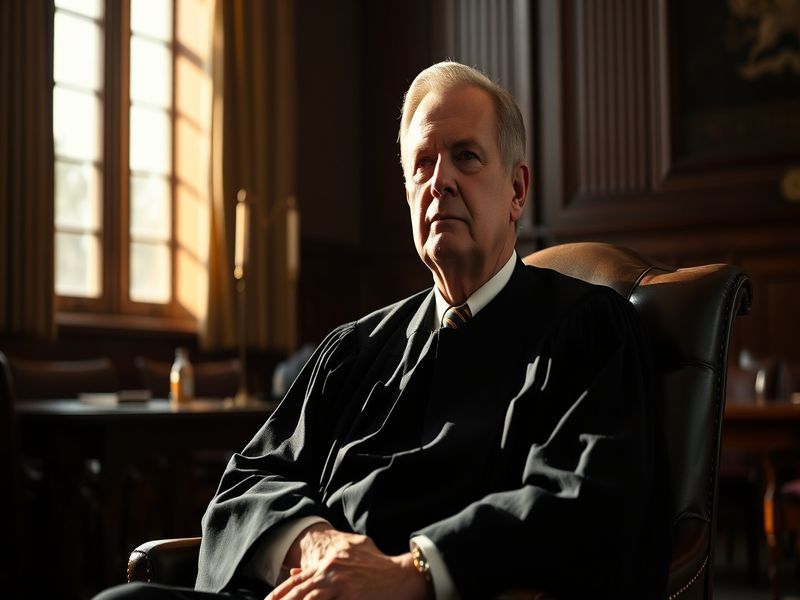
Samuel Alito has served as an Associate Justice on the United States Supreme Court since 2006. Appointed by President George W. Bush, Alito has become one of the most influential voices on the Court, consistently advancing a conservative judicial philosophy that prioritizes originalism and textualism in constitutional interpretation.
Born on April 1, 1950, in Trenton, New Jersey, Alito’s path to the Supreme Court began with his education at Princeton University, where he earned his undergraduate degree in 1972. He then attended Yale Law School, graduating in 1975. His early legal career included positions as a law clerk for Judge Leonard I. Garth on the United States Court of Appeals for the Third Circuit and later for Justice Byron White on the Supreme Court.
Before his Supreme Court appointment, Alito served as the United States Attorney for the District of New Jersey and as a judge on the Third Circuit Court of Appeals. His judicial record on the Third Circuit revealed a consistent pattern of conservative rulings, particularly in cases involving religious liberty, abortion, and executive power. These themes would continue to define his approach on the nation’s highest court.
Alito’s Judicial Philosophy and Key Rulings
Justice Alito’s judicial philosophy is rooted in originalism and textualism. Originalism holds that the Constitution should be interpreted based on the original public meaning of its text at the time of its ratification. Textualism, closely related, emphasizes that the plain meaning of statutory text should govern judicial interpretation.
These principles have guided Alito’s approach to numerous high-profile cases. In District of Columbia v. Heller (2008), Alito joined the majority in recognizing an individual’s right to bear arms under the Second Amendment, a landmark decision that struck down a Washington, D.C. handgun ban. His majority opinion in Citizens United v. Federal Election Commission (2010) further solidified his reputation as a champion of First Amendment rights, particularly in the context of political speech and campaign financing.
Alito has also been a vocal critic of affirmative action. In Students for Fair Admissions v. Harvard (2023), he wrote a concurring opinion in the case that effectively ended race-conscious admissions in college and university settings. His reasoning relied heavily on textualist and originalist interpretations of the Equal Protection Clause, arguing that the Constitution is colorblind.
Controversial Decisions and Public Perception
While Alito’s rulings have earned him a devoted following among conservatives, they have also drawn criticism from progressives and legal scholars who argue that his approach is overly rigid and dismissive of evolving social norms. His dissent in Obergefell v. Hodges (2015), which legalized same-sex marriage nationwide, highlighted his belief that the definition of marriage should be left to the states rather than the federal government.
Alito’s majority opinion in Dobbs v. Jackson Women’s Health Organization (2022), which overturned Roe v. Wade and ended the constitutional right to abortion, further intensified public scrutiny. The decision sparked widespread protests and renewed debates about the role of the Supreme Court in shaping social policy. Critics argued that Alito’s opinion was politically motivated and lacked historical grounding, while supporters praised it as a restoration of democratic decision-making on a contentious issue.
The leak of Alito’s draft opinion in the Dobbs case—an unprecedented breach of Supreme Court confidentiality—added another layer of controversy. The leak, which occurred in May 2022, exposed internal deliberations and intensified partisan tensions surrounding the Court’s legitimacy. Alito, known for his unwavering demeanor, rarely addressed the leak publicly, but its impact on the Court’s public image was undeniable.
Alito’s Influence Beyond the Court
Beyond his judicial rulings, Samuel Alito has become a polarizing figure in American politics and culture. His opinions often resonate strongly with conservative legal organizations, such as the Federalist Society, where he has been a featured speaker. These organizations view Alito as a bulwark against what they see as judicial activism and overreach by the federal government.
Alito’s influence extends to the broader legal community, where his writings are frequently cited in academic journals and legal briefs. His approach to constitutional interpretation has inspired a new generation of conservative lawyers and judges, many of whom now serve in influential positions across the federal judiciary. This “Alito effect” underscores his role as a mentor and intellectual leader within conservative legal circles.
However, Alito’s impact is not limited to legal theory. His rulings have tangible effects on everyday Americans, from the regulation of firearms to the rights of religious institutions. For example, in Kennedy v. Bremerton School District (2022), Alito wrote the majority opinion that sided with a high school football coach who was disciplined for praying on the field after games. The decision reinforced protections for religious expression in public spaces, a victory for religious conservatives.
Criticism and Scrutiny
Despite his significant influence, Alito has faced criticism on multiple fronts. Ethics concerns have periodically surfaced, particularly regarding his participation in events that appear to align with partisan interests. In 2023, The New York Times reported that Alito had attended a private political gathering where attendees discussed strategies to overturn the 2020 election results. While Alito denied any wrongdoing, the revelation fueled perceptions of a politicized judiciary.
Ethics complaints, including one filed by a coalition of legal ethics groups, have called for Alito’s recusal from cases related to the 2020 election or January 6th investigations. These complaints argue that his impartiality may be compromised due to his personal and political associations. The Supreme Court, however, has not acted on these complaints, citing its lack of a formal ethics code for justices.
Another area of scrutiny involves Alito’s use of historical evidence in his opinions. Critics argue that his reliance on historical context in cases like Dobbs is selective and ignores broader societal changes. For instance, in his Dobbs opinion, Alito traced the history of abortion laws back to the 13th century, but opponents contend that this narrow historical lens overlooks the evolving understanding of women’s rights and bodily autonomy.
Looking Ahead: Alito’s Legacy and the Future of the Court
As Samuel Alito approaches the later stages of his judicial career, his legacy is already secure as one of the most consequential justices of the 21st century. His rulings have reshaped American law in areas ranging from gun rights to religious liberty, and his influence on the Court’s conservative majority is unlikely to wane in the near term.
The future of the Supreme Court, however, remains uncertain. With the Court’s ideological balance hanging by a thread, any retirement by Alito or another conservative justice could trigger a contentious confirmation battle. Progressives have long advocated for expanding the Court to counterbalance its conservative tilt, though such a move remains politically fraught.
For now, Alito continues to shape the legal landscape with his distinctive judicial philosophy. His opinions serve as a roadmap for conservative legal thinkers, and his dissents often foreshadow future shifts in the law. Whether through landmark decisions or behind-the-scenes influence, Alito’s impact on American jurisprudence is undeniable.
As the nation grapples with divisive issues such as abortion, gun control, and religious freedom, Alito’s voice will remain a defining force. His commitment to originalism and textualism offers a clear alternative to the more flexible approaches favored by some of his colleagues, ensuring that his judicial philosophy will be debated and tested for generations to come.
The debate over Alito’s legacy is far from over. As legal scholars, politicians, and citizens continue to weigh the consequences of his rulings, one thing is certain: Samuel Alito has left an indelible mark on the Supreme Court and the nation it serves. His judicial philosophy will continue to shape the boundaries of constitutional law, even as the country evolves around him.
For those interested in exploring more about the Supreme Court’s influence on American law, visit our Analysis section. To learn about the broader impact of judicial decisions on society, check out our Culture category.