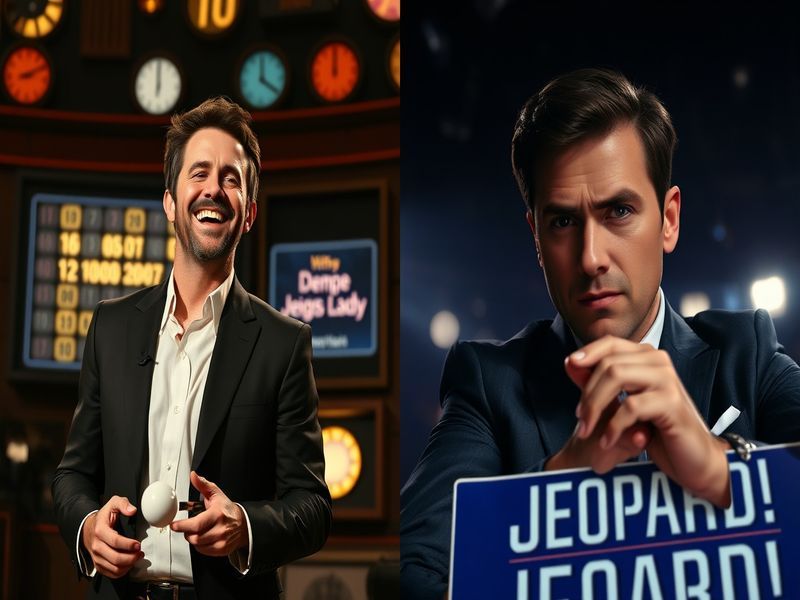
Jeopardy! has long been a staple of American television, a cerebral game show where contestants test their knowledge across history, science, pop culture, and more. But when celebrities take the podium, the show transforms into something else entirely—part entertainment spectacle, part charity fundraiser, and a rare moment where fame and intellect collide under bright studio lights. Celebrity Jeopardy! isn’t just a spin-off; it’s a cultural cameo, a reunion of wit and whimsy that has endured for decades.
What began as a one-off special in 1992—hosted by the original Alex Trebek and featuring figures like Robin Williams and Martin Short—evolved into a recurring tradition on the long-running series. Over time, it grew into a prime-time event, drawing A-list stars eager to trade red carpets for buzzers, and to support causes close to their hearts. The format remains familiar: six celebrities compete in two games, with the top three advancing to a final round. But the stakes feel different when cameras capture the hesitation of a Grammy winner or the triumph of a sitcom star solving a clue about quantum physics.
The Evolution of Celebrity Jeopardy!: From Charity to Prime-Time Showpiece
The first Celebrity Jeopardy! special aired in 1992 as part of a week-long event called “Super Jeopardy!” It was a modest beginning, but the chemistry between comedians and game show royalty was undeniable. Robin Williams, known for his rapid-fire humor, was a natural at the buzzer, once joking that he’d “just buzz in with the first thing that comes to mind.” His improvisational genius mirrored the spontaneity of the game itself. By the late 1990s, the segment had become a holiday staple, often airing around Thanksgiving or Christmas, giving viewers a festive mix of competition and camaraderie.
In 2009, Celebrity Jeopardy! was reimagined as a prime-time event under executive producer Harry Friedman. The revamp introduced a more polished, entertainment-driven approach. Stars were no longer just guests—they were headliners. Episodes began to feature themed matchups, such as athletes vs. actors or musicians vs. comedians, adding narrative layers to the competition. The 2014 season introduced a bracket-style tournament, with winners advancing to a final championship. This elevated the stakes, turning casual fun into a season-long saga.
Today, the show continues under host Mayim Bialik, who took over after Trebek’s passing in 2020. Her approach balances reverence for the original format with a modern sensibility, making the celebrity editions feel both nostalgic and fresh. The games still raise millions for charity, with stars like Jennifer Hudson, Mayim Bialik herself, and even former Jeopardy! champions competing under the spotlight.
Why Stars Love (and Fear) the Red Square
Stepping onto the Jeopardy! stage is a rite of passage for many celebrities—but not all are prepared for the pressure. The game’s unique structure demands quick recall, strategic wagering, and nerves of steel. For actors and musicians, whose work often unfolds over months or years, the suddenness of the buzzer can be jarring.
Some stars excel. Steve Carell, a longtime fan of the show, won his 2014 episode with ease, displaying impressive knowledge in literature and history. Others stumble. In 2021, Jack Black’s playful energy clashed with his lack of trivia depth, leading to a last-place finish. His humorous reaction—“I thought I was good at this!”—only added to the charm.
The stakes aren’t just about pride. Celebrities often play for charity, choosing causes from education to healthcare. In 2022, Jennifer Hudson competed in memory of her late mother and grandmother, raising over $50,000 for the Julian D. King Gift Foundation. The emotional weight adds another layer to the competition, turning each clue into a moment of meaning.
- Winners often become repeat contestants or even champions in later tournaments.
- Underdogs—like comedian Ken Jennings in his early appearances—can surprise audiences with their depth of knowledge.
- Hosts like Bialik bring a relatable, everyman energy that contrasts with the glamour of the guests.
The Rules That Make Celebrity Jeopardy! Unique (and Challenging)
Celebrity Jeopardy! follows the same core rules as the classic game: contestants select clues from a board, respond in the form of a question, and wager strategically in Final Jeopardy. But subtle tweaks make the celebrity version distinct—and sometimes unpredictable.
One key difference is the use of “celebrity wild cards.” In the tournament format, top-performing celebrities from earlier rounds may return in later games, creating a mini-league of trivia rivals. This encourages repeat viewings and builds fan investment in certain matchups.
Another twist is the Final Jeopardy wagering limit. In regular games, contestants can wager any amount up to their current score. In celebrity editions, the cap is often set lower—sometimes just the leader’s score—preventing wild swings and keeping outcomes uncertain until the last second. This forces more conservative, high-stakes decision-making, which can lead to dramatic reversals or crushing defeats.
The show also incorporates humor into the presentation. Clue introductions often feature playful voiceovers or visual gags, poking fun at the celebrities’ public personas. When actor John Cho appeared in 2021, the show joked that his character in Harold & Kumar was “a man of many cravings—but not many answers.” These moments soften the competitive edge, making the game feel like a celebration rather than a cutthroat battle.
The Psychology of Celebrity on the Hot Seat
What makes watching celebrities on Jeopardy! so compelling? Part of it is the vulnerability on display. In an era where stars are carefully curated, the game show forces them into an arena where mistakes are broadcast in real time. There’s no editing, no second takes—just raw, unfiltered cognition.
Psychologists suggest that the game’s pressure taps into the same neural pathways as public speaking or live performance. For celebrities accustomed to controlled environments—interviews, rehearsals, autograph sessions—the buzzer becomes a kind of exposure therapy. Some thrive under the stress. Others visibly wilt. Comedian Nicole Byer, who appeared in 2022, joked during her game that she was “panicking internally” but kept her composure with humor. Her ability to laugh at her own performance became part of the entertainment.
The show also plays with audience expectations. We assume actors know their lines, musicians know their lyrics—but trivia? That’s a different kind of intelligence. When a dramatic actor aces a science category or a rock star stumbles on literature, the cognitive dissonance is delicious. It reminds us that talent isn’t monolithic, and that even the most famous among us have gaps in knowledge.
From Memorable Moments to Viral Legends
Over the years, Celebrity Jeopardy! has produced moments that transcend the game itself. Some are hilarious. Others are heartwarming. A few have even sparked conversations about representation and inclusion.
In 2017, comedian Nicole Byer returned for a second appearance and delivered one of the most quoted responses in show history. When stumped by a clue about the 1985 film St. Elmo’s Fire, she deadpanned, “I don’t know, and I don’t care.” The audience erupted, and the clip became a meme, spawning countless parodies and even a tattoo. The moment wasn’t about winning—it was about authenticity, and it resonated with viewers tired of performative perfection.
Another standout came in 2021 when actor and activist Matt Bomer competed. Known for his roles in White Collar and Doom Patrol, Bomer brought both charm and sharp trivia skills. But it was his poise under pressure that stood out. When he missed a Final Jeopardy question about U.S. Presidents, he handled it with grace, earning praise from fans and even a nod from Alex Trebek in archival footage aired after his episode.
And then there’s the 2022 tournament, where a group of celebrities—including Mayim Bialik, David Chang, and Ike Barinholtz—competed in a bracket-style format. The final matchup featured Barinholtz, a comedian with a background in improv, facing off against Bialik, a neuroscientist-turned-host. The clash of disciplines made for a fascinating dynamic, culminating in a nail-biting Final Jeopardy round decided by a single dollar.
These moments do more than entertain. They humanize celebrities, showing them as fallible, curious, and sometimes even flawed individuals. In a media landscape often dominated by curated images, Celebrity Jeopardy! offers a rare glimpse into the minds behind the fame.
Why Celebrity Jeopardy! Still Matters in the Streaming Era
In an age of on-demand content and algorithm-driven entertainment, Celebrity Jeopardy! endures because it’s live, unpredictable, and communal. It’s one of the few shows where viewers gather around screens—not just to watch, but to play along at home. Social media amplifies this experience, with fans live-tweeting their own answers, debating wagers, and celebrating (or mourning) a celebrity’s performance in real time.
The show also serves as a bridge between generations. Younger viewers, who may not have experienced the original run of Jeopardy!, discover it through viral clips or streaming platforms like Dave’s Locker Entertainment section. Meanwhile, longtime fans relish the nostalgia of seeing modern stars engage with the same board that hosted legends like Trebek and Ken Jennings.
Moreover, Cele