Dustin May: The Rising Star Redefining Pitching in MLB
Dustin May’s ascent in Major League Baseball is a story of precision, resilience, and quiet dominance. Since debuting with the Los Angeles Dodgers in 2019, the right-handed pitcher has carved out a reputation as one of the game’s most effective and unpredictable arms. His ability to blend mid-90s fastballs with deceptive secondary pitches has made him a nightmare for hitters, while his unorthodox mechanics—often compared to a “whip-like” motion—create timing challenges even for elite lineups.
What sets May apart isn’t just his physical tools but his adaptability. Unlike many pitchers who rely on a single dominant pitch, May’s arsenal includes a high-spin four-seamer, a sinker that induces weak contact, and a slider that has become one of the most lethal weapons in his repertoire. His 2023 season was particularly telling: despite missing nearly two months with a forearm strain, he posted a 2.54 ERA in 13 starts, striking out 90 batters in 74.2 innings. Those numbers underscore a pitcher who thrives under pressure and against top-tier competition.
The Mechanics Behind the Madness
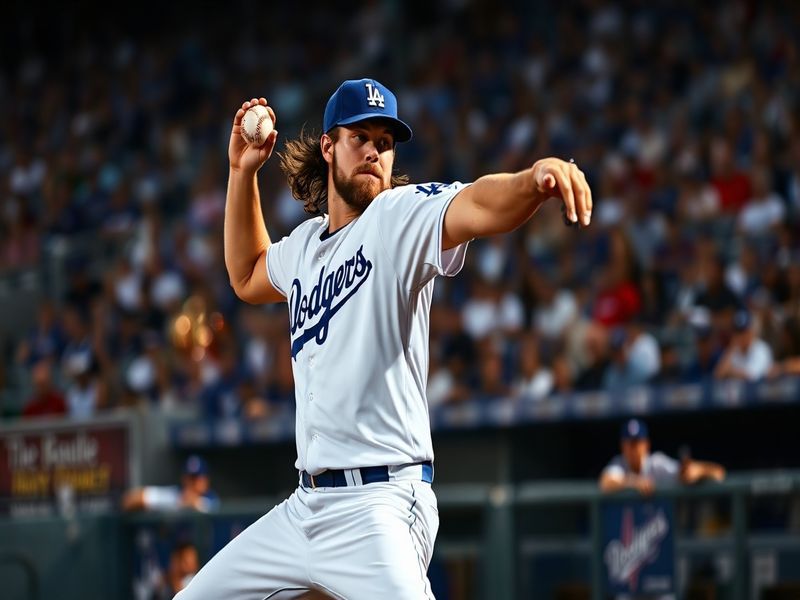
May’s pitching motion is a study in efficiency. His delivery begins with a minimal leg kick, which keeps runners honest while allowing him to generate explosive torque from his lower half. The real magic happens in his upper body, where his arm whips through the zone with such speed that hitters often struggle to track the ball until it’s too late. This unorthodox approach has drawn comparisons to pitchers like Jacob deGrom and Trevor Bauer, though May’s mechanics are uniquely his own.
Pitching coaches and analysts often highlight three key elements of May’s delivery:
- Lower-body leverage: May uses his legs to create a powerful base, allowing him to transfer energy efficiently from the mound to the plate.
- Elbow angle: His high three-quarters arm slot hides the ball well, making it difficult for hitters to pick up spin early.
- Follow-through: Unlike pitchers who finish with a stiff arm, May’s follow-through is loose and natural, reducing strain on his elbow and shoulder.
This combination of mechanics and athleticism has made May a favorite among advanced metrics enthusiasts. According to FanGraphs, his 2023 xERA (expected ERA) of 2.89 was among the best in baseball, suggesting his performance wasn’t just a fluke but a product of sustainable skill. For a deeper look at how May’s mechanics compare to other elite pitchers, check out our Analysis section.
Cultural Impact and the Rise of the “Underrated Ace”
May’s rise coincides with a broader shift in how MLB fans perceive pitchers. In an era dominated by analytics and velocity, May’s success challenges the notion that a 98-mph fastball is a prerequisite for dominance. His ability to confound hitters with movement and deception has resonated with a generation of baseball purists who value craft over sheer power.
Beyond the field, May represents a new archetype: the “underrated ace.” Unlike the headline-grabbing superstars who dominate headlines, May’s impact is felt in the margins—whether it’s a crucial strikeout in the seventh inning or a complete-game shutout in a high-pressure series. This quiet excellence has earned him a cult following among Dodgers fans and baseball aficionados alike, who see him as a throwback to an older, more cerebral style of pitching.
His cultural footprint extends beyond stats and highlights. May’s social media presence, though low-key, offers fans a glimpse into his personality—often sharing clips of his bullpen sessions or behind-the-scenes looks at his training regimen. This transparency has humanized him in an era where athletes are increasingly expected to curate their public personas. For a closer look at how pitchers like May are shaping baseball’s cultural landscape, explore our Entertainment category.
The Road Ahead: Challenges and Opportunities
Despite his success, May faces challenges that could define the next phase of his career. Durability has been a question mark: he’s missed significant time in three of his five MLB seasons, and his 2023 forearm strain raised concerns about his long-term workload. The Dodgers, known for their cautious approach to pitcher health, will likely manage his innings carefully, which could limit his availability in high-leverage spots.
Another hurdle is the Dodgers’ crowded rotation. With aces like Clayton Kershaw and Julio Urías still on the roster (at least for now), May must fight for starts in a rotation that’s one of the deepest in baseball. His ability to outperform expectations in these situations will be key to solidifying his role as the team’s third starter—or perhaps more.
Looking globally, May’s story also reflects broader trends in baseball’s international growth. While MLB has traditionally been dominated by American and Latin American talent, pitchers like May—hailing from Texas—highlight the sport’s geographic diversity. His success could inspire young pitchers from non-traditional baseball hotbeds to pursue the game with renewed ambition.
For now, May remains focused on refining his craft. His offseason work with pitching coordinator Mark Prior has reportedly emphasized command and secondary-pitch development, areas where even small improvements could translate to even greater dominance. If he can stay healthy, the next few years could cement his legacy as one of the most effective pitchers of his generation.
A Legacy in the Making
Dustin May’s career is still in its prime, but the foundation is already in place for something special. His blend of mechanics, adaptability, and resilience makes him a pitcher who defies easy categorization. He’s not the hardest thrower, nor does he have the gaudiest strikeout totals. Instead, May wins with a combination of guile, precision, and an unshakable belief in his abilities.
As baseball continues to evolve, pitchers like May remind us that success isn’t always about raw power or flashy numbers. Sometimes, it’s about the subtle art of outthinking the hitter—and doing it consistently, game after game. For fans of the game, that’s a thrill worth watching.