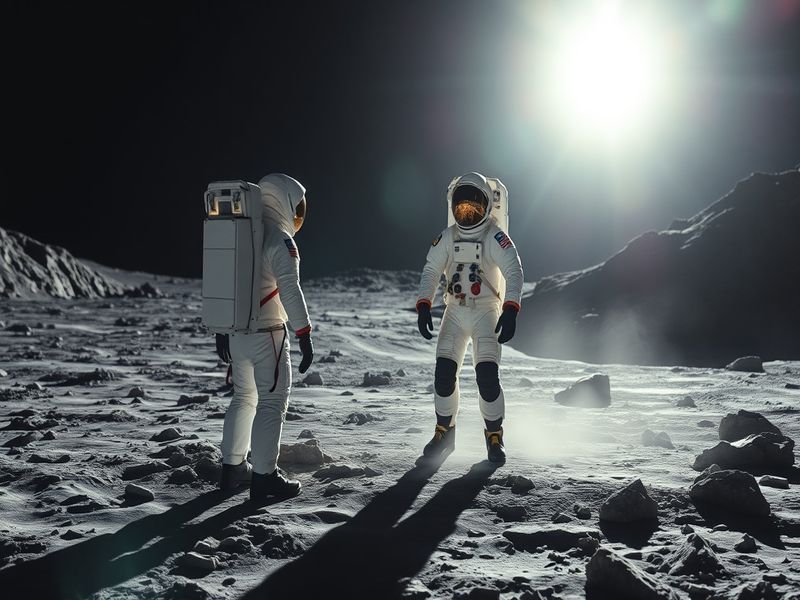
With the Artemis program, humanity prepares to return to the lunar surface for the first time in over five decades. The four astronauts selected for Artemis II will not land on the moon, but their 10-day mission around its far side will lay crucial groundwork for future explorers.
The Crew: A Blend of Experience and Firsts
NASA and the Canadian Space Agency (CSA) have selected a diverse team for this landmark journey. Commander Reid Wiseman, a veteran of the International Space Station, brings deep experience in long-duration spaceflight. Pilot Victor Glover, the first Black astronaut to serve on a lunar mission, adds operational expertise from his time aboard the ISS.
The mission specialists reflect a commitment to global collaboration and representation. Jeremy Hansen, the first Canadian to venture beyond low Earth orbit, represents CSA’s growing role in deep-space exploration. Christina Koch, a record-holding astronaut with extensive ISS experience, will become the first woman to travel around the moon.
Together, they embody a new era of inclusivity in space exploration. Their backgrounds in science, engineering, and piloting reflect the multidisciplinary nature of modern astronautics. This crew was chosen not just for their technical skills, but for their ability to inspire the next generation of explorers.
The Artemis II Mission: What to Expect
Scheduled for no earlier than November 2024, Artemis II will follow a hybrid trajectory. The Orion spacecraft, launched by the Space Launch System (SLS) rocket, will first enter Earth orbit before performing a trans-lunar injection. This will send the crew on a figure-eight path around the moon and back to Earth.
The mission’s primary objectives include testing Orion’s life support systems, navigation, and communication capabilities in deep space. Unlike the uncrewed Artemis I, which validated the spacecraft’s systems, Artemis II will carry humans through the Van Allen radiation belts and beyond. This presents unique challenges in radiation shielding and thermal protection.
A critical phase will occur during the lunar flyby, when Orion swings behind the moon and loses direct communication with Earth. The crew will rely on autonomous systems and pre-programmed maneuvers during this 30-minute blackout period. Success here will demonstrate NASA’s readiness for more complex missions.
Key Objectives of Artemis II
- Validate Orion’s crew systems for deep-space travel
- Test proximity operations and docking maneuvers
- Demonstrate life support and radiation protection in cislunar space
- Collect data on crew health and performance in microgravity
- Pave the way for the Artemis III lunar landing mission
Broader Implications for Space Exploration
The Artemis program represents more than a return to the moon—it’s a strategic pivot for NASA and its international partners. By establishing a sustainable presence on the lunar surface, the agency aims to develop technologies for eventual Mars missions. The Lunar Gateway, a small space station orbiting the moon, will serve as a staging point for these ambitious goals.
Commercial partnerships are central to this vision. Companies like SpaceX and Blue Origin are developing lunar landers and habitats under NASA’s CLPS (Commercial Lunar Payload Services) program. These collaborations reduce costs and accelerate innovation, mirroring the approach that fueled the growth of low Earth orbit ventures.
Geopolitically, Artemis strengthens U.S. leadership in space while fostering international cooperation. Canada’s contribution of the Canadarm3 robotic system for the Gateway underscores the program’s collaborative ethos. Other nations, including Japan and Europe, are contributing scientific instruments and technology demonstrations.
“Artemis II is more than a mission—it’s a statement about what humanity can achieve when we work together across borders and disciplines.” — NASA Administrator Bill Nelson
Why This Mission Matters Beyond the Launch
The ripple effects of Artemis II extend far beyond its 10-day duration. For the scientific community, the mission will enable new research in lunar geology, space medicine, and materials science. The crew will conduct experiments during their journey, including studies on crew cognition in deep space and the effects of microgravity on biological systems.
Economically, the Artemis program is projected to generate thousands of jobs and stimulate growth in the aerospace sector. From manufacturing to software development, the supply chain spans multiple industries. NASA’s estimates suggest a $100 billion economic impact over the next decade, with long-term benefits for STEM education and workforce development.
Culturally, Artemis II reignites the world’s imagination about space exploration. In an era of streaming services and digital entertainment, the mission offers a unifying spectacle—a reminder of humanity’s shared heritage as explorers. The images of Earth rising over the lunar horizon, captured by the Apollo missions, became iconic symbols of our planet’s fragility. Artemis II will once again provide such moments, this time with a more diverse and globally representative crew.
The mission also serves as a proving ground for NASA’s new approach to exploration. Unlike Apollo, which was a government-only effort, Artemis embraces commercial and international partnerships. This model could redefine how humanity ventures into the solar system, making space more accessible and sustainable for future generations.
Looking Ahead to Artemis III and Beyond
While Artemis II captures the world’s attention, the ultimate goal remains the lunar surface. Artemis III, currently targeted for 2025, will see the first woman and the next man walk on the moon, including the first person of color. The landing site near the lunar south pole offers access to water ice, a critical resource for sustained human presence.
Longer-term, the Artemis program envisions a sustainable lunar base by the end of the decade. This would serve as a testbed for technologies like 3D-printed habitats, in-situ resource utilization, and closed-loop life support systems. These innovations will be essential for the next giant leap: sending humans to Mars.
For now, the world watches as four astronauts prepare to venture farther from Earth than anyone has gone since 1972. Their mission is a bridge between the heroic era of Apollo and the collaborative future of interplanetary exploration. As they train and test their spacecraft, they carry with them the hopes of a planet united in curiosity and ambition.
To learn more about NASA’s lunar ambitions and the technology behind them, explore our coverage of space exploration and space technology.