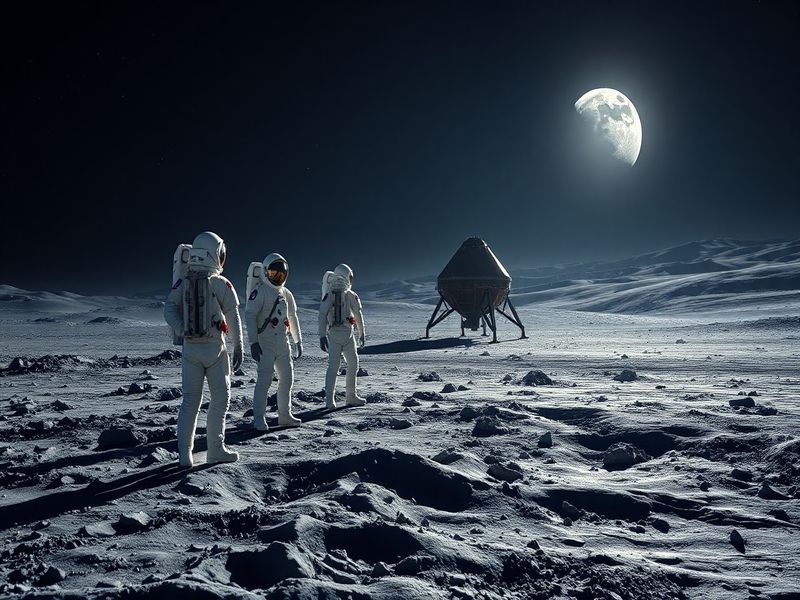
NASA Artemis II Astronauts Set for Historic Moon Mission in 2024
In a carefully choreographed sequence of events that spans decades of spaceflight evolution, NASA has selected four astronauts to embark on Artemis II, humanity’s first crewed mission to the Moon since 1972. This mission represents more than just a technical achievement; it embodies a cultural moment where science, international collaboration, and human ambition converge against the backdrop of 21st-century geopolitical dynamics.
The crew—comprising three NASA astronauts and one from the Canadian Space Agency—was announced on April 3, 2023, marking a pivotal step toward the agency’s broader Artemis program. Their names—Reid Wiseman, Victor Glover, Christina Koch, and Jeremy Hansen—carry different meanings across diverse global audiences. For some, they symbolize the culmination of a lifelong dream; for others, they represent the democratization of space exploration; and for many, they serve as a reminder of how far humanity has come since the Apollo era.
The Crew: A Blend of Experience and Firsts
Reid Wiseman, a former U.S. Navy test pilot, will command Artemis II. His prior experience includes a six-month stay on the International Space Station (ISS) in 2014, where he served as flight engineer. Wiseman’s leadership style, known for its calm authority, positions him well to guide this high-stakes mission.
Victor Glover, the mission pilot, brings operational depth to the crew. As a naval aviator and former ISS resident, Glover became the first Black astronaut to serve on a long-duration space station mission. His selection underscores NASA’s commitment to diversity and inclusion, themes increasingly central to global perceptions of space agencies.
Christina Koch, the mission specialist, holds the record for the longest single spaceflight by a woman—328 days aboard the ISS. Her expertise in electrical engineering and physics makes her invaluable for the technical demands of lunar proximity operations.
Jeremy Hansen, the Canadian mission specialist, is a unique addition. As a member of the Canadian Space Agency and a former fighter pilot, Hansen becomes the first non-American to fly to the Moon. His inclusion reflects Canada’s growing role in deep-space exploration and the country’s investment in robotics and AI technologies, as seen in its contributions to the Lunar Gateway project.
Together, they form a crew that balances technical excellence with symbolic significance, appealing to both scientific communities and broader cultural narratives about progress and representation.
The Mission: From Earth to Lunar Orbit and Back
Scheduled for no earlier than November 2024, Artemis II will follow a hybrid trajectory. The mission will launch aboard NASA’s Space Launch System (SLS)—the most powerful rocket ever built—carrying the Orion spacecraft. Unlike Apollo missions that landed on the Moon, Artemis II will orbit our celestial neighbor at a distance of approximately 8,889 kilometers before returning to Earth.
This trajectory allows the crew to test critical systems while maintaining a safe distance from the lunar surface. The mission is expected to last about 10 days, during which the astronauts will evaluate life support systems, communication protocols, and navigation accuracy. One of the most anticipated moments will be the live broadcast from lunar orbit, offering millions of people worldwide a firsthand view of the Moon’s far side.
The mission also serves as a proving ground for the Lunar Gateway, a planned space station that will orbit the Moon and support future landings. International partners, including the European Space Agency (ESA), Japan Aerospace Exploration Agency (JAXA), and Canada, are contributing modules and systems. This collaborative framework reflects a shift from the Cold War-era space race to a new model of shared exploration and resource utilization.
- Launch Vehicle: Space Launch System (SLS) Block 1
- Spacecraft: Orion Multi-Purpose Crew Vehicle
- Trajectory Type: Hybrid free-return with lunar flyby
- Primary Objectives: Validate crewed systems, test navigation, demonstrate life support
- Duration: Approximately 10 days
A Global Perspective: Politics, Culture, and Inspiration
The Artemis program is not just an American initiative—it is a global undertaking with profound cultural implications. The inclusion of an international astronaut signals a departure from the unilateral dominance of the Apollo era. Instead, Artemis operates within a framework of international cooperation, mirroring the structure of the ISS.
In Europe, the mission is seen as a continuation of the continent’s investment in space exploration. The ESA’s contribution of the European Service Module (ESM) for Orion highlights how technological collaboration can transcend geopolitical tensions. Similarly, Japan and Canada view Artemis as an opportunity to expand their scientific and industrial presence in space, positioning their aerospace sectors for future commercial ventures.
Culturally, the mission resonates deeply in regions where space exploration has historically been less prominent. In Africa and parts of Asia, where space programs are still developing, Artemis II serves as a symbol of possibility. It reminds these regions that the Moon is not just a destination for established spacefaring nations but a shared frontier for all of humanity.
Moreover, the mission’s timing coincides with a renewed global fascination with the Moon. From China’s Chang’e missions to India’s Chandrayaan program, lunar exploration has become a unifying theme in international science. Even in popular culture, the Moon is experiencing a renaissance, from science fiction films like Ad Astra to the success of space documentaries on streaming platforms.
The Road Ahead: Beyond Artemis II
While Artemis II captures global attention, it is only one step in a much larger journey. NASA’s ultimate goal is to return humans to the lunar surface with Artemis III, planned for 2025 or later. That mission will include the first woman and the first person of color to walk on the Moon, further emphasizing the agency’s commitment to diversity.
The Lunar Gateway, once operational, will serve as a staging point for both lunar landings and future missions to Mars. It will also provide opportunities for commercial partnerships, with companies like SpaceX and Blue Origin contributing to logistics and infrastructure.
Yet, the mission’s legacy extends beyond technical milestones. It challenges us to reconsider our place in the universe. In an era marked by division and uncertainty, Artemis II offers a vision of cooperation, innovation, and shared aspiration. It reminds us that the Moon is not just a destination—it is a mirror reflecting our highest ideals and deepest questions about what it means to be human.
As the crew trains for their historic journey, the world watches. Not just as spectators, but as participants in a shared human endeavor that transcends borders, languages, and ideologies. Their mission is not merely to travel to the Moon, but to carry with them the hopes and dreams of a planet united by curiosity and the unyielding pursuit of knowledge.
In the words of astronaut Christina Koch: “We go not just to plant a flag, but to extend a hand—to the past, to the future, and to each other.”