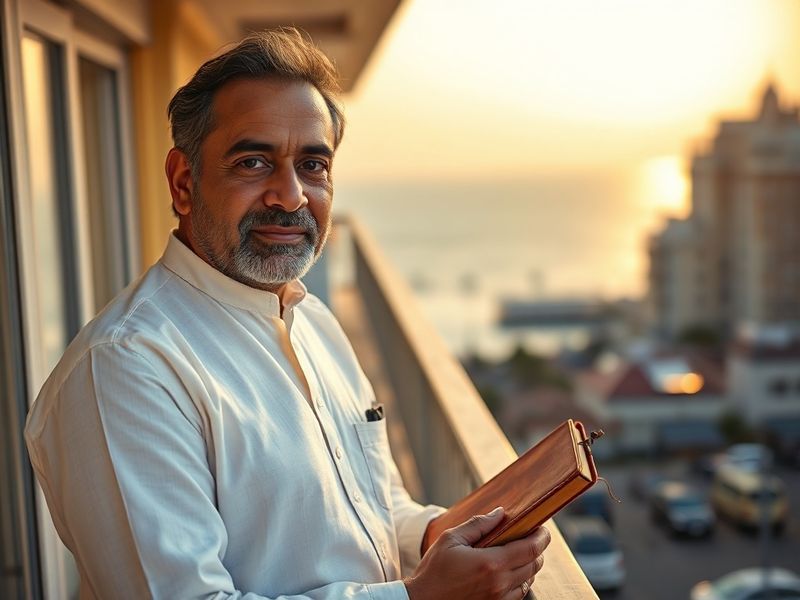
Sunny Mehta’s name resonates across creative industries from Mumbai to Manhattan, where his work bridges gaps between design, technology, and storytelling. As a multi-disciplinary creator, entrepreneur, and cultural curator, Mehta has carved a distinct path—one that blends traditional artistry with cutting-edge digital innovation. His influence extends beyond commercial projects into the realm of cultural commentary, making him a figure of interest not just for designers and technologists, but for anyone invested in how creativity evolves in a hyper-connected world.
Born in India and raised in a globalized environment, Mehta’s upbringing was marked by exposure to diverse artistic traditions and rapid technological change. This dual influence shaped his approach: rooted in craftsmanship, yet uncompromisingly forward-looking. Over the past decade, he has led initiatives that challenge conventional boundaries—whether through immersive digital experiences, experimental typography, or sustainable design practices. His projects often feel like cultural artifacts from the future, where aesthetics meet ethics, and form serves function without sacrificing emotion.
The Evolution of a Multi-Disciplinary Creator
Mehta’s journey reflects the broader transformation of the creative economy. He began his career in print and branding, working with studios in New York and London, where he honed skills in visual identity and communication design. Yet, as digital platforms began to dominate the cultural landscape, he pivoted—not away from design, but deeper into its intersection with technology and human experience.
One of his early breakthroughs came in 2015 with a redesign of a historic Indian literary magazine, where he introduced interactive digital editions that preserved the tactile feel of print while enabling new forms of reader engagement. The project caught the attention of global design critics and established Mehta as someone who understood that innovation doesn’t require abandoning tradition—it requires reimagining it.
By 2018, he had co-founded a creative technology studio focused on augmented reality in public art. The studio’s installations—often blending poetry, local folklore, and AR overlays—were installed in cities from Berlin to Bengaluru. These weren’t just digital artworks; they were social experiments, inviting passersby to reconsider their surroundings through layered narratives.
- 2012–2014: Led branding projects for cultural institutions in New York and London.
- 2015: Redesigned a 90-year-old Indian literary magazine with interactive digital editions.
- 2018: Co-founded a creative tech studio specializing in AR public art.
- 2020–Present: Launched a global platform for experimental typography and generative design.
Cultural Commentary Through Design and Code
What sets Mehta apart is his commitment to using design as a form of cultural critique. His most celebrated project to date is Alphabets of Displacement, a generative typography series that visualizes migration patterns through dynamic letterforms. Each character in the alphabet is algorithmically reshaped based on real-time data from refugee movements, creating a living font that evolves with global events.
This project was not just a technical feat—it was a statement. By turning humanitarian data into poetic visuals, Mehta challenged the passive consumption of news and invited viewers to engage emotionally with statistics. The work was exhibited at the Venice Architecture Biennale and the Tribeca Film Festival, drawing praise for its fusion of art, activism, and technology.
Mehta often speaks about “design as dialogue.” In interviews, he emphasizes how visual language can either reinforce divisions or build bridges. His typeface Vernacular, for instance, integrates scripts from marginalized communities into a single, cohesive system. The goal isn’t just aesthetic harmony—it’s to make invisible cultures visible in everyday spaces like signage, apps, and public interfaces.
Global Influence and the Future of Creative Practice
Mehta’s work has been recognized by institutions including the MIT Media Lab and the British Council, which invited him to lead workshops in South Asia on digital storytelling. His influence is particularly strong in regions where digital adoption is outpacing infrastructure—places like Southeast Asia and East Africa—where he advocates for inclusive design that respects local contexts.
He is also vocal about the ethics of AI in creativity. While many designers embrace generative tools, Mehta cautions against over-reliance on automation, arguing that true innovation comes from human intuition and lived experience. In a 2023 essay for Eye Magazine, he wrote: “Technology can mimic creativity, but it cannot feel culture. The role of the designer is not to replace human expression—it is to amplify it.”
Looking ahead, Mehta is focusing on two major initiatives. The first is a global network of “slow design” labs, where artisans, coders, and storytellers collaborate on projects that prioritize sustainability and cultural integrity. The second is an open-source platform for indigenous language preservation through digital typography—a project that aligns with his belief that design can be a tool for cultural survival.
The Role of Creativity in a Fragmented World
In an era marked by polarization and algorithmic polarization, Mehta’s work offers a counter-narrative: one where creativity is a unifying force. His projects demonstrate that design can be both beautiful and meaningful, technological yet deeply human. Whether through a font that tells a refugee’s story or an AR mural that reimagines a city’s history, he proves that art isn’t just decoration—it’s a language of connection.
As digital spaces become the primary stage for cultural exchange, figures like Mehta remind us that innovation must be rooted in empathy. His career is a testament to the idea that the most groundbreaking work often comes not from chasing trends, but from listening to the stories that need to be told.