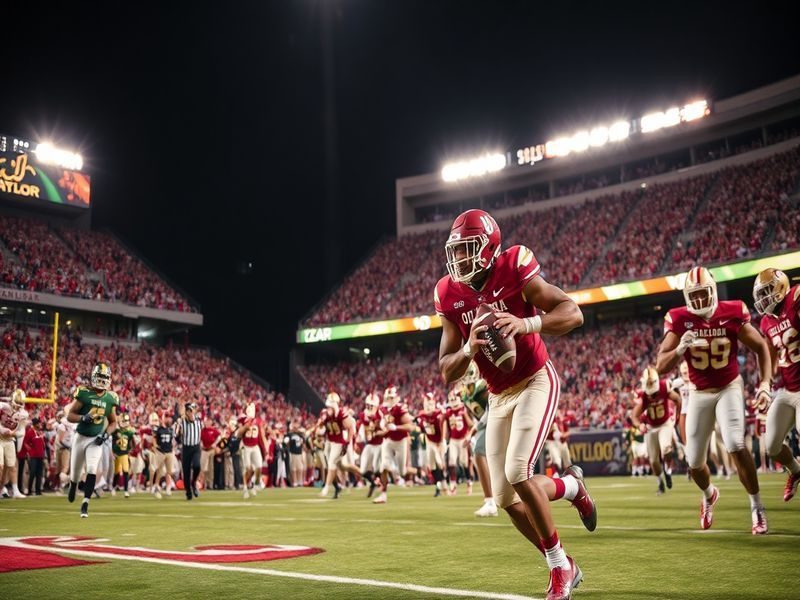
Football in the American heartland is more than a sport; it’s a cultural institution that shapes local identities and regional pride. The matchup between Oklahoma and Baylor, two programs with distinct histories and contrasting approaches to the game, offers more than just athletic competition. It reflects broader narratives about tradition, innovation, and the evolving nature of college football in the 21st century. This rivalry transcends the field, touching on themes of regional identity, institutional values, and the shifting dynamics of power in collegiate athletics.
For decades, Oklahoma has been synonymous with offensive firepower and gridiron dominance, particularly under legendary coaches like Bud Wilkinson and Barry Switzer. The Sooners’ tradition of high-scoring, wide-open football has cultivated a global fanbase and produced NFL stars. Baylor, meanwhile, has long been viewed as an underdog—a program that punched above its weight in the shadow of Texas’ football behemoths. But in recent years, the Bears have emerged as a force to be reckoned with, challenging the status quo and redefining what it means to compete at the highest level.
The Evolution of Two Football Philosophies
Baylor’s rise has been one of the most compelling stories in college football over the past decade. Long dismissed as a regional power confined to the Big 12’s periphery, the Bears have transformed under the leadership of coaches like Art Briles and Matt Rhule. Their offensive schemes, characterized by tempo, creativity, and quarterback-friendly systems, represent a departure from Oklahoma’s more traditional, power-oriented approach. Where the Sooners rely on physicality and precision in the running game, Baylor’s identity has been built on innovation and adaptability.
This philosophical divide extends beyond play-calling. It reflects deeper institutional priorities. Oklahoma’s program is deeply embedded in its athletic department’s infrastructure, with facilities and resources that rival those of elite SEC programs. Baylor, despite its limitations in budget and fanbase size, has leveraged its academic prestige and strategic investments in coaching to level the playing field. The contrast is stark: one program leans on legacy and infrastructure, the other on ingenuity and ambition.
Key Moments in the Rivalry
The history between Oklahoma and Baylor is punctuated by moments that define their competitive dynamic. While Oklahoma has largely held the upper hand, Baylor has delivered its fair share of surprises, particularly in high-profile matchups. Consider the following pivotal games that have shaped their modern rivalry:
- 2013: Baylor’s 41-12 Blowout Victory – This game marked a turning point. Baylor’s high-octane offense dismantled Oklahoma’s defense, signaling the Bears’ arrival as a legitimate contender. The Sooners’ porous defense was exposed, and quarterback Bryce Petty carved up the field with ease.
- 2019: Lincoln Riley’s Final Game as Oklahoma’s Coach – A 34-31 Baylor win in Norman ended Oklahoma’s 14-game winning streak in the series. Jalen Hurts, playing his first game as a Sooner, was outdueled by Baylor’s Charlie Brewer, who orchestrated a fourth-quarter comeback.
- 2021: Playoff Implications and Playoff Snubs – Oklahoma entered the season with national championship aspirations, only to fall short in a 27-14 loss to Baylor in Waco. The defeat contributed to Oklahoma’s exclusion from the College Football Playoff, a decision that sparked debates about the selection committee’s biases.
These games are more than statistical milestones; they represent shifts in momentum and perception. Each victory by Baylor has chipped away at Oklahoma’s aura of invincibility, forcing the Sooners to adapt and Baylor to believe in its own potential.
Cultural and Regional Implications
Football in the American South and Southwest is deeply intertwined with regional identity. Oklahoma’s dominance has long been a source of state pride, a symbol of resilience and excellence that extends beyond the gridiron. The Sooners’ crimson and cream colors are emblazoned on everything from barbecue joints to pickup trucks, a visual shorthand for Oklahoma’s cultural ethos.
Baylor, by contrast, represents the complex identity of Texas—a state where football is religion, but where institutional diversity and academic rigor also hold significant value. Waco, the home of Baylor, is a city of contrasts: a place where evangelical culture and intellectual curiosity intersect. The Bears’ success has given the region a new narrative, one that challenges the dominance of Texas’ traditional football powers like Texas A&M and Texas.
Globally, this rivalry resonates with fans who see parallels in their own sporting cultures. In countries like Australia, where rugby league and Australian rules football dominate, the concept of David vs Goliath is familiar. In European football, the clash between established giants and ambitious underdogs is a recurring theme. Oklahoma vs Baylor, therefore, is not just an American football game; it’s a microcosm of global sporting narratives where tradition meets ambition.
The Coaching Carousel and Its Impact
The coaching carousel has played a significant role in shaping this rivalry. Oklahoma’s recent history has been marked by turnover, with Lincoln Riley’s departure to USC and the subsequent hiring of Brent Venables creating a period of transition. Venables, known for his defensive acumen, represents a shift back toward a more physical, defensive-minded identity—a departure from Riley’s offensive-minded tenure.
Baylor, meanwhile, has navigated its own coaching changes, with Dave Aranda taking the reins after Rhule’s departure to the NFL. Aranda’s arrival brought a renewed emphasis on defensive discipline, a counterbalance to Baylor’s offensive roots. This shift has made the Bears more versatile and unpredictable, a development that has complicated Oklahoma’s preparation.
The contrast in coaching philosophies adds another layer to the rivalry. Oklahoma’s defense under Venables is built on aggression and playmaking, while Baylor’s offense under Aranda’s predecessor, Seth Littrell, prioritized tempo and explosive plays. The 2023 matchup between the two programs will feature new dynamics on both sides of the ball, ensuring that the game remains unpredictable.
A Global Perspective on College Football’s Future
As college football grapples with realignment, NIL (Name, Image, Likeness) policies, and the expansion of the College Football Playoff, the Oklahoma vs Baylor rivalry offers a lens into the sport’s future. The Sooners’ move to the SEC in 2024 will further elevate their profile, but it also risks diluting the Big 12’s competitive balance—a league where Baylor has thrived.
For Baylor, the challenge will be maintaining relevance in a landscape dominated by mega-conferences and financial disparities. The Bears’ ability to compete in this new environment will depend on their capacity to innovate, whether through recruiting strategies, technological investments, or cultural branding. The rivalry with Oklahoma, therefore, is more than a game; it’s a test of whether smaller programs can sustain excellence in an era of super-conferences.
Globally, this shift mirrors trends in European football, where clubs from smaller leagues (e.g., Ajax, Porto) must adapt to compete with financial giants like Manchester City and PSG. The parallels extend to Asia, where leagues like Japan’s J-League strive to compete with European powerhouses. College football’s evolution reflects a broader globalization of sports, where tradition and innovation must coexist.
Conclusion: More Than a Game
The Oklahoma vs Baylor rivalry is a testament to the enduring appeal of college football—a sport where history, culture, and competition intersect. For Oklahoma, it’s an opportunity to reassert its dominance and reclaim its place among the nation’s elite. For Baylor, it’s a chance to prove that ambition and innovation can overcome traditional power structures.
As the two programs prepare to face off in 2023 and beyond, the stakes extend beyond wins and losses. This rivalry is a microcosm of college football’s broader challenges: balancing tradition with progress, ambition with humility, and excellence with accessibility. For fans around the world, it’s a reminder that the most compelling stories in sports are rarely about the destination—they’re about the journey.
One thing is certain: when Oklahoma and Baylor take the field, they’re not just playing for a victory. They’re playing for the soul of a conference, the pride of a region, and the future of a sport that continues to captivate global audiences.