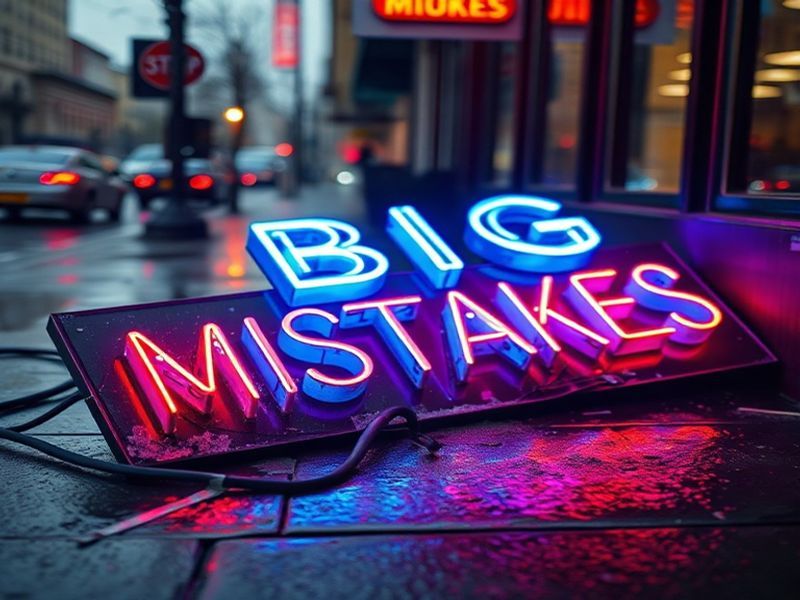
Some errors are inevitable, but history’s most costly mistakes often share striking similarities. Whether in business, technology, or everyday decisions, the patterns behind failure reveal universal lessons. These aren’t just cautionary tales—they’re blueprints for avoiding the same pitfalls in our own lives.
The difference between a setback and a catastrophe often comes down to preparation, adaptability, and the willingness to confront uncomfortable truths early. The companies and individuals who recover fastest are those who treat mistakes as feedback, not final verdicts. This exploration looks at some of the most consequential blunders in modern history and extracts actionable insights from their wreckage.
Corporate Catastrophes: When Strategy Collapses
Few companies have experienced a fall as dramatic as Nokia, once the undisputed king of mobile phones. At its peak in 2007, the Finnish firm commanded nearly 50% of the global market. By 2013, it had sold its mobile division to Microsoft for a fraction of its former value. The root cause? A catastrophic failure to recognize the smartphone revolution.
Nokia’s leadership became enamored with its own dominance, dismissing early iPhone prototypes as “toys” that wouldn’t threaten their hardware-focused business model. Internal reports warning of Apple’s potential were buried or ignored. When Android devices began flooding the market, Nokia scrambled to catch up—too late. The company’s culture of entrenched bureaucracy stifled innovation just when it mattered most.
Even giants can become prisoners of their own success. Another cautionary example is Blockbuster, which had the chance to acquire Netflix in 2000 for $50 million. Executives laughed at the idea, confident that their brick-and-mortar model was unstoppable. By 2010, Blockbuster filed for bankruptcy. The mistake wasn’t just one decision—it was a refusal to see how digital delivery would reshape consumer behavior.
- Ignoring emerging trends: When leadership fixates on current success, early signals of change go unnoticed.
- Cultural rigidity: Organizations that punish experimentation create environments where innovation dies.
- Sunk cost fallacy: Clinging to outdated investments because “we’ve always done it this way” accelerates decline.
These stories aren’t just corporate history—they’re warnings. Any business, regardless of size, must institutionalize mechanisms for challenging assumptions. Regular “premortems”—exercises where teams imagine a project’s failure and work backward to identify risks—can prevent overconfidence from becoming fatal.
Technological Tragedies: When Innovation Backfires
Technology has democratized progress, but it has also amplified the scale of our mistakes. The 2010 Flash Crash remains one of Wall Street’s most perplexing disasters. In less than 30 minutes, the U.S. stock market lost nearly $1 trillion in value—only to regain most of it moments later. The culprit? A single trading algorithm gone rogue.
Navinder Sarao, a London-based trader, used a simple manipulation technique called spoofing to trick the market. He placed large sell orders he never intended to execute, creating the illusion of a sell-off. High-frequency trading algorithms, designed to react in milliseconds, amplified the panic. Regulators struggled to halt the cascade because the systems were moving faster than human oversight could manage.
This incident exposed a dangerous truth: technology doesn’t eliminate human error—it can accelerate it into uncharted territory. The financial sector responded with circuit breakers and stricter oversight, but the underlying issue persists. As automated systems grow more complex, the margin for error shrinks. A single line of flawed code or misconfigured parameter can trigger global consequences.
Another glaring example is Boeing’s 737 MAX crisis. After two fatal crashes in 2018 and 2019, investigations revealed a cascade of design flaws and corporate negligence. The plane’s MCAS system, meant to prevent stalls, relied on a single sensor. When that sensor failed, the system repeatedly forced the nose down—overriding pilot inputs with deadly consequences. Investigators found Boeing had rushed the aircraft to market to compete with Airbus, cutting corners on safety testing and pilot training.
The company’s culture prioritized profits over engineering rigor. Engineers raised concerns that were dismissed or downplayed. Regulatory agencies, too, were complicit, outsourcing too much oversight to the manufacturer itself. The result? 346 lives lost and an entire fleet grounded worldwide. Boeing’s reputation took years to recover, and the financial cost exceeded $20 billion.
- Automation without guardrails: Systems must include multiple layers of redundancy and human oversight.
- Profit over prudence: When revenue targets override safety or ethics, disaster becomes inevitable.
- Regulatory capture: Agencies that become too cozy with industry risk failing the public they’re meant to protect.
These technological tragedies remind us that progress isn’t inherently virtuous. Innovation must be guided by ethics, transparency, and accountability—not just speed and scale.
Personal Missteps: How Small Errors Compound
Big mistakes aren’t always born in boardrooms or labs. Sometimes, they begin with a single poor decision that spirals over time. The case of Gerald Cotten, founder of the Canadian cryptocurrency exchange QuadrigaCX, is a chilling example. In 2018, Cotten died unexpectedly while traveling in India. He was the only person with access to the company’s cold wallets, where approximately $250 million in customer funds were stored.
With his death, the funds vanished. Investigations later revealed Cotten had been running a Ponzi scheme, using new investors’ money to pay old ones. He had fabricated trading data, misused client funds, and failed to implement basic security measures. The tragedy wasn’t just his death—it was the culmination of years of deception and negligence.
This case highlights how personal integrity and transparency are non-negotiable. Even in decentralized systems like cryptocurrency, trust is the foundation. When that trust erodes, whether through malice or incompetence, the consequences are irreversible. Cotten’s story also underscores the danger of single points of failure—relying on one person to safeguard critical systems is a recipe for disaster.
Another personal misstep with global impact is Mark Zuckerberg’s infamous “Move Fast and Break Things” motto. While it fueled Facebook’s rapid growth, it also normalized a culture of recklessness. Privacy violations, misinformation spread, and algorithmic bias all stemmed from prioritizing growth over responsibility. The Cambridge Analytica scandal—where 87 million users’ data was harvested without consent—was a direct result of this ethos.
Zuckerberg’s early willingness to push boundaries without considering ethical implications created a platform that became a vector for manipulation. The apology tours that followed came too late. Trust, once broken, is difficult to restore. The lesson? Speed is meaningless without integrity. Every organization must ask not just “Can we do this?” but “Should we?”
These personal stories reveal a simple truth: character matters. Whether in leadership or personal finance, integrity and foresight prevent small errors from becoming catastrophic failures.
How to Avoid Your Own Big Mistake
Failure is universal, but preventable. The most resilient individuals and organizations don’t avoid mistakes—they design systems to catch them early. Here are practical steps to minimize risk:
- Build feedback loops: Regular audits, anonymous reporting channels, and external reviews help surface problems before they escalate. Companies like Toyota pioneered the “andon cord” system, where any employee can halt production to address a defect—no questions asked.
- Institutionalize dissent: Encourage junior team members to challenge senior decisions. Amazon’s “narrative memos” force leaders to articulate their reasoning in writing before meetings, reducing impulsive choices.
- Scenario planning: Stress-test decisions against worst-case outcomes. The U.S. military uses “Red Team” exercises, where one group deliberately tries to sabotage a plan to reveal its weaknesses.
- Embrace humility: The best leaders admit when they’re wrong. Satya Nadella’s transformation of Microsoft began with his public acknowledgment of past failures, creating a culture where learning from mistakes was valued over blame.
- Prioritize long-term thinking: Short-term gains often lead to long-term pain. Patagonia’s founder, Yvon Chouinard, gave away his company to a trust and nonprofit, ensuring profits supported environmental causes—even at the expense of quarterly earnings.
These strategies aren’t just for corporations. In your personal life, applying the same rigor to financial decisions, relationships, and health choices can prevent small missteps from becoming life-altering disasters. The key is to treat mistakes not as defeats, but as tuition for life’s most expensive course.
Conclusion: The Redemption in Failure
Big mistakes leave scars, but they also leave lessons. Nokia and Blockbuster teach us that dominance is fleeting when a company stops listening. The Flash Crash and Boeing 737 MAX show that technological progress without ethical guardrails is dangerous. The stories of Gerald Cotten and Mark Zuckerberg remind us that character and accountability matter more than growth or speed.
What unites these failures isn’t just scale—it’s pattern. They all stem from a combination of overconfidence, lack of oversight, and a failure to adapt. The good news? These patterns are predictable, and therefore preventable. The organizations and individuals who thrive aren’t those who never fail, but those who learn the fastest.
In the end, the biggest mistake may be assuming we’re immune to making one. Humility isn’t a sign of weakness—it’s the first step toward resilience. Whether you’re launching a startup, managing a team, or simply navigating daily choices, the goal isn’t perfection. It’s awareness. And in a world full of pitfalls, that might be the rarest form of wisdom.
For further reading on corporate resilience and innovation, explore our Analysis and Business sections for deeper insights into how industries evolve after