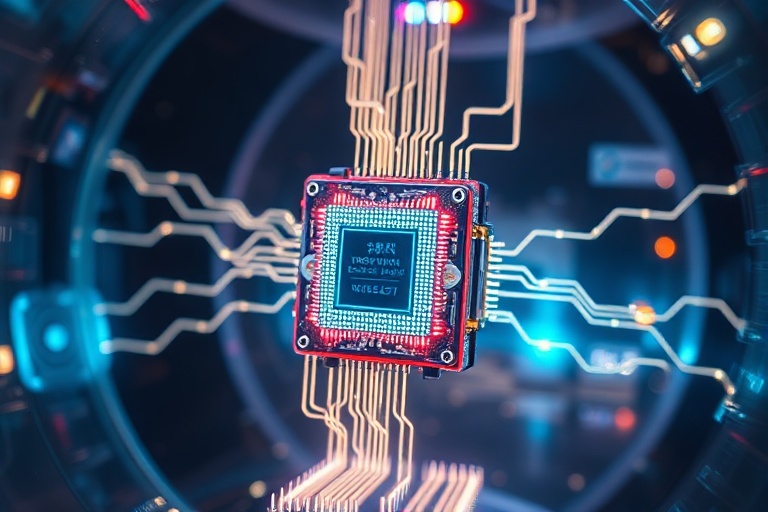
Quantum Computing: The Next Frontier in Technology
Quantum computing represents one of the most transformative advancements in modern science and technology. Unlike classical computers, which rely on bits to process information as either 0s or 1s, quantum computers use quantum bits—or qubits—which can exist in multiple states simultaneously thanks to the principles of superposition and entanglement. This allows quantum computers to perform complex calculations at speeds that are exponentially faster than their classical counterparts for certain problems.
The potential applications of quantum computing span industries from cryptography to drug discovery, and even artificial intelligence. As research accelerates, the world is beginning to see the first practical implementations of quantum technologies. However, significant challenges remain in scaling these systems and making them accessible for widespread use. This article explores the science behind quantum computing, its current state, real-world implications, and the road ahead.
The Science Behind Quantum Computing
At the core of quantum computing lies the concept of quantum mechanics, a branch of physics that describes the behavior of matter and energy at the smallest scales. Classical bits are binary—either 0 or 1—but qubits can be both at once, a property known as superposition. When qubits become entangled, the state of one qubit is directly related to the state of another, no matter the distance between them. This enables quantum computers to process vast amounts of information in parallel.
Quantum computers require extreme conditions to operate, often needing temperatures near absolute zero to maintain quantum coherence. This is achieved using specialized refrigeration systems and isolation from external interference. The most common approaches to building quantum computers include superconducting circuits, trapped ions, and topological qubits. Each method has its advantages and limitations in terms of scalability, error rates, and operational stability.
One of the most cited examples of quantum advantage is Shor’s algorithm, which can factor large integers exponentially faster than classical methods. This has profound implications for cryptography, particularly in breaking widely used encryption standards. Another key algorithm is Grover’s search algorithm, which offers a quadratic speedup for unstructured search problems. These theoretical breakthroughs are now being tested on real quantum hardware, marking a pivotal moment in the field.
Current State of Quantum Computing
Today, quantum computing is transitioning from the realm of theory and lab experiments to practical, albeit limited, applications. Companies like IBM, Google, and Rigetti have developed quantum processors with increasing qubit counts—IBM’s Eagle processor, for example, boasts 127 qubits. Meanwhile, Google’s Sycamore processor demonstrated quantum supremacy in 2019 by performing a specific calculation in 200 seconds that would take a supercomputer thousands of years. Yet, quantum supremacy remains narrowly defined and does not yet translate to real-world utility.
Startups and research institutions are also making strides. IonQ, a quantum computing company, uses trapped-ion technology and has achieved high-fidelity operations with long coherence times. Meanwhile, companies like D-Wave focus on quantum annealing, a specialized approach optimized for optimization problems. These diverse approaches reflect the experimental nature of the field, with no single technology yet dominating the landscape.
Despite progress, quantum computing is still in its early stages. Most current quantum computers are noisy and error-prone, requiring extensive error correction to produce reliable results. This is where hybrid quantum-classical systems come into play, where quantum processors handle specific sub-tasks while classical systems manage the rest. These hybrid models are already being used in fields such as financial modeling, logistics optimization, and materials science.
Real-World Implications and Industry Adoption
The impact of quantum computing could be felt across multiple sectors. In healthcare, quantum simulations could revolutionize drug discovery by modeling molecular interactions with unprecedented accuracy. Pharmaceutical giants like Roche and Merck are already partnering with quantum computing firms to explore these possibilities. Similarly, in materials science, quantum computers could help design superconductors or more efficient solar cells by simulating quantum systems at the atomic level.
In finance, quantum computing could transform risk assessment and portfolio optimization by processing vast datasets in real time. Banks and asset managers are investing in quantum algorithms to gain a competitive edge in trading strategies and fraud detection. Meanwhile, in cybersecurity, the advent of quantum computing poses both a threat and an opportunity. While quantum computers could break current encryption standards, they also enable the development of quantum-resistant cryptography, which is now a focus of national security agencies worldwide.
Governments are also taking notice. The United States has invested over $1.2 billion through the National Quantum Initiative Act, while the European Union has launched a €1 billion Quantum Flagship program. China has made significant investments in quantum communication and computing, aiming to become a global leader in the field. These initiatives reflect a growing recognition that quantum technologies could define the next era of technological and economic leadership.
Challenges and the Path Forward
Despite the promise, quantum computing faces formidable challenges. One of the biggest hurdles is error correction. Qubits are highly sensitive to their environment, and even minor disturbances can cause decoherence, leading to computational errors. Current quantum computers require thousands of physical qubits to create a single logical qubit that can perform reliable calculations. This scalability issue remains a major bottleneck.
Another challenge is the lack of standardization in quantum programming. Unlike classical computing, where languages like Python and C++ dominate, quantum computing requires specialized frameworks such as Qiskit, Cirq, and Q#. These tools are still evolving, and the learning curve for developers remains steep. Additionally, access to quantum computers is limited, with most systems housed in research labs or corporate data centers. Cloud-based quantum computing services, such as IBM Quantum Experience and Amazon Braket, are helping democratize access, but they are still constrained by hardware limitations.
Looking ahead, the next decade will likely see incremental but meaningful progress. Researchers are exploring new qubit technologies, such as photonics and silicon spin qubits, which could offer better scalability and lower operational costs. Advances in error correction, such as surface codes and topological qubits, could also pave the way for fault-tolerant quantum computers. Meanwhile, the integration of quantum and classical systems will continue to drive practical applications, even as full-scale, general-purpose quantum computers remain years away.
For those interested in staying updated on quantum computing and related technologies, following industry developments and investing in foundational knowledge will be crucial. Resources like Dave’s Locker Technology section offer curated insights into emerging tech trends and innovations that are shaping the future.
Conclusion
Quantum computing stands at the precipice of a technological revolution. While significant challenges remain, the progress made in recent years has been nothing short of remarkable. From theoretical breakthroughs to early commercial applications, quantum computing is beginning to demonstrate its potential to transform industries, solve complex problems, and redefine the boundaries of computation. As research continues and technology matures, the question is no longer whether quantum computing will change the world—but how soon and in what ways. For now, the journey has only just begun.