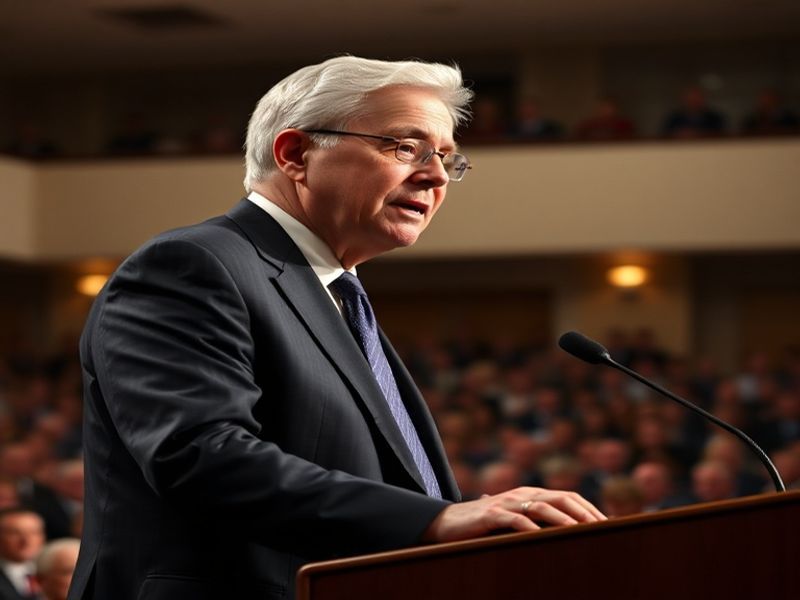
Few religious leaders have shaped modern faith communities with the same quiet authority as Dieter F. Uchtdorf. Born in Czechoslovakia in 1940, Uchtdorf’s journey—from fleeing war-torn Europe as a child to becoming one of the most influential voices in The Church of Jesus Christ of Latter-day Saints—is a narrative of resilience, spiritual depth, and global engagement. His leadership has extended beyond doctrinal boundaries, resonating with millions who seek meaning in an increasingly complex world.
Uchtdorf’s career spans aviation, humanitarian work, and decades of service in the LDS Church’s highest councils. His ability to connect across cultures and generations has made him a unifying figure in an era often marked by division. This article explores his life’s milestones, his evolving role in global religious discourse, and the lessons his journey offers about faith in motion.
From Aviation to Apostleship: A Life in Motion
Long before he became a global religious leader, Dieter Uchtdorf was an engineer and pilot. After his family fled communist Czechoslovakia in 1946, they settled in Germany, where Uchtdorf developed a passion for flight. He joined Lufthansa, rising through the ranks to become one of the airline’s first flight captains. His aviation career lasted over 25 years, during which he flew commercial jets across continents and cultures—a foundation that would later shape his approach to leadership.
In 1994, after decades in aviation, Uchtdorf received a call that would redirect his life. The LDS Church called him to serve as a general authority, beginning a rapid ascent through its leadership structure. By 2004, he was sustained as an apostle, and in 2008, he became second counselor in the First Presidency under President Thomas S. Monson. His selection was historic: one of the few non-Americans—and the first of German descent—to hold such a prominent position in a church traditionally centered in the United States.
Uchtdorf’s aviation background was more than a resume item. It became a metaphor for his leadership style. He often spoke of “pilot leadership,” emphasizing preparation, vision, and the courage to navigate uncertainty. In a world where institutional trust is often fragile, his ability to blend technical discipline with spiritual warmth set him apart.
A Voice of Inclusivity in a Fragmented World
As a global leader, Uchtdorf has consistently advocated for a faith that embraces rather than excludes. His sermons are marked by a gentle tone, rich with personal anecdotes and universal truths. He has spoken openly about the importance of kindness, the dangers of judgment, and the power of hope—values that transcend religious affiliation.
One of his most enduring messages came in a 2013 conference address titled “You Matter to Him.” In it, he reminded listeners that divine love is not conditional on perfection. The talk went viral, shared widely outside religious circles and translated into dozens of languages. It reflected a broader trend in modern spirituality: the search for meaning that is both deeply personal and broadly accessible.
Uchtdorf’s influence extends beyond pulpits. He has been a vocal advocate for refugees, environmental stewardship, and interfaith dialogue. During Europe’s migration crisis in the 2010s, he encouraged Latter-day Saints to welcome displaced families. His stance was not just humanitarian but theological—rooted in the belief that all are children of a loving God.
Global Reach and Cultural Adaptation
Unlike many religious leaders who focus on domestic audiences, Uchtdorf has cultivated a global perspective. He has traveled to over 100 countries, often visiting remote congregations where members see him as both a spiritual guide and a symbol of hope. In Japan, he met with survivors of the 2011 earthquake and tsunami. In Africa, he addressed the rapid growth of the church on a continent where faith is deeply communal.
His speeches often reflect cultural awareness. In Latin America, he emphasized family bonds. In Asia, he spoke of perseverance in the face of adversity. In Europe, he addressed secularism with empathy, acknowledging the challenges of maintaining faith in post-Christian societies. This adaptability has helped the LDS Church grow from a predominantly American movement to a global faith with over 16 million members.
Legacy and Lessons: Leadership Beyond Doctrine
Uchtdorf’s legacy is not measured solely in membership numbers or institutional influence. It lies in how he has redefined what religious leadership can look like in the 21st century. He has shown that faith leaders can be both doctrinally grounded and culturally fluent. They can uphold tradition while embracing change. They can lead with authority and still remain approachable.
His retirement from the First Presidency in 2022—following the death of President Russell M. Nelson—marked the end of an era in LDS leadership. Yet his voice continues to echo through published talks, social media, and personal ministry. He remains a sought-after speaker at interfaith events and university forums, where he often emphasizes education, ethical leadership, and the power of small acts of goodness.
Uchtdorf’s life offers a counter-narrative to the polarization that defines so much of today’s religious and political discourse. In an age where leaders are often expected to choose sides, he has consistently chosen humanity. His message is simple: faith is not a fortress, but a journey—and everyone has a place on the path.
Looking Ahead: The Future of Faith in a Connected World
As the LDS Church continues to evolve under new leadership, Uchtdorf’s influence remains a reference point. His emphasis on personal worth, global compassion, and adaptive leadership will likely shape the church’s approach to outreach in the coming decades.
For those outside the LDS tradition, Uchtdorf’s career is a case study in how faith can transcend borders—literally and figuratively. His story challenges the assumption that religious leaders must be isolated from the world they serve. Instead, he demonstrates that faith is most vibrant when it engages with the world, learns from it, and contributes to its healing.
In an era where institutional trust is declining, leaders like Uchtdorf remind us that authority is not about control, but connection. His legacy is not built on control, but on connection—between people, cultures, and generations. It is a legacy of movement: not just the motion of an airplane, but the journey of the human spirit.
As one observer noted, “Uchtdorf didn’t just fly planes; he helped people fly.” In that metaphor lies the essence of his leadership—and perhaps a blueprint for faith in the modern age.
Dave’s Locker brings you thoughtful analysis on faith, culture, and global leadership. Explore more stories in our Culture and News sections.