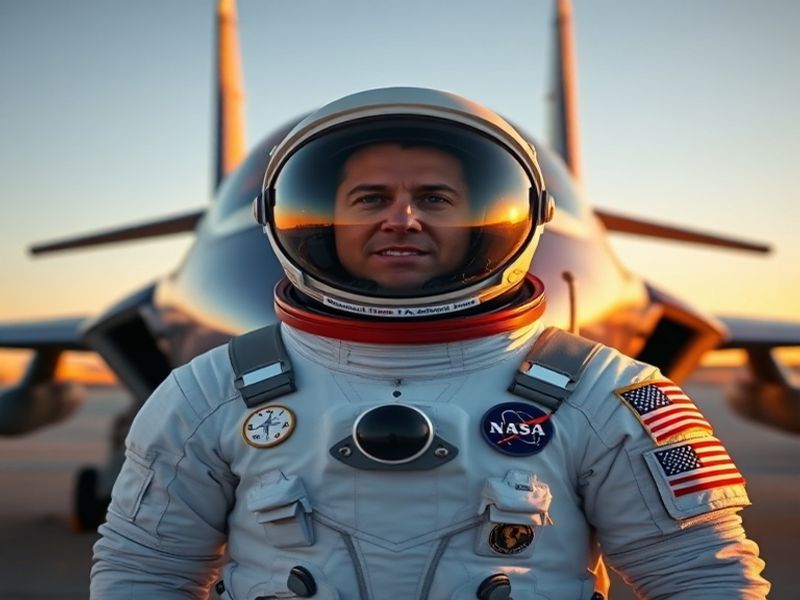
Reid Wiseman: NASA’s Chief Astronaut Shaping the Future of Space Exploration
“`html
Reid Wiseman: From Naval Aviator to NASA’s New Era of Space Leadership
Reid Wiseman’s career has followed a path few could have predicted when he first took to the skies as a naval aviator. Today, he stands at the forefront of NASA’s human spaceflight program, shaping the agency’s future beyond low Earth orbit. His journey—marked by technical expertise, leadership, and a rare ability to communicate the wonder of space exploration—has made him one of the most influential figures in modern aerospace.
Born in Baltimore, Maryland, in 1975, Wiseman’s early fascination with flight led him to the U.S. Naval Academy. After graduating in 1997, he trained as a naval aviator, flying the F-14 Tomcat and later the F/A-18F Super Hornet. His military service included deployments to the Middle East, where he flew combat missions in support of Operation Iraqi Freedom. These experiences instilled in him a discipline and resilience that would later define his approach to spaceflight.
The Making of an Astronaut: From Earth to Orbit
Wiseman’s transition from military aviation to NASA began in 2009 when he was selected as part of the agency’s 20th astronaut class. At the time, NASA was shifting its focus from the Space Shuttle era to the development of the Orion spacecraft and the Artemis program, which aims to return humans to the Moon and eventually reach Mars. Wiseman’s background made him an ideal candidate for this new chapter in space exploration.
His first spaceflight came in 2014 aboard Expedition 40/41 to the International Space Station (ISS). During his 165 days in orbit, Wiseman conducted over 300 experiments, ranging from biological studies to technology demonstrations. He also became known for his social media presence, sharing stunning images of Earth and life aboard the ISS. His posts brought the experience of spaceflight to millions, bridging the gap between NASA’s technical work and public curiosity.
Wiseman’s ability to connect with audiences extended beyond social media. In 2015, he was named the first Chief of the Astronaut Office’s Exploration Branch, a role that placed him at the heart of NASA’s plans for deep space missions. His leadership during this period helped lay the groundwork for the Artemis program, which now stands as NASA’s most ambitious human spaceflight initiative since Apollo.
Artemis and the Future of Lunar Exploration
In December 2020, NASA announced Wiseman’s appointment as Chief Astronaut, a position that places him at the helm of the agency’s astronaut corps. In this role, he oversees the selection, training, and assignment of astronauts to missions, including those destined for the Moon under the Artemis program. His leadership has been critical as NASA prepares to land the first woman and the next man on the lunar surface by 2026.
The Artemis program is not just about returning to the Moon; it’s about establishing a sustainable human presence there and using the Moon as a stepping stone for missions to Mars. Wiseman has emphasized the program’s global and commercial partnerships, including collaborations with the European Space Agency, Japan Aerospace Exploration Agency, and private companies like SpaceX and Blue Origin. These alliances reflect a broader shift in space exploration, where international cooperation and commercial innovation are as vital as technical achievement.
Under Wiseman’s guidance, NASA has also prioritized diversity in its astronaut corps. The agency’s latest class of astronauts includes a record number of women and candidates from diverse backgrounds, reflecting the changing face of both space exploration and the broader aerospace industry. Wiseman has spoken openly about the importance of representation, noting that it inspires the next generation of explorers.
A Cultural Bridge Between Science and Society
Wiseman’s influence extends beyond mission logistics and technical innovation. He has become a cultural figure, using his platform to advocate for STEM education and public engagement with space science. His appearances on television, podcasts, and at international forums have helped demystify space exploration, making it more accessible to people around the world.
One of his most notable efforts has been in fostering international collaboration. Space exploration has long been a unifying force, and Wiseman has worked to strengthen ties between NASA and other space agencies. For example, his involvement in the ISS program highlighted the importance of global partnerships in maintaining a continuous human presence in space. These efforts are crucial as competition in space intensifies, particularly with the rise of new players like China and private companies such as SpaceX.
Wiseman’s leadership style is often described as collaborative and forward-thinking. He has encouraged NASA to embrace innovation, including the use of advanced technologies like artificial intelligence and machine learning to enhance mission planning and execution. His approach reflects a broader trend in aerospace, where traditional methods are increasingly supplemented by cutting-edge tools and data-driven decision-making.
Legacy and the Road Ahead
As NASA prepares for the Artemis missions, Wiseman’s role in shaping the agency’s future cannot be overstated. His career—from naval aviator to chief astronaut—embodies the evolution of space exploration itself. It is a field that once belonged exclusively to government agencies but is now shared with private enterprises and international partners.
Looking ahead, Wiseman’s influence will be felt in several key areas:
- Lunar Infrastructure: Developing the lunar Gateway, a small space station orbiting the Moon, which will serve as a staging point for surface missions.
- Sustainability: Ensuring that Artemis missions are sustainable, with reusable landers and in-situ resource utilization (using lunar resources for fuel and life support).
- Public Engagement: Continuing to inspire the next generation through education and outreach, particularly in underserved communities.
- Global Collaboration: Strengthening partnerships with allies to ensure that space exploration remains a cooperative, rather than competitive, endeavor.
Wiseman’s journey also underscores the importance of adaptability in an ever-changing field. The aerospace industry today faces challenges ranging from budget constraints to geopolitical tensions. Yet, figures like Wiseman demonstrate how leadership, vision, and a commitment to exploration can navigate these complexities.
For aspiring astronauts and engineers, Wiseman’s career offers a blueprint for success: a blend of technical excellence, leadership, and the ability to communicate a grand vision in a way that resonates with people across cultures and generations. His story is a reminder that space exploration is not just about reaching new destinations—it’s about pushing the boundaries of what humanity can achieve.
As NASA and its partners embark on this new era of lunar exploration, Wiseman’s leadership will be instrumental in ensuring that the mission is not only successful but also inclusive and inspiring. The Moon is no longer the final frontier; it is the next stepping stone, and Wiseman is helping to lead the way.
Conclusion: Beyond the Stars
Reid Wiseman’s career reflects the broader trajectory of space exploration: a field that has evolved from a Cold War competition to a collaborative, innovative endeavor. His contributions to NASA’s Artemis program and his efforts to engage the public highlight the multifaceted role of modern astronauts. They are not just explorers but leaders, educators, and ambassadors for the possibilities of human achievement.
As the world watches NASA prepare for humanity’s return to the Moon, Wiseman’s leadership serves as a guiding light. His ability to bridge the gap between the technical and the human, the scientific and the inspirational, ensures that space exploration remains a unifying force for generations to come.