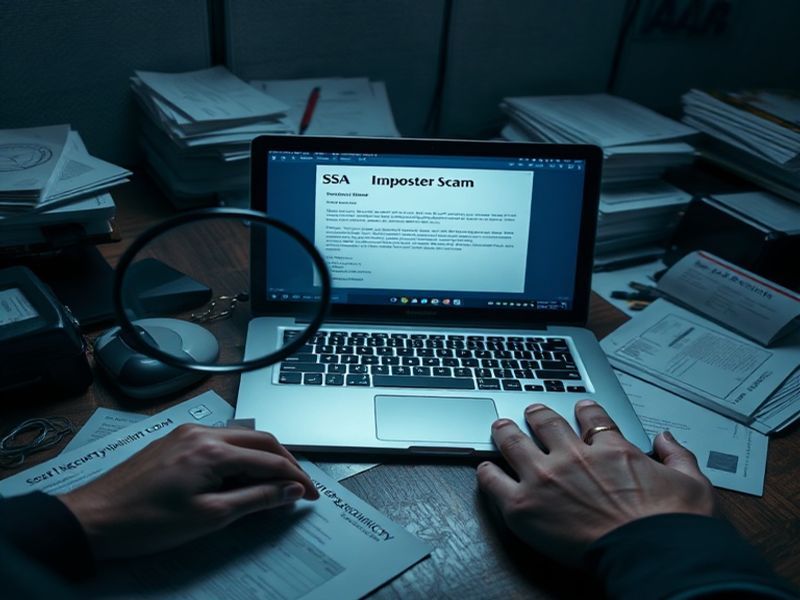
The Social Security Administration (SSA) imposter scam has evolved into one of the most pervasive digital frauds globally. Scammers impersonate SSA officials in emails, text messages, and phone calls, preying on fear and urgency to extract sensitive personal information or direct payments. This fraud transcends borders, affecting millions across North America, Europe, and parts of Asia, where English-speaking populations are targeted with sophisticated psychological tactics.
Unlike traditional phishing attempts, SSA imposter scams often begin with an email that appears legitimate at first glance. The messages frequently reference fabricated “suspensions” of Social Security numbers or claims of “unclaimed benefits,” creating a false sense of crisis. As awareness grows, so does the creativity of these scams, with some now including spoofed SSA logos, official-looking case numbers, and even links to cloned government websites designed to harvest login credentials.
The Anatomy of a Modern SSA Imposter Email
Most SSA imposter emails follow a predictable but increasingly refined structure. The sender’s address is often spoofed to mimic an official SSA domain—variations like support@ssa-gov.com or alert@socialsecurity-administration.net are common. The subject lines are crafted to trigger immediate action, ranging from “URGENT: Your Social Security Number Has Been Suspended” to “Final Notice: Unclaimed SSA Benefits Await You.”
These emails typically contain several key elements:
- Official branding: Scammers replicate SSA letterhead, fonts, and logos with surprising accuracy. Some even include the agency’s physical address in Richmond, Virginia, to appear legitimate.
- Threat of suspension: A recurring tactic is claiming the recipient’s Social Security number has been “suspended due to suspicious activity” or tied to a crime. This is false, but the fear of losing access to benefits drives quick responses.
- Fake case references: Emails often include a “case number” or “reference ID” to create the illusion of an official proceeding, making the message feel urgent and specific.
- Call-to-action buttons: Links labeled “Verify My Account,” “Appeal Suspension,” or “Claim My Benefits” lead to phishing sites that closely resemble the real SSA portal.
- Phone number spoofing: Some emails include a toll-free number that connects to an automated voice system mimicking the SSA’s real customer service line.
In 2023, researchers at the cybersecurity firm Technology firm Recorded Future identified over 12,000 unique SSA-themed phishing domains registered globally—an 87% increase from the previous year. These domains are often hosted on servers in countries with lax cyber enforcement, including parts of Eastern Europe and Southeast Asia, making them difficult to shut down quickly.
Why This Scam Works: The Psychology Behind the Fraud
The success of SSA imposter scams hinges on exploiting deeply rooted fears and bureaucratic confusion. Social Security is a cornerstone of financial security for retirees, disabled individuals, and low-income families. When an email claims their lifeline is at risk, recipients often act without verifying the source.
Cultural context plays a significant role. In the United States, where Social Security is a political lightning rod, scammers exploit public uncertainty about the program’s future. Meanwhile, in Canada, where the equivalent is the Canada Pension Plan (CPP), similar scams have emerged using spoofed Service Canada emails. In the UK, fraudsters impersonate the Department for Work and Pensions, sending emails about “missing National Insurance contributions.”
Scammers also leverage linguistic and regional targeting. Spanish-speaking recipients in the U.S. receive emails in Spanish warning of “suspensión de su número de Seguro Social,” while older adults in rural areas—less familiar with digital threats—are disproportionately victimized. According to the FBI’s Internet Crime Complaint Center (IC3), victims over 60 lost over $1.2 billion to tech support and government impersonation scams in 2023 alone.
How to Protect Yourself: A Step-by-Step Guide
Recognizing an SSA imposter email requires skepticism and attention to detail. The real SSA will never initiate contact via email, text, or phone to demand immediate payment or personal information. Here’s how to respond safely:
- Verify the sender: Hover over the sender’s email address (without clicking) to check the domain. The real SSA uses
@ssa.gov. Any variation—even@socialsecurity.gov—is a red flag. - Inspect links carefully: Before clicking, hover over any link to see the actual URL. Fake links often use URL shorteners (like bit.ly) or mimic the SSA domain with slight misspellings (e.g.,
ssagov.net). - Look for threats or urgency: The SSA does not suspend Social Security numbers or threaten arrest. Any message claiming immediate consequences is fraudulent.
- Never share personal data: Do not enter your Social Security number, bank details, or Medicare information into a web form received via email. Always initiate contact through the official SSA website: www.ssa.gov.
- Report suspicious messages: Forward phishing emails to oig.hotline@ssa.gov and report the domain to the IC3. If you’ve shared sensitive information, contact the Identity Theft Resource Center.
For those who receive repeated scam attempts, consider using email filters to block known fraudulent domains. Tools like Gmail’s “Report Phishing” button and Microsoft Defender’s anti-phishing protections can help reduce exposure. However, the most effective defense remains human vigilance—questioning unexpected messages, especially those invoking fear or authority.
The Global Response: Governments and Tech Companies Fight Back
Governments worldwide are stepping up efforts to combat SSA imposter scams, but progress is uneven. In the U.S., the SSA has launched public awareness campaigns, including videos and social media posts warning about impersonation attempts. The Federal Trade Commission (FTC) has also increased warnings, noting that scams involving government impersonation accounted for 35% of all reported fraud losses in 2023.
Technology platforms are under pressure to do more. In 2022, Meta and Google began removing thousands of fake government impersonation ads after investigations by consumer advocacy groups. However, scammers quickly adapt, using encrypted messaging apps like WhatsApp and Telegram to distribute fraudulent links without detection.
International cooperation remains a challenge. While agencies like Interpol and Europol track cybercrime rings, many operate across jurisdictions with differing laws. In Southeast Asia, where many scam operations originate, local authorities often lack the resources to dismantle sophisticated fraud networks. This has led to a rise in “pig butchering” scams—elaborate schemes where victims are groomed over weeks before being defrauded.
Despite these hurdles, some countries have seen success. Australia’s Scamwatch initiative reduced government impersonation losses by 40% in 2023 through targeted public education and real-time reporting systems. Similarly, Singapore’s National Crime Prevention Council launched a multilingual campaign using memes and TikTok videos to reach younger audiences—a rare example of cultural adaptation in anti-scam messaging.
What to Do If You’ve Been Targeted
If you suspect you’ve fallen for an SSA imposter scam, act quickly. First, freeze your credit with the three major bureaus (Experian, Equifax, TransUnion) to prevent unauthorized accounts. Next, report the incident to the FTC at reportfraud.ftc.gov and file a police report if you’ve suffered financial loss.
Victims should also monitor their Social Security statements via my Social Security for any unauthorized changes. If your number has been compromised, the SSA can issue a new one, though the process is cumbersome and not guaranteed. For those on fixed incomes, this can be devastating—losing access to benefits even temporarily can lead to financial ruin.
Scammers often sell stolen personal information on the dark web, where bundles of Social Security numbers and financial data fetch high prices. This secondary market fuels identity theft rings that can take years to resolve. The emotional toll is equally significant, with many victims reporting feelings of shame, isolation, and mistrust toward government agencies.
Looking Ahead: Can We Stop the Scourge?
The fight against SSA imposter scams is a marathon, not a sprint. While law enforcement and tech companies are making progress, scammers remain one step ahead due to their adaptability and the low cost of launching new campaigns. Public education is the most powerful tool available—but it must evolve alongside the threats.
Innovations like AI-powered email filtering and blockchain-based domain verification could reduce fraud in the future. However, until then, the best defense is a combination of skepticism, verification, and rapid reporting. The SSA itself has acknowledged that it cannot eliminate impersonation scams alone—it needs a cultural shift where digital literacy is prioritized from an early age.
For now, the most important message is simple: The SSA will never email you out of the blue with threats or demands. If you receive such a message, it’s not just a scam—it’s a test of your ability to question what you see. Passing that test could save your identity, your savings, and your peace of mind.
Have you encountered an SSA imposter scam? Share your experience in the comments below.