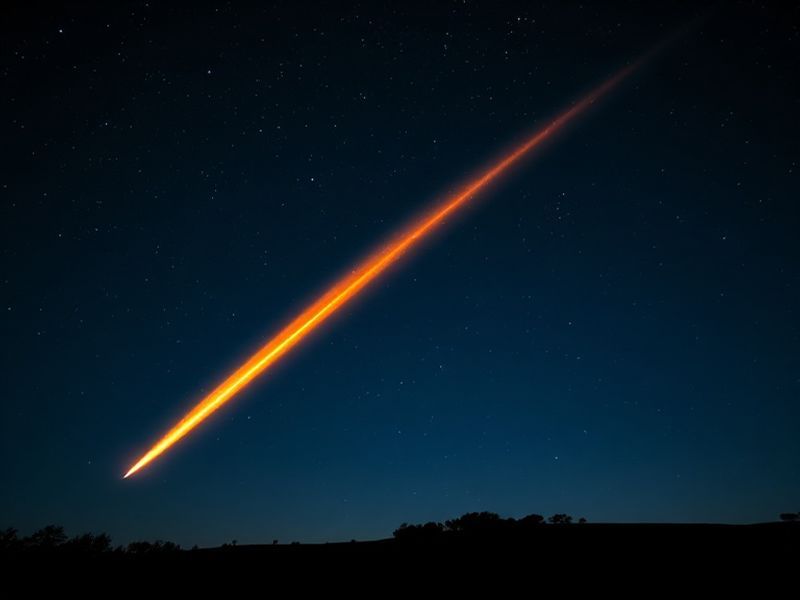
On any given night, Earth’s atmosphere becomes a stage for fleeting cosmic performances. Among the most spectacular are fireball meteors—intense streaks of light that outshine the moon and leave observers in awe. These aren’t your average shooting stars. Fireball meteors are larger, brighter, and often accompanied by dramatic visual effects, sometimes even producing sonic booms. Their sudden appearance reminds us of the dynamic and sometimes unpredictable nature of space debris interacting with our planet.
What exactly defines a fireball meteor? The scientific community sets the threshold at an apparent magnitude of -4 or brighter. For context, Venus at its brightest shines around -4.7. Anything brighter than this solar system landmark qualifies as a fireball. These events occur when meteoroids—small rocky or metallic bodies from space—enter Earth’s atmosphere at high velocities, compressing and heating the air in front of them until they ignite in a brilliant display of plasma. The result is a spectacle visible from hundreds of miles away, often lasting several seconds.
How Fireball Meteors Differ from Regular Meteors
The distinction between a typical meteor and a fireball meteor lies primarily in brightness and persistence. While a regular meteor might flicker for less than a second, a fireball can blaze across the sky for up to 10 seconds or more. Their glow often leaves behind a smoky trail that lingers before dispersing. Some fireballs fragment mid-flight, creating a dazzling chain of glowing debris known as a “terminal burst.”
Another key difference is their frequency and origin. Small meteors are common—Earth encounters millions daily. Fireballs, however, are rarer. NASA’s All-sky Fireball Network detects only about 30 large fireballs each year over the United States. Many originate from the asteroid belt, though a growing number are linked to cometary debris streams during annual meteor showers like the Perseids or Geminids.
Key Characteristics of Fireball Meteors
- Brightness: Typically -4 magnitude or brighter, often rivaling the moon.
- Duration: Lasts 2–10 seconds, sometimes longer during fragmentation.
- Color: Varies due to chemical composition—green (magnesium), yellow (sodium), blue (copper), or red (silicate).
- Trail: Persistent smoke or ionized gas trail visible for minutes.
- Sound: Sonic booms or delayed rumbles may follow bright fireballs.
The Science Behind the Spectacle
Fireball meteors are more than just visual phenomena—they’re natural laboratories for atmospheric physics. When a meteoroid enters the atmosphere at speeds between 11 and 72 kilometers per second, the surrounding air is compressed so rapidly that it heats to thousands of degrees Celsius. This process, called ablation, strips away the meteoroid’s outer layers while emitting light across the visible spectrum.
The color of a fireball reveals its chemical makeup. A greenish hue often indicates magnesium, while yellow suggests sodium. Blue may point to copper, and red can signal the presence of silicate minerals. These spectral signatures allow astronomers to classify meteoroids without ever collecting physical samples—a rare advantage in planetary science.
Occasionally, a fireball survives its fiery plunge and reaches the ground as a meteorite. These rare events are scientifically valuable because they provide direct samples of the early solar system. The famous Chelyabinsk meteor of 2013, which injured over 1,500 people in Russia, began as a fireball before exploding in the atmosphere with the force of 30 atomic bombs. The resulting meteorite fragments have since been studied to better understand asteroid composition and impact risks.
When and Where to Watch for Fireballs
Fireballs can appear at any time, but they are more likely during major meteor showers. These events occur when Earth passes through the debris trails of comets or, less commonly, asteroids. The Geminids in December and the Perseids in August are particularly rich in bright meteors, including fireballs. The Quadrantids in January and the Orionids in October also produce notable displays.
Location matters too. Observers in rural areas with dark skies report fireballs far more frequently than city dwellers. Light pollution washes out all but the brightest events. Still, even under urban skies, a well-placed fireball can be visible if it’s large enough—especially when it fragments or produces a terminal burst.
NASA and the American Meteor Society (AMS) maintain databases of reported fireball sightings. These citizen science initiatives have grown in importance as automated detection networks expand. In 2023, over 1,500 fireball events were logged globally, with nearly 20% producing recoverable meteorites. This trend highlights the value of public participation in tracking these celestial visitors.
Broader Implications: From Science to Safety
Fireball meteors are more than just visual wonders—they’re windows into cosmic hazards. While the chance of a meteorite striking a person is extremely low—estimated at about 1 in 1.6 million over a lifetime—larger impacts pose real risks. The Tunguska event of 1908 flattened 2,000 square kilometers of Siberian forest, and though it produced no crater, its airburst released energy equivalent to 15 megatons of TNT.
Modern detection systems like the Planetary Defense Coordination Office (PDCO) monitor the skies for near-Earth objects (NEOs) larger than 140 meters. While fireballs from smaller objects rarely reach the ground, their study helps refine models of atmospheric entry and fragmentation. This data improves predictions about potential impacts and informs mitigation strategies, such as deflection missions like NASA’s DART test.
Fireballs also play a role in public engagement with astronomy. Viral videos of bright meteors often go viral, drawing attention to space science. They remind communities of their connection to the cosmos and can inspire future scientists. In an era of declining science literacy, these fleeting lights in the sky serve as powerful educational tools.
Conclusion: A Reminder of Our Place in the Universe
Fireball meteors are fleeting, unpredictable, and utterly mesmerizing. They connect us to the violent, creative forces that shaped our solar system. Each one is a brief reminder that Earth is not isolated—it’s part of a larger, dynamic universe where collisions and cosmic debris play a constant role in evolution.
Next time you look up at the night sky, remember: the universe is still writing its story, and sometimes, it drops a chapter right in front of us. Whether for science, wonder, or sheer awe, fireball meteors are one of nature’s most dazzling performances—and they’re free for anyone to watch.