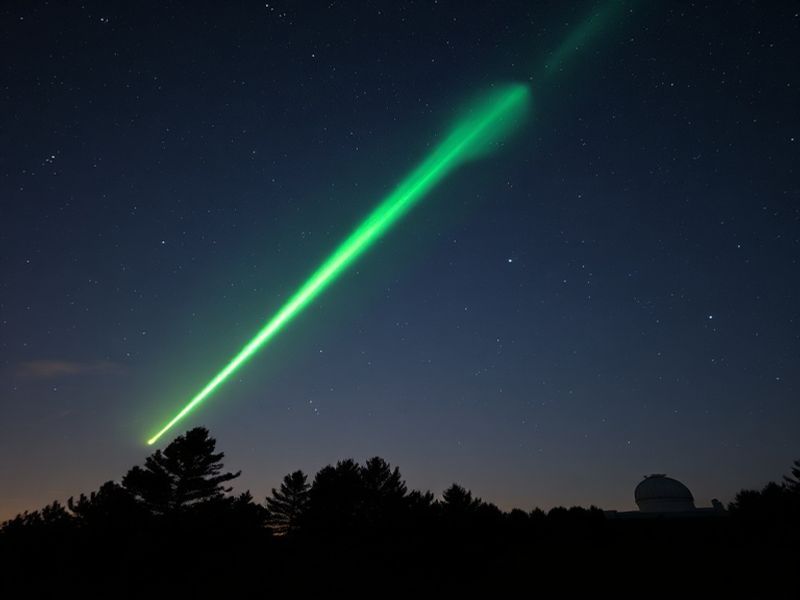
The universe has a way of reminding us just how small we are. On a quiet Tuesday evening in late September, residents from Texas to Ohio gasped as a meteor fireball streaked across the sky, its brilliant green hue and explosive finale captured on dashboard cameras, doorbell cams, and even smartphones. Events like these aren’t just fleeting moments of cosmic drama—they’re windows into the violent, beautiful chaos of space.
Fireballs aren’t your average shooting stars. They’re larger, brighter, and more dramatic, often burning up in a spectacular display when they enter Earth’s atmosphere. But what exactly triggers these celestial performances? And why do they sometimes end with a bang?
What Exactly Is a Meteor Fireball?
A meteor fireball, also known as a bolide, is essentially a very bright meteor—so luminous that it outshines the planet Venus in the night sky. While regular meteors might appear as faint streaks, fireballs can cast shadows and leave glowing trails that linger for several seconds. The term “fireball” is reserved for meteors brighter than magnitude -4, which is roughly the brightness of Venus at its most visible.
Most fireballs originate from space rocks—asteroids or comets—that collide with Earth’s atmosphere. When these objects enter at speeds exceeding 25 miles per second, friction heats them to thousands of degrees, creating the dazzling light show we see. What makes a fireball particularly special is its size; typically, these objects are at least a few centimeters across, though some can be as large as a car or even bigger. The September event, for example, was estimated by NASA to have released energy equivalent to 2.1 kilotons of TNT.
How Do Fireballs Differ From Other Meteors?
Not all meteors are created equal. Understanding the distinctions helps clarify why fireballs stand out:
- Brightness: Fireballs shine with an intensity that rivals the moon. A typical meteor might glow at magnitude 2 or 3, while a fireball can reach -10 or brighter.
- Duration: These events last longer than standard meteors, often several seconds, due to their larger size and slower deceleration.
- Sonic Effects: Some fireballs produce sonic booms or pressure waves, a sign that they’ve penetrated deep enough into the atmosphere to interact with air molecules violently.
- Fragmentation: High-profile fireballs, like the Chelyabinsk meteor in 2013, can break apart mid-flight, creating multiple streaks and explosive flashes.
The Science Behind the Spectacle
Fireballs aren’t just pretty lights—they’re scientific goldmines. Each event offers researchers clues about the composition of near-Earth objects and the dynamics of atmospheric entry. NASA’s Fireball Network tracks these phenomena using a network of cameras designed to triangulate their trajectories and estimate impact locations.
When a fireball is detected, scientists analyze its spectrum—the light it emits—to determine its chemical makeup. Iron, magnesium, and sodium often leave distinct signatures, revealing whether the object is metallic, stony, or a primitive relic from the early solar system. The September fireball, for instance, showed strong magnesium traces, suggesting it may have been a fragment of a larger asteroid.
The energy released during a fireball’s descent also provides data on atmospheric density and composition. As the object burns, it heats the surrounding air, creating a plasma trail that can be studied to refine models of atmospheric chemistry. These insights aren’t just academic—they help improve our understanding of how to protect Earth from future impacts.
Are Fireballs Dangerous?
The short answer is: rarely. Most fireballs disintegrate harmlessly in the upper atmosphere, raining down only tiny fragments that pose no threat. However, history shows that exceptions exist. The Chelyabinsk meteor, which exploded over Russia in 2013, injured over 1,500 people and damaged thousands of buildings. Its shockwave shattered windows across six cities. The energy released was equivalent to 400-500 kilotons of TNT—30 times the power of the Hiroshima bomb.
Events like Chelyabinsk are reminders that space isn’t as distant as it seems. NASA and other agencies continuously monitor near-Earth objects (NEOs) larger than 140 meters, which could cause regional devastation if they struck. While no known asteroid currently poses an imminent threat, fireballs serve as real-time demonstrations of the risks—and the need for vigilance.
Cultural and Historical Echoes
Fireballs have long held a place in human imagination. Ancient cultures often interpreted them as omens or messages from the gods. The Romans saw shooting stars as the tears of gods, while the Chinese associated them with celestial battles. In medieval Europe, fireballs were sometimes seen as harbingers of war or plague.
Modern times haven’t dulled the awe. The 2013 Chelyabinsk event became a viral sensation, with countless videos shared across platforms like YouTube and TikTok. It sparked renewed interest in astronomy and even inspired a wave of citizen science projects, where amateur astronomers contributed to tracking and analyzing fireballs. Today, platforms like the American Meteor Society rely on public reports and footage to map fireball sightings, turning ordinary people into active participants in cosmic discovery.
Fireballs also feature prominently in popular culture. Films like “Armageddon” and “Deep Impact” dramatize humanity’s struggle against asteroid impacts, while video games and literature often use them as plot devices. Yet, these fictional portrayals rarely capture the scientific complexity of real-life events. A fireball isn’t just a dramatic backdrop—it’s a fleeting glimpse into the raw power of the cosmos.
What Should You Do If You Spot a Fireball?
If you’re lucky enough to witness a fireball, your first instinct might be to grab your phone and hit record. That’s great—but there’s more you can do to contribute to science. Here’s a quick guide:
- Note the Time and Location: Record the exact time and your precise location. Even a general area helps researchers narrow down the trajectory.
- Observe the Path: Watch the direction the fireball travels. Did it move from north to south? Left to right? This information is crucial for triangulation.
- Capture the Moment: Use your phone or camera to record the event. If possible, include landmarks or the horizon for scale.
- Report It: Submit your sighting to organizations like the American Meteor Society or NASA’s Fireball Network. Include as many details as possible.
- Look for Fragments: If the fireball was particularly large, check local news or community groups for reports of meteorites. Never touch or disturb potential fragments without expert guidance.
Your observations could help scientists refine models of asteroid composition, atmospheric entry, and even planetary defense strategies. In the grand scheme of things, a fireball sighting is a collaborative moment—a chance for humanity to come together and marvel at the universe we’re all a part of.
Conclusion: A Reminder of Our Place in the Cosmos
Meteor fireballs are more than just fleeting lights in the sky. They’re dynamic, unpredictable, and deeply informative, offering insights into the origins of our solar system and the potential threats we face. They bridge the gap between science and wonder, reminding us that Earth is part of a much larger, more chaotic universe.
As technology advances, our ability to track and study these events improves. Networks of cameras, satellites, and citizen scientists are turning what were once rare and mysterious occurrences into routine data points. Yet, the magic of a fireball remains undiminished. Whether it’s a quiet green streak over Ohio or a city-shaking explosion over Russia, these events captivate us because they’re a direct connection to the cosmos—a reminder that we’re not separate from the universe, but very much a part of it.
The next time you look up at the night sky, remember: the universe is always putting on a show. You just have to know where—and when—to look.