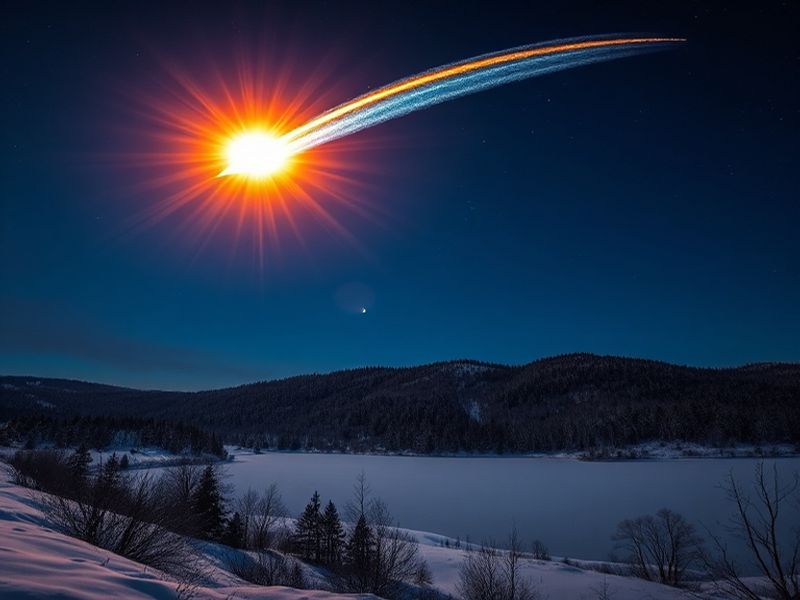
The night sky over the northeastern United States became a temporary spectacle on Tuesday evening when a fireball meteor illuminated the darkness. Observers from Pennsylvania to Maine reported seeing the bright, fast-moving object, which briefly outshone the moon before disappearing from view. The event lasted only a few seconds but left a lasting impression on those fortunate enough to witness it.
Fireball meteors are not uncommon, but their appearance in populated regions often sparks widespread attention. According to astronomers, these meteors occur when space debris enters Earth’s atmosphere at high speeds, creating a brilliant display of light due to friction. While most fireballs burn up completely, some fragments may survive and reach the ground as meteorites. In this case, no reports of impacts have been confirmed as of yet.
Public Reaction and Social Media Buzz
The meteor’s appearance triggered a wave of reactions across social media platforms. Residents in cities like Boston, New York, and Philadelphia shared videos and photos of the event, with many describing it as a once-in-a-lifetime experience. Some compared the sight to fireworks, while others noted the eerie silence that followed the bright flash.
Local news outlets quickly picked up on the story, with many interviewing witnesses who described the meteor’s color and trajectory. A resident of Albany, New York, told reporters, “It was greenish-blue, like a neon firework, but way brighter. I’ve never seen anything like it.” The event also sparked discussions about the rarity of such sightings and the science behind them.
- Over 500 reports were submitted to the American Meteor Society within hours of the event.
- Videos of the meteor spread rapidly on Twitter and TikTok, amassing millions of views.
- Some conspiracy theories emerged online, though these were quickly debunked by experts.
A Global Perspective on Fireball Meteors
While the recent event in the northeast captured local attention, fireball meteors are a global phenomenon. Every year, thousands of these bright meteors streak across the sky, often going unnoticed due to their remote locations. However, when they occur over populated areas, they become a shared spectacle, uniting people in awe of the universe’s vastness.
In 2013, a particularly notable fireball meteor exploded over Chelyabinsk, Russia, releasing energy equivalent to 30 atomic bombs. The shockwave shattered windows and injured over 1,000 people, serving as a stark reminder of the potential dangers posed by near-Earth objects. Since then, organizations like NASA have increased efforts to track and study these celestial events.
Historical and Cultural Significance
Throughout history, meteors and comets have held deep cultural and spiritual significance. Ancient civilizations often interpreted these celestial events as omens or messages from the gods. The 1066 appearance of Halley’s Comet, for example, was seen as a precursor to the Norman Conquest of England. Even today, meteors are woven into modern folklore, appearing in literature, films, and art as symbols of mystery and wonder.
In some cultures, meteors are believed to carry wishes or bring good fortune. The tradition of making a wish upon a shooting star persists in many societies, reflecting humanity’s enduring fascination with the cosmos. While science has provided explanations for these phenomena, their ability to inspire awe remains undiminished.
Scientific Study and Future Observations
Astronomers and researchers are now analyzing data from the recent fireball event to determine its size, speed, and potential trajectory. Instruments like the NASA All Sky Fireball Network and the Global Fireball Observatory track these events in real-time, providing valuable insights into the composition and origins of space debris.
For amateur astronomers and stargazers, events like these serve as a reminder of the importance of citizen science. Platforms like the Science section on Dave’s Locker encourage enthusiasts to report sightings and contribute to ongoing research. By collaborating with professionals, hobbyists can play a crucial role in expanding our understanding of the universe.
Looking ahead, scientists predict that more fireball meteors will be detected as tracking technology improves. These events not only provide thrilling visual displays but also offer opportunities to study the building blocks of our solar system. Each meteor is a fragment of the early universe, offering clues about the formation of planets and the origins of life.
How to Prepare for Future Events
While fireball meteors are generally harmless, their unpredictability makes them a topic of interest for both scientists and the public. If you’re eager to witness one yourself, here are a few tips:
- Check weather forecasts to ensure clear skies.
- Find a location away from city lights to maximize visibility.
- Use apps like SkyView or Star Walk to track celestial activity.
- Join local astronomy clubs or online communities to stay informed.
For those who missed the recent event, don’t worry—another fireball meteor is likely just around the corner. Until then, keep looking up at the night sky. You never know what wonders it might reveal.
Conclusion
The fireball meteor over the northeast serves as a reminder of the dynamic and often unpredictable nature of our universe. While these events can be fleeting, their impact lingers in the memories of those who witness them. As technology advances, our ability to study and appreciate these celestial phenomena grows, bridging the gap between science and wonder.
For now, the night sky remains a canvas of endless possibilities, and events like these remind us to stay curious, stay informed, and always keep an eye on the horizon. Whether you’re an astronomer, a casual observer, or simply someone who enjoys the beauty of the cosmos, there’s always more to discover.