Fireball Meteor Lights Up Northeast Skies: What You Need to Know
“`html
The Fireball Meteor Over the Northeast: A Global Perspective on a Spectacular Display
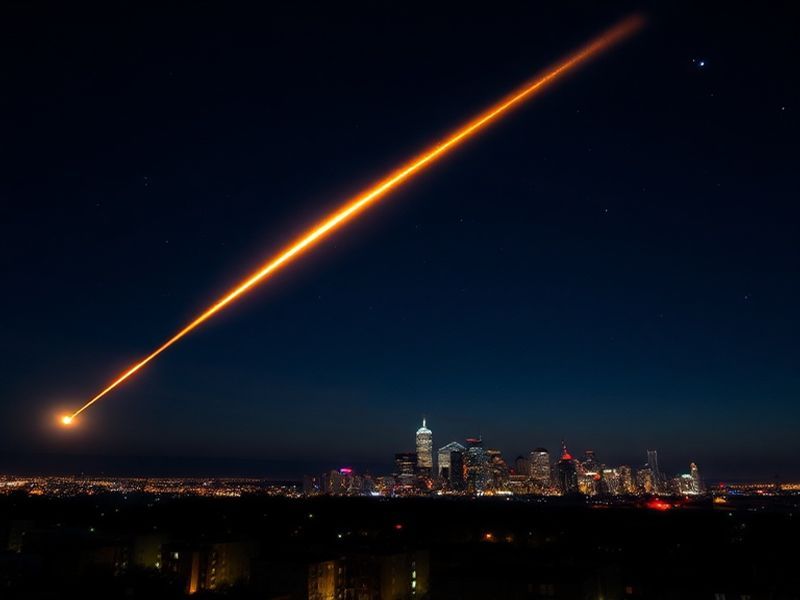
The night sky over the northeastern United States recently provided a breathtaking spectacle as a fireball meteor streaked across the horizon. Witnesses from New York to Maine reported seeing a brilliant, glowing orb that flared briefly before vanishing. Such events are not just isolated occurrences; they remind us of the dynamic and often dramatic interactions between Earth and the cosmos.
Fireball meteors, also known as bolides, are brighter than the planet Venus and often leave a visible trail as they burn up in the atmosphere. While they are relatively common on a global scale, sightings over populated areas like the Northeast generate significant attention. The sheer unpredictability of these celestial visitors makes them a compelling subject for both casual observers and scientists alike.
The Science Behind the Fireball
A fireball meteor is essentially a large meteoroid—a chunk of space rock—that enters Earth’s atmosphere at high speed. As friction with the air increases, the meteoroid heats up and begins to glow, creating the bright streak we see from the ground. If the object is large enough, it can produce a sonic boom or even fragments that survive the journey to the surface as meteorites.
According to NASA’s Meteor Watch program, fireballs are detected regularly, though most go unnoticed because they occur over oceans or unpopulated regions. The Northeast’s dense population increases the likelihood of sightings, making it a prime location for documenting these cosmic events. The fireball over the region was likely a few feet in diameter, though precise measurements require careful analysis of witness reports and any recovered fragments.
Such events also offer scientists valuable data. By studying the trajectory, brightness, and composition of fireballs, researchers can glean insights into the origins of these space rocks. Many meteoroids originate from the asteroid belt between Mars and Jupiter, while others may be remnants from the early solar system. The fireball over the Northeast could provide clues about the materials that make up these distant objects.
Cultural and Historical Context
Throughout history, meteors and fireballs have captured human imagination. Ancient cultures often interpreted these celestial events as omens or messages from the gods. In medieval Europe, a bright fireball was sometimes seen as a sign of impending doom or divine intervention. Even today, these phenomena inspire awe and curiosity, bridging the gap between science and folklore.
The Northeast has a rich history of celestial observations. In 1992, a meteorite from a fireball streaked across the skies of Peekskill, New York, and even crashed into a parked car, creating a media sensation. Such events become woven into local lore, reminding communities of their connection to the universe. Even in an age dominated by technology, the sight of a fireball meteor can evoke a sense of wonder that transcends generations.
In other parts of the world, fireballs have played significant roles in cultural narratives. In Japan, for example, meteors are sometimes associated with the legendary “Tsuchinoko,” a mythical serpent said to fall from the sky. Similarly, Indigenous Australian stories describe “fire devils” that traverse the night sky. These interpretations highlight how different cultures have sought to explain and integrate such phenomena into their worldviews.
How to Report and Track Fireballs
For those who witness a fireball meteor, reporting the event can contribute to scientific research. Organizations like the NASA Fireball Network and the American Meteor Society collect data from eyewitnesses to determine the trajectory and potential landing sites of meteorites. Reporting a fireball is straightforward and can be done online through dedicated platforms.
If you spot a fireball, here are some steps to take:
- Note the time and location of the sighting.
- Observe the direction and duration of the fireball’s path.
- Record any sounds, such as a sonic boom, which can indicate a large or close event.
- Check for any fragments that may have reached the ground, but do not attempt to handle them without proper precautions.
- Submit a report to organizations like the American Meteor Society or NASA’s Meteor Watch program.
Tracking fireballs also relies on advanced technology. Networks of cameras and sensors, such as the one operated by the SETI Institute, monitor the skies for these fleeting events. The data collected helps scientists refine models of asteroid and meteoroid populations, which is crucial for understanding potential future impacts.
The Broader Implications of Fireball Events
While fireballs are generally harmless, they serve as a reminder of the importance of monitoring near-Earth objects. Space agencies around the world, including NASA and the European Space Agency (ESA), invest in programs to track asteroids and comets that could pose a threat to our planet. The Chelyabinsk meteor, which exploded over Russia in 2013, injured over 1,000 people and caused significant damage, underscoring the need for vigilance.
Fireballs also inspire public interest in astronomy and space science. Events like the one over the Northeast can spark curiosity about the cosmos, encouraging people to learn more about the universe and our place within it. This renewed interest can lead to greater support for scientific research and education, fostering the next generation of astronomers and engineers.
Moreover, fireballs highlight the interconnectedness of our planet with the broader universe. They remind us that Earth is not an isolated system but part of a dynamic and ever-changing cosmos. From a cultural perspective, they challenge us to think beyond our daily routines and consider our place in the grand tapestry of space and time.
Conclusion
The fireball meteor over the Northeast was more than just a fleeting light in the night sky. It was a reminder of the wonders and mysteries that lie beyond our planet, as well as a call to appreciate the delicate balance of our cosmic environment. Events like these connect us to both the past and the future, bridging ancient myths with modern science.
As technology advances, our ability to study and understand these celestial visitors will only improve. Whether through scientific research, cultural storytelling, or simple observation, fireball meteors continue to captivate and inspire. The next time you gaze at the night sky, remember that you might just witness a spectacle that has fascinated humanity for millennia.
—