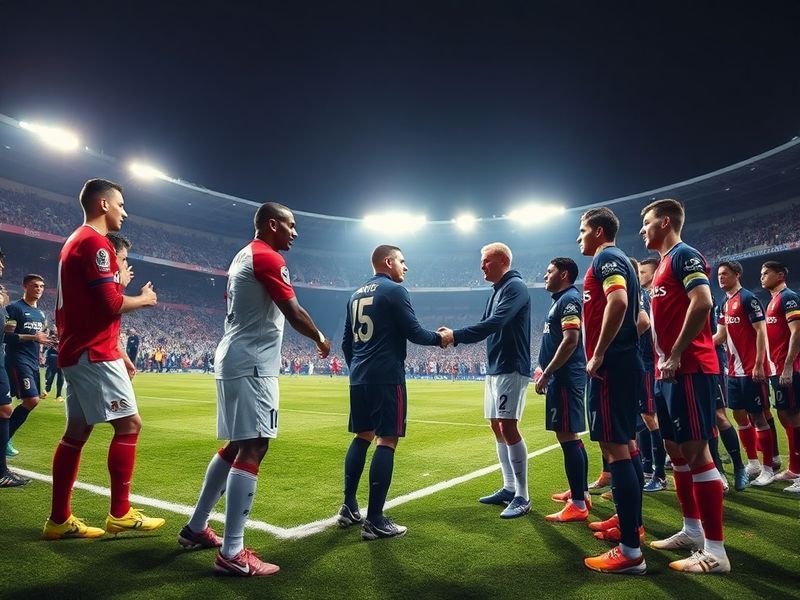
The matchup between Paris FC and AS Monaco is more than just a football game; it’s a collision of identities, ambitions, and footballing philosophies. One club represents the raw, unfiltered heartbeat of Parisian working-class culture, while the other embodies the glitz and calculated precision of Monaco’s elite sporting project. When these two sides meet, the pitch becomes a stage for a broader narrative—one that stretches from the banks of the Seine to the shores of the Mediterranean.
This fixture carries particular weight in the French football hierarchy. Paris FC, born from the remnants of Paris Saint-Germain’s early struggles, has long been the underdog, a club that refuses to fade into obscurity despite financial constraints. Monaco, meanwhile, operates as a satellite club for wealthy owners, a model that has drawn both admiration and criticism in equal measure. Their encounters are not just about three points; they’re about proving that football, at its core, remains a reflection of the societies it entertains.
The Cultural Divide: Paris vs. Monaco
Paris FC’s roots trace back to 1969, when dissident PSG fans broke away to form their own club. The move was born from frustration and defiance, a rejection of the commercialization that threatened the soul of Parisian football. Today, Paris FC plays at the Stade Charléty, a modest stadium in the city’s southern reaches, surrounded by the everyday life of Parisians rather than the tourist crowds of the Champs-Élysées.
Monaco, on the other hand, is a club that has been shaped by wealth and ambition. Owned by Russian billionaire Dmitry Rybolovlev since 2011, the club has invested heavily in infrastructure, youth development, and high-profile signings. Their stadium, the Stade Louis II, is a sleek, modern venue in the heart of the principality, a place where football intersects with luxury and exclusivity. While Paris FC’s supporters sing in the terraces of a working-class district, Monaco’s fans often arrive in designer cars, blending football fandom with high-society glamour.
This contrast extends beyond the pitch. Paris FC’s fanbase is diverse, drawn from the city’s immigrant communities and long-time locals who see the club as a symbol of resistance. Monaco’s supporters, meanwhile, are a mix of expatriates, wealthy locals, and football tourists drawn by the allure of Ligue 1’s most glamorous club. When these two groups converge for a match, the cultural friction is palpable—both on and off the field.
Tactical Approaches: Pragmatism vs. Precision
The tactical battle between Paris FC and Monaco is a study in contrasts. Paris FC, often operating with limited resources, relies on a pragmatic, organized approach. Their managers tend to prioritize defensive solidity and quick transitions, turning counterattacks into a potent weapon. The club’s style reflects its underdog status—a refusal to concede anything, grinding out results through sheer effort and teamwork.
Monaco, meanwhile, plays a brand of football that mirrors its ownership structure: bold, ambitious, and technically refined. Under managers like Leonardo Jardim and Niko Kovač, the club has embraced a high-pressing, possession-based system, often fielding young talents who are groomed for stardom before being sold for massive profits. Their football is designed to entertain, to showcase individual brilliance within a cohesive system. When Monaco faces a team like Paris FC, the clash is almost inevitable—the Monegasques seek to impose their will, while the Parisian side looks to frustrate and exploit any lapse in concentration.
Historically, Monaco has held the upper hand in this fixture. Their financial advantages have allowed them to attract more talented players, and their tactical sophistication has often been the difference in tight encounters. However, Paris FC’s resilience has seen them claim surprising victories, particularly in cup competitions where the underdog narrative adds an extra layer of motivation. These upsets are celebrated not just for the result, but for what they represent—a David vs. Goliath story that resonates far beyond the football pitch.
Key Matches and Memorable Moments
The rivalry between Paris FC and Monaco has produced several notable matches over the years. While league encounters often lack the drama of cup ties, the most memorable moments have come in the Coupe de France and Coupe de la Ligue. Here are a few standout fixtures:
- 2017 Coupe de France Round of 64: Monaco defeated Paris FC 2-1 in a tightly contested match. Despite Paris FC’s spirited performance, Monaco’s individual quality proved decisive in the final stages.
- 2019 Ligue 1 Encounter: Monaco secured a 1-0 victory at home, with their pressing game stifling Paris FC’s creativity. The match highlighted the tactical gulf between the two sides at the time.
- 2021 Coupe de France Round of 32: In a rare cup upset, Paris FC held Monaco to a 1-1 draw before losing on penalties. The result was celebrated as a moral victory for the capital club, showcasing their ability to compete with France’s elite.
These matches are more than just results; they are snapshots of a rivalry that transcends the ordinary. For Paris FC, each meeting is an opportunity to challenge the status quo, to remind Monaco—and the rest of France—that football is not merely a business but a passion rooted in community. For Monaco, every game is a chance to assert dominance, to reinforce their status as a club that operates on a different plane.
The Global Perspective: Football as a Mirror of Society
From a global standpoint, the Paris FC vs. Monaco rivalry encapsulates broader trends in modern football. The financial disparities between clubs have never been more pronounced, with a handful of wealthy owners reshaping the landscape. Monaco’s model—buying young talent, developing them, and selling them for massive profits—has been replicated by clubs across Europe, from Chelsea to Manchester City. Meanwhile, clubs like Paris FC represent the traditional, community-driven approach to football, where survival is as much a victory as any trophy.
This dynamic plays out in leagues across the world. In England, clubs like Brentford and Brighton have carved out niches as competitive underdogs, challenging the financial might of clubs like Manchester United and Liverpool. In Italy, Atalanta’s rise under the guidance of Gian Piero Gasperini has shown that tactical intelligence and collective effort can defy the odds. The Paris FC vs. Monaco rivalry is a microcosm of these broader narratives—a reminder that football’s beauty lies in its unpredictability and its ability to reflect the societies it serves.
Moreover, the rivalry highlights the cultural significance of football in different regions. In Paris, the sport is intertwined with the city’s identity—its diversity, its struggles, and its triumphs. Monaco, while tiny in size, punches above its weight in football terms, reflecting the principality’s outsized influence in global finance and luxury. When these two worlds collide, the result is a clash not just of playing styles, but of cultures and values.
Conclusion: More Than Just a Game
The next time Paris FC and Monaco meet, it will be another chapter in a rivalry that is about far more than football. It will be a confrontation of ideologies—of wealth vs. resilience, glamour vs. grit, ambition vs. tradition. For the players, it’s a chance to prove themselves in a high-stakes environment. For the fans, it’s an opportunity to rally behind a cause greater than themselves.
Football has always been a reflection of the world around it, and few fixtures embody this truth as clearly as Paris FC vs. Monaco. One club represents the heart of a global city, a place where dreams are both born and shattered in equal measure. The other embodies the aspirational allure of a tax haven, where success is measured in trophies and transfer fees. When they face off, the result is never just a scoreboard reading—it’s a story, a cultural moment, and a reminder that the beautiful game is at its best when it captures the complexities of the societies it entertains.
For more insights into French football and its cultural impact, explore our Sports and Culture sections.