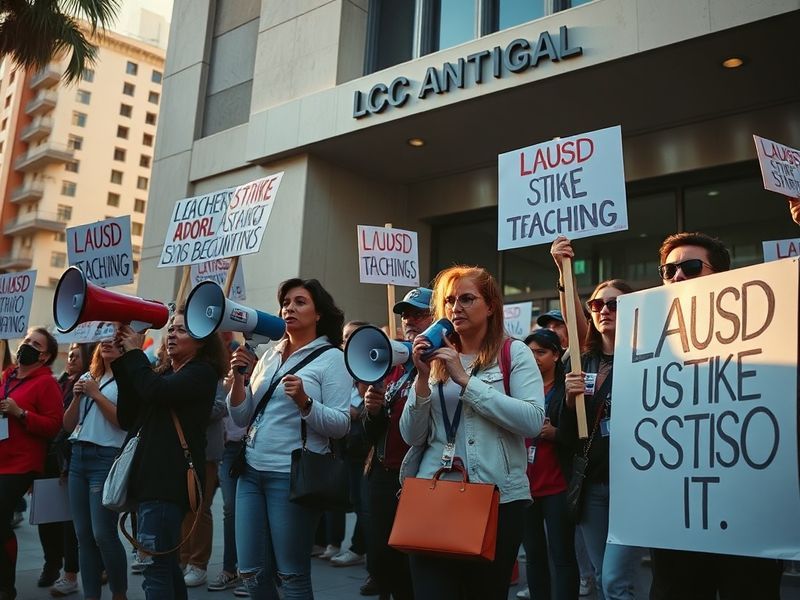
The Los Angeles Unified School District (LAUSD) strike that unfolded in early 2023 was not just a local labor dispute—it became a global flashpoint for education reform, economic inequality, and the role of public institutions in modern society. As thousands of educators walked out of classrooms, they carried signs that read “Our students deserve more” and “Fund our schools, not police”. These slogans underscored deeper tensions in America’s second-largest school district, where underfunded schools, overcrowded classrooms, and inadequate resources had reached a breaking point.
The strike lasted six days before a tentative agreement was reached, but its ripple effects extended far beyond Los Angeles. Teachers in other U.S. cities, from Oakland to Chicago, watched closely, knowing their own battles might follow a similar script. Internationally, educators in countries like the United Kingdom and Mexico drew parallels to their struggles with austerity measures and privatization efforts. The LAUSD strike became a case study in how labor actions in one corner of the world can inspire—or warn—activists elsewhere.
The Core Issues Behind the Strike
The immediate trigger for the strike was a demand for better wages and smaller class sizes. Teachers argued that their salaries—starting at around $50,000 per year—had not kept pace with the rising cost of living in Los Angeles. Meanwhile, class sizes in some schools exceeded 30 students, making it difficult to provide individualized attention. But the strike was about more than just paychecks and pupil-teacher ratios. It was a protest against systemic neglect.
Underlying the strike were several key issues:
- Chronic underfunding: California ranks 40th in the nation for per-pupil spending, despite being one of the wealthiest states. LAUSD’s budget has been stretched thin by declining enrollment, pension costs, and the financial burden of educating a high-needs student population.
- Overcrowded schools: Many LAUSD classrooms operate at or above capacity, with some schools using trailers and modular buildings to accommodate overflow. Teachers reported conditions that made it nearly impossible to teach effectively.
- Support staff shortages: Counselors, nurses, and librarians are in short supply, leaving students without critical mental health services and academic support.
- Disinvestment in public education: Critics pointed to the district’s decision to spend millions on high-tech security systems while cutting arts programs and extracurricular activities. The strike forced a reckoning with priorities.
These issues are not unique to Los Angeles. In cities like Philadelphia and Detroit, teachers have staged similar walkouts over underfunded schools. Globally, public education systems from Brazil to South Africa have faced cuts in the name of austerity, leading to protests and strikes. The LAUSD strike highlighted a global trend: the struggle to maintain public education as a cornerstone of democracy in an era of privatization and market-driven reforms.
How the Strike Played Out: Tactics and Public Response
The strike began on January 10, 2023, with nearly 30,000 teachers and staff walking out. The United Teachers Los Angeles (UTLA) union organized daily rallies outside LAUSD headquarters, where educators were joined by parents, students, and community activists. The protests were colorful and loud, featuring marching bands, student speeches, and art installations made from discarded school supplies. The visuals were powerful, but the message was clear: the status quo was unsustainable.
Public opinion was divided. Polls showed strong support for the teachers among parents and progressive voters, but some business leaders and conservative commentators argued that the strike was harming students and damaging the district’s reputation. The district’s superintendent, Alberto Carvalho, initially resisted the union’s demands, framing the strike as a threat to students’ education. However, as the days passed, pressure mounted on both sides to reach a deal.
One of the strike’s most effective tactics was the involvement of students. Teenagers organized walkouts in solidarity, and young children sent letters to district officials pleading for smaller classes and better resources. The education community had rarely seen such a united front. Even celebrities weighed in, with stars like John Legend and J.Lo publicly supporting the teachers. The strike became a cultural moment, amplified by social media and 24-hour news cycles.
By the sixth day, a tentative agreement was reached. The deal included a 21% salary increase over two years, reductions in class sizes, and commitments to hire more counselors and nurses. The victory was hard-won, but it left many questions unanswered. Would the district follow through on its promises? And could the gains made in Los Angeles inspire similar movements elsewhere?
Global Implications: What LAUSD’s Strike Means for Education Worldwide
The LAUSD strike was a microcosm of broader struggles in public education. In many countries, teachers have become the frontline fighters against policies that prioritize budget cuts over student well-being. In the United Kingdom, for example, teachers have staged multiple strikes over real-term pay cuts and deteriorating working conditions. Meanwhile, in Mexico, educators have protested against education reforms that they argue are designed to dismantle the public school system in favor of private alternatives.
One of the most striking parallels can be drawn with the 2019 teacher strikes in the United States, which saw educators in West Virginia, Oklahoma, and Arizona walk out in protest of low wages and underfunded schools. Those strikes led to significant wage increases and renewed attention to education funding. The LAUSD strike suggests that the movement is far from over. If anything, it has gained momentum as the COVID-19 pandemic exposed the fragility of public education systems around the world.
The strike also highlighted the role of race and class in education. LAUSD serves a predominantly Latino and Black student body, many of whom come from low-income households. The strike was as much about racial justice as it was about labor rights. Teachers and activists pointed out that schools in wealthy, predominantly white neighborhoods often have better resources, while schools in poorer, minority communities are left to struggle. This disparity is a global issue, with similar patterns playing out in countries like France and South Africa.
For global observers, the LAUSD strike was a reminder that public education is not just an economic issue—it’s a cultural one. Schools are where societies shape their future citizens, and when those institutions are underfunded, the consequences ripple through generations. The strike forced a conversation about what kind of society we want to build: one that invests in its people, or one that leaves them behind.
What’s Next for LAUSD and Public Education?
The tentative agreement in Los Angeles was a step forward, but it was only the beginning. Implementation will be key. Will the district follow through on its promises to reduce class sizes and hire more support staff? Or will budget constraints lead to delays and half-measures? The union has vowed to hold the district accountable, but the road ahead is uncertain.
For teachers and activists, the strike was a call to action. It proved that collective action can yield results, but it also showed that the fight for public education is ongoing. In the coming years, we may see more strikes, more protests, and more demands for change. The question is whether these actions will lead to lasting reform or merely temporary fixes.
Globally, the LAUSD strike has emboldened educators to push back against austerity and privatization. In countries where public education is under threat, teachers are looking to Los Angeles as an example of what is possible. But they are also watching closely to see whether the gains made in LAUSD will stand the test of time.
The strike was a reminder that education is not a luxury—it’s a right. And when that right is threatened, people will fight for it. The question now is whether that fight will lead to a better future for students everywhere.
For more on labor movements in education, explore our News and Education sections.