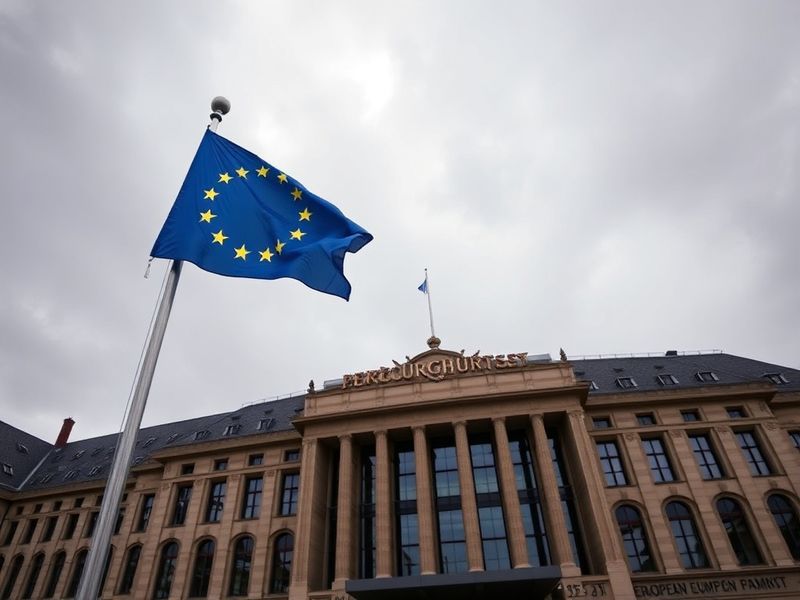
The European Union stands as one of the most ambitious political and economic experiments of the modern era. Born from the ashes of two world wars, it has grown from six founding nations to 27 member states spanning the continent. While often criticized for its bureaucracy, the EU has quietly reshaped global trade, diplomacy, and even cultural identity. Its influence extends far beyond Europe’s borders, making it a defining institution of the 21st century.
At its core, the EU is a customs union and a single market, allowing goods, services, capital, and people to move freely across member states. This principle of free movement has fostered unprecedented economic integration. Over 450 million people benefit from shared standards in food safety, environmental regulations, and digital services. The euro, adopted by 20 of these nations, has become the world’s second-most used currency, rivaling the U.S. dollar in global reserves. These achievements are not merely technical—they reflect a deliberate choice to prioritize collective stability over narrow nationalism.
The Origins: From Coal and Steel to Shared Sovereignty
The EU’s foundations were laid not in grand declarations, but in practical necessity. In 1951, six countries—Belgium, France, West Germany, Italy, Luxembourg, and the Netherlands—created the European Coal and Steel Community. This modest agreement pooled control of two critical industries, removing the temptation to use them as weapons of war. It was a radical idea: pooling sovereignty to prevent conflict. By 1957, the Treaty of Rome established the European Economic Community, expanding cooperation into trade, agriculture, and infrastructure.
This model of shared authority was revolutionary. Unlike traditional alliances or trade blocs, the EU didn’t just coordinate policies—it created institutions with real power. The European Commission proposes laws, the European Parliament represents citizens, and the European Council brings together heads of state. This system of “supranational governance” has allowed Europe to act with a unified voice on global issues, from climate change to human rights. It’s a structure that challenges the notion that cooperation must always come at the expense of sovereignty.
Economic Integration and Global Influence
The EU’s single market is the largest in the world by GDP, generating over €18 trillion annually. It is the top trading partner for 80 countries, from the United States to Japan. The elimination of tariffs and harmonization of regulations have made Europe a magnet for foreign investment. Multinational corporations often locate their European headquarters in cities like Berlin, Paris, or Amsterdam, not just for access to consumers, but for the predictability of EU-wide rules.
Yet integration has come with challenges. The eurozone crisis of 2010 revealed deep fault lines between northern creditor nations and southern debtor states. Countries like Greece and Italy faced brutal austerity measures, sparking protests and political backlash. These tensions persist today, with debates over debt mutualization and fiscal solidarity still unresolved. Meanwhile, the rise of populist parties across Europe has framed the EU as an elite project disconnected from ordinary citizens. These critiques, though powerful, often overlook the tangible benefits many Europeans enjoy—from subsidized education to cross-border healthcare.
The EU’s trade policy also reflects its global ambitions. It has negotiated over 70 free trade agreements, including groundbreaking deals with Canada and Japan. These agreements don’t just lower tariffs—they embed environmental, labor, and digital standards into international commerce. In an era of rising protectionism, the EU stands as a defender of multilateralism. Its approach contrasts sharply with the U.S.-China trade war, offering an alternative model of engagement based on rules, not coercion.
A Cultural Paradox: Unity in Diversity
Europe’s cultural landscape is defined by its diversity—24 official languages, multiple religions, and centuries of competing histories. The EU has sought to preserve this richness while fostering a shared identity. Programs like Erasmus+ have funded over 10 million student exchanges, creating a generation that sees itself as both French and European. Cultural initiatives, from the European Capital of Culture to funding for independent filmmakers, aim to build a common narrative without erasing local traditions.
Yet this project is fraught with tension. Nationalist movements in Poland, Hungary, and beyond reject what they call “cultural homogenization.” They argue that Brussels seeks to impose liberal values on conservative societies. The EU’s response—tying funding to rule-of-law conditions—has deepened the divide. The bloc now faces a paradox: to survive, it must protect its democratic values, even when doing so alienates its members. This struggle is not just political—it’s existential.
Challenges on the Horizon: Migration, Climate, and Identity
The EU’s future hinges on its ability to address three existential challenges. First is migration. The 2015 refugee crisis exposed the limits of solidarity. Countries on the Mediterranean’s frontlines, like Italy and Greece, were overwhelmed, while others refused to accept relocated asylum seekers. The result was a patchwork of national policies that undermined the Schengen Zone’s open borders. The EU has since tightened external borders and outsourced migration control to countries like Turkey and Libya, drawing criticism for human rights violations.
Second is climate change. The EU has positioned itself as a global leader in green transition, pledging to cut emissions by 55% by 2030. The Green Deal, a €1 trillion investment plan, aims to make Europe the first climate-neutral continent. But this agenda faces resistance from industries dependent on fossil fuels and from voters skeptical of higher energy costs. The challenge is not just technological—it’s about reconciling ambition with political feasibility.
Finally, there’s the question of identity. As the UK’s 2020 Brexit demonstrated, the EU’s greatest strength—its ability to bind nations together—can also be its greatest vulnerability. The UK’s departure left a €10 billion annual hole in the budget and dealt a symbolic blow to the idea of an “ever-closer union.” Yet the remaining members have shown resilience. Countries like Ukraine and Moldova, though not yet members, have sought closer ties, seeing the EU as a shield against Russian aggression.
What the EU Teaches the World
The European Union offers a counter-narrative to the retreat into nationalism seen in the U.S., UK, and elsewhere. It proves that cooperation can outlast conflict, that shared rules can coexist with local identity, and that prosperity can be built without exploitation. Its flaws—bureaucracy, democratic deficits, and internal divisions—are well-documented. But so are its successes: peace in a continent once torn by war, a currency that rivals the dollar, and a continent that punches above its weight in global affairs.
The EU’s model is not perfect, nor is it universally applicable. But it remains a vital experiment in how diverse societies can govern themselves without descending into chaos. As the world grapples with climate change, pandemics, and geopolitical rivalry, the EU’s lessons are more relevant than ever. Whether it can adapt to new threats while preserving its core ideals will determine not just its future, but the shape of global order in the decades to come.
In an age where isolationism is on the rise, the European Union stands as a reminder that progress is possible—when nations choose cooperation over confrontation, and when institutions are built not to dominate, but to serve.
Explore more on global cooperation: Learn about Political Alliances shaping today’s world or dive into Economic Integration trends reshaping trade.