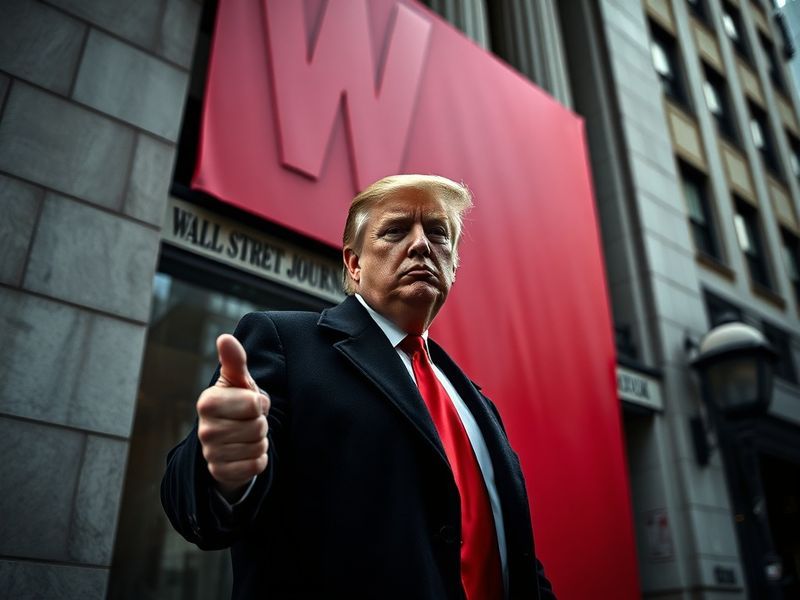
The legal battle between former President Donald Trump and the Wall Street Journal escalated this month as Trump filed a lawsuit against the publication and its parent company, Dow Jones & Company. The lawsuit centers on an opinion column published in March 2023 that Trump alleges contains defamatory statements about his business dealings and financial practices.
The opinion piece, written by former Journal editor James Freeman, criticized Trump’s real estate ventures and questioned the legitimacy of his financial disclosures. The column titled “Trump’s Dubious Financial Disclosures” argued that Trump’s business records showed a pattern of misrepresentation that warranted closer scrutiny. Trump’s legal team has since filed a complaint in New York State Supreme Court, seeking unspecified damages for reputational harm.
Legal Grounds for the Lawsuit
The lawsuit hinges on allegations of defamation, claiming the opinion column contained false and damaging statements that were published with reckless disregard for the truth. According to the complaint, the column relied on flawed financial data and selectively presented information to paint an inaccurate portrait of Trump’s business history.
Under New York defamation law, public figures like Trump face a higher burden of proof. They must demonstrate that the statements were made with actual malice—knowing they were false or acting with reckless disregard for the truth. Trump’s legal team argues that the Journal failed to verify key claims in the column, particularly regarding the valuation of Trump’s properties and the accuracy of his financial disclosures.
The lawsuit also includes claims of intentional infliction of emotional distress, citing the stress and reputational damage caused by the publication. Trump’s attorneys have requested a jury trial, seeking compensatory and punitive damages, though the exact amount has not been specified in public filings.
Response from the Wall Street Journal
The Wall Street Journal has publicly defended its opinion column, stating that the piece was a legitimate exercise of editorial judgment and protected under the First Amendment. A spokesperson for Dow Jones & Company emphasized that opinion journalism is an essential part of the publication’s mission and that the column was based on publicly available financial records.
The newspaper’s legal team has not yet filed a formal response to the lawsuit, but industry analysts expect it to argue that the opinion column falls under the protections of free speech. The Journal has a history of publishing critical commentary on political figures, including Trump during his presidency and afterward, often framing such pieces as part of its commitment to rigorous debate.
Legal experts note that defamation cases involving opinion columns are particularly challenging to win, as courts have consistently ruled that hyperbolic or exaggerated statements in opinion pieces are generally protected. However, Trump’s legal strategy may focus on the argument that the column crossed the line from opinion into factual misrepresentation.
Broader Implications for Media and Free Speech
The lawsuit has drawn attention from media watchdogs, legal scholars, and First Amendment advocates, who see it as part of a broader trend of public figures using litigation to challenge critical reporting. While Trump has filed numerous lawsuits against media outlets over the years, this case is notable for targeting an opinion column rather than straight news reporting.
Critics argue that such lawsuits could have a chilling effect on editorial independence, discouraging publications from publishing tough commentary on powerful individuals. The Wall Street Journal has long positioned itself as a bastion of conservative-leaning opinion journalism, and a ruling against it could set a precedent for future legal challenges against editorial content.
Legal analysts point out that the case may hinge on whether the statements in question are deemed to be factual assertions rather than protected opinion. Courts have historically drawn a distinction between statements of fact and statements of opinion, with the latter receiving stronger legal protections.
If the lawsuit proceeds, it could take years to resolve, with appeals likely regardless of the initial ruling. The outcome may also influence how media organizations approach opinion journalism, particularly when covering high-profile figures with a history of litigious behavior.
Trump’s Broader Legal Strategy
This lawsuit is part of a wider pattern of legal challenges initiated by Trump against media organizations, political opponents, and business associates. Since leaving office, Trump has filed or threatened legal action in multiple high-profile cases, including lawsuits against CNN, The New York Times, and his niece Mary Trump.
Legal experts suggest that these lawsuits serve multiple purposes for Trump: to retaliate against perceived slights, to rally his political base by portraying himself as a victim of media bias, and potentially to deter future critical reporting. However, the success rate of these lawsuits has been mixed, with many being dismissed or settled on unfavorable terms for Trump.
In the case of the Wall Street Journal, the lawsuit may also be a strategic move to pressure the publication into adopting a more favorable editorial stance. Trump has a long-standing relationship with the Journal, having frequently contributed opinion pieces to the paper during and after his presidency. Some analysts speculate that the lawsuit could be an attempt to influence the publication’s future coverage.
Regardless of the outcome, the case underscores the ongoing tension between public figures and the media, particularly in an era where litigation is increasingly used as a tool to challenge critical journalism.
Conclusion: A Test Case for Media and Free Speech
The lawsuit filed by Donald Trump against the Wall Street Journal is more than just a legal dispute—it is a test case for the boundaries of free speech, editorial independence, and the accountability of media organizations. As the case proceeds, it will likely attract significant attention from legal scholars, journalists, and the public alike.
For the Wall Street Journal, the lawsuit represents a challenge to its long-standing commitment to opinion journalism and its willingness to publish critical commentary on powerful individuals. For Trump, it is another chapter in his broader legal and political strategy, one that could further shape the landscape of media accountability in the years to come.
Regardless of the outcome, the case serves as a reminder of the delicate balance between free expression and the protection of reputations in an increasingly litigious media environment.
For those interested in the intersection of media and politics, this lawsuit offers a compelling case study in how legal challenges can shape the boundaries of public discourse. To explore more on this topic, visit our News and Analysis sections for further insights.