The relationship between former U.S. President Donald Trump and Pope Francis has been one of the most unusual and publicly contentious dynamics in modern diplomacy. Over the past decade, their interactions have oscillated between polite formalities and sharp public disagreements, reflecting broader tensions between conservative American politics and progressive Catholic social teaching.
Their exchanges often unfolded in real time, with both figures using their global platforms to critique the other’s policies and rhetoric. While Trump framed his presidency as a defender of Christian values, Francis frequently condemned policies that he argued ran counter to Catholic teachings on immigration, poverty, and environmental stewardship.
The 2016 Campaign: Trump’s Call for “Strong Christian Leadership”
During the 2016 presidential campaign, Trump positioned himself as a champion of religious conservatives, particularly evangelical Christians. In a high-profile meeting with hundreds of evangelical leaders in New York, he declared, “We’re going to protect Christianity in this country.” His rhetoric resonated strongly with a base that felt under cultural siege.
Pope Francis, meanwhile, remained publicly neutral during the election but had already signaled his discomfort with Trump’s rhetoric. In February 2016, during an airborne press conference, Francis was asked about Trump’s proposal to build a wall along the U.S.-Mexico border. The Pope responded, “A person who thinks only about building walls… and not building bridges, is not Christian.” Trump fired back, calling Francis’s comment “disgraceful” and suggesting the Pope was being manipulated by Mexican political interests.
This exchange marked the beginning of a pattern: Trump’s policies drew direct criticism from the Vatican, and the Pope’s statements were met with sharp rebuttals from the then-candidate and later president.
Policy Clashes: Immigration, Climate, and Social Values
Once Trump took office, the tensions escalated from rhetorical sparring to substantive policy disputes. The most visible conflict centered on immigration. Trump’s “zero tolerance” policy in 2018, which led to the separation of families at the U.S.-Mexico border, drew a rare papal rebuke. Francis had long advocated for humane treatment of migrants, calling the Mediterranean “the largest cemetery in Europe” due to migrant drownings. In a 2018 address, he explicitly condemned family separations, saying, “Every migrant is a human person who, as such, possesses fundamental, inalienable rights that must be respected by all and in every circumstance.”
The Vatican also criticized Trump’s decision to withdraw the U.S. from the Paris Climate Agreement in 2017. Francis had devoted an entire encyclical, Laudato Si’, to environmental ethics, arguing that climate change disproportionately harms the poor. Trump, by contrast, framed the agreement as an economic burden. The Pope’s environmental advocacy put him directly at odds with the Trump administration’s deregulatory agenda.
On social issues, the divide was equally stark. Francis emphasized mercy, inclusion, and dialogue with marginalized communities, while Trump championed policies aligned with conservative Christian advocacy groups, such as restrictions on abortion access and the appointment of conservative judges. The Pope’s calls for economic justice and support for refugees stood in contrast to Trump’s “America First” nationalism.
Key Areas of Disagreement
- Immigration: Trump’s border policies vs. Francis’s call for open borders and humane treatment of migrants.
- Climate Change: Trump’s withdrawal from the Paris Accord vs. Francis’s encyclical on environmental stewardship.
- Social Justice: Francis’s focus on poverty and inequality vs. Trump’s emphasis on deregulation and conservative judicial appointments.
- Religious Freedom: Trump’s support for Christian conservatives vs. Francis’s inclusive vision of faith.
These disagreements were not merely ideological—they reflected a fundamental tension between nationalism and global Catholicism, between exclusionary rhetoric and a Church that sees itself as universal.
Personal Dynamics: From Formal to Fractured
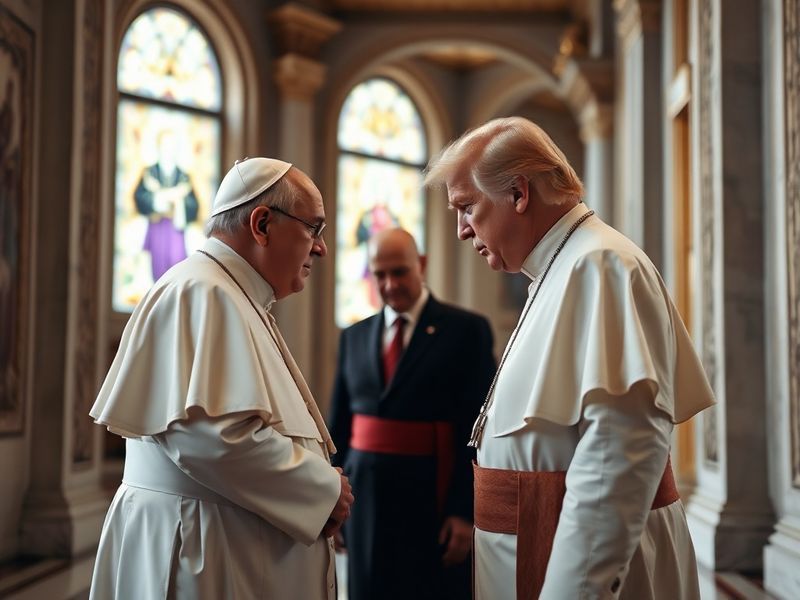
Despite their differences, Trump and Francis maintained a veneer of mutual respect early in the presidency. In 2017, they met at the Vatican, where Trump presented Francis with a copy of his book, The Art of the Deal. Francis gave Trump a medallion symbolizing peace and a plea for dialogue. Photographs showed both men smiling, but their body language suggested distance.
Over time, the warmth faded. In 2019, Francis told reporters aboard the papal plane that Trump was “not Christian” because of his immigration policies. “A person who has this mind-set… I don’t know if he’s aware of it, but it’s not the right path,” the Pope said. Trump responded by calling Francis “very political” and suggesting he was being used by the left.
While world leaders often avoid personal attacks, both Trump and Francis seemed willing to cross that line. Their feud became part of their public personas—Trump as the defiant outsider and Francis as the moral voice of the global Church.
Legacy and the Future of U.S.-Vatican Relations
The Trump era tested the relationship between the United States and the Holy See, a diplomatic relationship that dates back to 1984. Under Trump, the U.S. scaled back participation in multilateral institutions and adopted a transactional approach to international relations. The Vatican, by contrast, has long supported multilateral diplomacy, especially on issues like nuclear disarmament and climate change.
With Joe Biden’s presidency, the tone shifted. Biden, a practicing Catholic, has aligned more closely with Francis on issues like climate change, immigration reform, and healthcare. In 2021, Biden met with Francis at the Vatican, and the two discussed shared concerns about poverty and environmental justice.
Yet the Trump-Francis feud left a lasting mark. It highlighted a growing divide within Christianity itself—between conservative nationalists who see faith as a cultural identity and progressive Catholics who see it as a call to global solidarity.
For historians and political observers, their relationship offers a case study in how personality, policy, and public theology can collide on the world stage. It also raises questions about the role of religion in modern governance: Can a leader be both a devout Christian and a nationalist who prioritizes borders over mercy? Can a Church leader advocate for the poor while remaining neutral in political conflicts?
One thing is clear: the Trump-Pope dynamic was more than a clash of personalities. It was a collision between two competing visions of faith, nation, and global responsibility.
As the U.S. continues to debate immigration, climate policy, and social justice, the shadow of this feud lingers. It reminds us that in a pluralistic world, moral leadership is not just about power—it’s about principle.
To explore more on the intersection of religion and politics, visit our Politics section. For deeper analysis on global leadership, see our Analysis category.