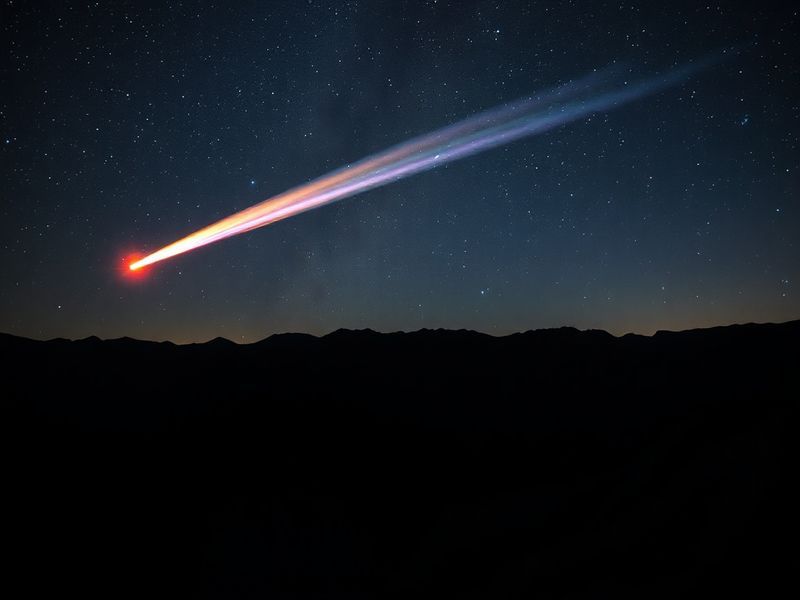
What Is a Meteor Fireball? Science, History & Where to See Them
“`html
The Sky’s Unexpected Fireworks: Understanding Meteor Fireballs
Few celestial events capture human imagination quite like a meteor fireball streaking across the night sky. These brilliant, often unexpected visitors from space have inspired myths, scientific inquiry, and fleeting moments of collective awe for millennia. Unlike distant stars or predictable meteor showers, fireballs arrive unannounced, transforming an ordinary evening into something extraordinary.
While most burn up harmlessly in the atmosphere, some fragments survive the journey, reaching the ground as meteorites. These cosmic travelers carry secrets about the early solar system, offering clues to our planet’s formation. Their sudden appearance reminds us of the dynamic and sometimes unpredictable nature of the universe we inhabit.
The Science Behind the Spectacle
A meteor fireball occurs when a meteoroid—a small rocky or metallic body from space—enters Earth’s atmosphere at high velocity. Friction with the air heats the object to thousands of degrees, causing it to glow brightly. This luminous trail, often brighter than the planet Venus, is what we perceive as a fireball. Most meteoroids are no larger than a grain of sand, but those big enough to create visible fireballs can range from a few centimeters to several meters across.
The energy released during this process is immense. A fireball’s brightness depends on its size, speed, and composition. Iron-rich meteoroids, for example, tend to produce more vivid displays than stony ones. Occasionally, a fireball will fragment mid-flight, creating a spectacular series of explosions known as a bolide. These events are rare but unforgettable for those lucky enough to witness them.
Scientists categorize fireballs based on their brightness and behavior. The International Meteor Organization (IMO) tracks these events globally, using reports from amateur astronomers and automated cameras. Their data helps researchers determine the trajectory and potential landing sites of meteorites. Some fireballs even produce sonic booms, a reminder of the energy involved in these cosmic collisions.
Where Do These Cosmic Visitors Come From?
Most meteoroids originate from the asteroid belt between Mars and Jupiter, where gravitational interactions can nudge them toward Earth. Others may be debris from comets, traveling in elongated orbits that bring them close to our planet. The Perseid and Geminid meteor showers, for instance, are annual events caused by Earth passing through the trails of Comet Swift-Tuttle and asteroid 3200 Phaethon, respectively.
Fireballs, however, are usually solitary travelers, unrelated to these predictable showers. Their unpredictable nature makes them particularly fascinating. In 2013, a fireball over Chelyabinsk, Russia, injured over 1,500 people and damaged buildings when its shockwave shattered windows. The event highlighted the importance of tracking larger near-Earth objects, as even small asteroids can pose significant risks.
Not all fireballs are dangerous. Many burn up entirely, leaving behind only a brief, glowing trail. Others, like the 2018 Michigan meteor, produce meteorites that land harmlessly in rural areas. These events serve as gentle reminders of the solar system’s dynamism, offering both beauty and scientific value.
A Global Phenomenon with Cultural Echoes
Throughout history, fireballs have been interpreted through the lens of culture and superstition. Ancient civilizations often saw them as omens—signs from gods, portents of disaster, or messages from ancestors. In Chinese folklore, a fireball was sometimes called a “sky rat,” a creature gnawing at the fabric of the heavens. Norse mythology described them as the flaming wheels of the sun goddess, Sól, pursued by the wolf Sköll.
In medieval Europe, fireballs were often linked to divine judgment or impending doom. The 1456 fireball over Serbia was recorded in chronicles as a “fiery dragon,” while the 1664 sighting over England was interpreted as a warning of the Great Plague. These interpretations reflect a time when the night sky was both a map and a mirror for human anxieties.
Even today, fireball sightings spark curiosity and creativity. Social media amplifies these moments, turning fleeting streaks of light into viral phenomena. Videos of fireballs over cities like Los Angeles or Dubai often flood platforms like Twitter and TikTok within hours. Artists and musicians draw inspiration from these events, incorporating their imagery into music videos, paintings, and literature.
The fireball over Norway in 2006, which left a lingering smoke trail visible for hours, became a symbol of the country’s connection to nature and the cosmos. Similarly, the 2020 fireball over Japan was captured by thousands of dashcams, becoming a shared experience that transcended borders.
Chasing the Next Streak of Light
For scientists and enthusiasts alike, fireballs are more than just fleeting spectacles—they are opportunities. The NASA Fireball Network and similar projects worldwide use a network of cameras to triangulate the paths of these objects. By calculating their trajectories, researchers can predict where meteorites might land, allowing for rapid recovery and study.
Citizen science plays a crucial role in this effort. Programs like the SETI Institute’s Fireballs project encourage amateur astronomers to report sightings, contributing data that would otherwise be lost. These efforts have led to the recovery of meteorites from events like the 2018 Hamburg, Michigan, fall, which provided valuable samples for analysis.
For those eager to witness a fireball firsthand, patience is key. While meteor showers like the Leonids or Quadrantids offer predictable displays, fireballs remain unpredictable. The best strategy is to find a dark sky away from city lights, especially during peak meteor shower seasons. Apps like SkyView or Star Walk can help locate constellations, increasing the chances of spotting these cosmic visitors.
Photographers and videographers often set up time-lapse cameras to capture fireballs. These images not only document the event but also contribute to scientific databases. The rise of smartphone technology has democratized this process, allowing anyone to become a potential witness and contributor to meteor science.
Why These Moments Matter
Fireballs remind us of our place in the universe—a tiny speck on a pale blue dot, yet connected to the cosmos through the same materials that formed planets and stars. They challenge our perception of the night sky as static, revealing it as a dynamic, ever-changing canvas. In an age dominated by digital screens and artificial light, these natural phenomena offer a rare connection to the grandeur of the natural world.
They also serve as a call to action. The Chelyabinsk event demonstrated the very real risks posed by near-Earth objects. While the likelihood of a catastrophic impact is low, the potential consequences are severe. Projects like NASA’s Planetary Defense Coordination Office work to identify and track these objects, developing strategies to deflect them if necessary. Fireballs, in this context, are not just beautiful anomalies—they are test cases for our preparedness.
Beyond their scientific and cultural significance, fireballs embody the spirit of exploration. They inspire future generations of astronomers, engineers, and dreamers. Each streaking light across the sky is a reminder that the universe is still full of mysteries, waiting to be uncovered one bright trail at a time.
So the next time you find yourself under a clear night sky, take a moment to look up. You might just witness the universe putting on a show.