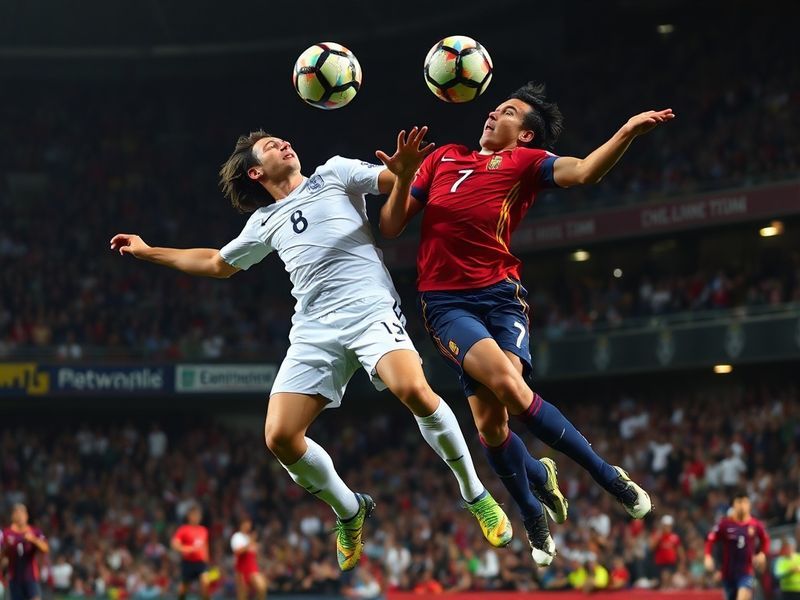
England vs Spain: Football Rivalry Beyond the Pitch
“`html
England vs Spain: A Rivalry Defined by History and Tactical Nuance
The clash between England and Spain transcends mere football. It represents a collision of cultures, tactics, and historical narratives that have unfolded over centuries. While their footballing rivalry has intensified in recent decades, the roots of their competition stretch beyond the pitch, weaving through geopolitics, colonial history, and sporting evolution. This article examines the multifaceted dimensions of this rivalry, from its historical underpinnings to its modern-day manifestations.
The Historical Roots of a Complex Rivalry
England and Spain’s sporting rivalry cannot be separated from their broader historical relationship. For centuries, the two nations were bound by conflict, alliance, and competition. The Anglo-Spanish War (1585–1604) and the legacy of the Spanish Armada left indelible marks on both societies. Even the English Civil War saw Spanish support for the Royalists, further entrenching a narrative of rivalry that extended into cultural and sporting arenas.
In football, this history translated into a rivalry that was often framed as one of style versus pragmatism. Spain’s tiki-taka, characterized by quick passing and positional play, stood in contrast to England’s more direct, physical approach. These tactical philosophies mirrored broader cultural stereotypes: Spain as elegant and methodical, England as resilient and combative. Yet, these simplifications often overlooked the nuance within each team’s evolution.
Footballing Evolution: From Humiliation to Redemption
Spain’s dominance in the early 21st century reshaped the narrative of the rivalry. The 2008 European Championship marked a turning point, as Spain’s possession-based football dismantled opponents with surgical precision. Their 4-0 victory over Italy in the 2012 final was a masterclass in control, a performance that left England’s traditional footballing identity looking outdated in comparison.
Yet, England’s resurgence in recent years has complicated this dynamic. The Three Lions’ performance at Euro 2020, where they reached the final, demonstrated a blend of tactical sophistication and raw athleticism. Players like Harry Kane and Phil Foden embodied a new era of English football, one that embraced technical refinement while retaining the team’s trademark fighting spirit. This evolution has forced Spain to adapt, shifting from their dogmatic possession style to a more flexible, counter-attacking approach.
The Tactical Chess Match: What the Numbers Reveal
Analyzing the tactical battle between England and Spain reveals a fascinating interplay of systems and adaptability. Spain’s golden generation under managers like Vicente del Bosque and Luis Enrique prioritized ball retention and positional play. Their 2010 World Cup triumph, built on a foundation of possession, was a testament to this philosophy. However, their struggles in tournaments like Euro 2016 and the 2018 World Cup exposed vulnerabilities against high-pressing teams.
England, on the other hand, has undergone a tactical renaissance. Under Gareth Southgate, the team has transitioned from a rigid 4-3-3 to a more fluid 3-5-2 formation, allowing wing-backs like Luke Shaw and Kyle Walker to dominate the flanks. This system has been particularly effective against possession-heavy teams like Spain, as seen in their 2018 World Cup semi-final defeat to Croatia—a match where England’s tactical flexibility was on full display.
The head-to-head record in recent years underscores this tactical shift. Since 2010, Spain has held a slight edge in competitive matches, but England’s progress has been undeniable. At Euro 2020, the two teams met in the semi-finals, where Spain’s dominance in possession was met with England’s clinical counter-attacking. The match ended 2-1 to Spain, but it was a closely contested affair that highlighted England’s growing tactical maturity.
Key Tactical Differences
- Possession vs. Direct Play: Spain’s reliance on possession often leaves them vulnerable to quick transitions, a weakness England has exploited in recent matches.
- Pressing Intensity: England’s aggressive pressing, led by players like Declan Rice and Jordan Henderson, contrasts with Spain’s more patient, positional approach.
- Defensive Solidity: Spain’s high defensive line, while effective in possession, can be exposed by England’s long-ball strategy and physicality.
- Set-Piece Threat: Both teams excel in set-pieces, but England’s aerial dominance (with players like Harry Maguire and John Stones) gives them an edge in dead-ball situations.
The Cultural and Psychological Dimensions
The England-Spain rivalry is as much about psychology as it is about tactics. For England, facing Spain has often been a psychological hurdle—a team they admire but struggle to overcome. The 2010 World Cup round-of-16 match, where Spain defeated England 1-0 thanks to a questionable Frank Lampard goal that wasn’t given, remains a sore point for English fans. The injustice of that decision fueled England’s determination to prove themselves against Spain in subsequent tournaments.
For Spain, the rivalry carries a different weight. Their footballing identity is deeply tied to their success against England, a team that represents the antithesis of their own style. Spain’s ability to impose their game on England has become a measure of their tactical superiority. When they fail to do so, as in Euro 2020, it raises questions about their adaptability and the future of their footballing philosophy.
The psychological aspect is further complicated by the media narrative. English media often frames matches against Spain as a test of England’s progress, while Spanish outlets view them as a chance to reaffirm their dominance. This media frenzy adds another layer to the rivalry, turning each encounter into a high-stakes spectacle.
Looking Ahead: The Next Chapter of the Rivalry
The future of the England-Spain rivalry promises to be as compelling as its past. With both teams boasting young, talented squads, the next decade could redefine their competitive balance. Spain’s rebuild under managers like Luis de la Fuente and Julen Lopetegui focuses on blending their traditional possession style with more direct, vertical football. Meanwhile, England’s golden generation, led by Gareth Southgate, continues to evolve, with a new crop of players like Jude Bellingham and Bukayo Saka poised to take the mantle.
Tactically, the rivalry could see further convergence. Spain’s adoption of a more direct approach and England’s refinement of their possession game suggest that the lines between their styles are blurring. This tactical hybridization could lead to even more intriguing encounters, where the battle is less about philosophy and more about execution.
The next major tournament will be a crucial barometer of their progress. Whether it’s the 2024 European Championship or the 2026 World Cup, the stakes will be higher than ever. For England, a victory against Spain would be a statement of their arrival as a footballing powerhouse. For Spain, defeat would signal a need for further introspection about their footballing identity.
Beyond the pitch, the rivalry will continue to be shaped by broader cultural and political developments. As both nations navigate the challenges of the modern era—from Brexit to Spain’s political complexities—their sporting encounters will remain a microcosm of their evolving relationship.
What’s at Stake in the Next Decade
- Tactical Innovation: Will Spain reclaim their possession-based dominance, or will England’s hybrid style become the new blueprint?
- Player Development: Both nations are producing world-class talent. The emergence of players like Gavi (Spain) and Cole Palmer (England) could define the next era.
- Managerial Impact: The choices of future managers—whether to double down on tradition or embrace radical change—will shape the rivalry’s trajectory.
- Global Standing: With the expansion of major tournaments, the winner of this rivalry could gain a significant advantage in seeding and prestige.
One thing is certain: the England-Spain rivalry is far from over. If anything, it is entering a new phase, one defined by mutual respect, tactical evolution, and the relentless pursuit of excellence. For fans of both nations, these encounters will continue to deliver drama, heartbreak, and moments of brilliance.
As football continues to evolve, so too will this rivalry. Whether it’s a World Cup final or a group-stage clash in a future tournament, the battles between England and Spain will remain must-watch events, offering a blend of history, drama, and tactical intrigue that few other fixtures can match.