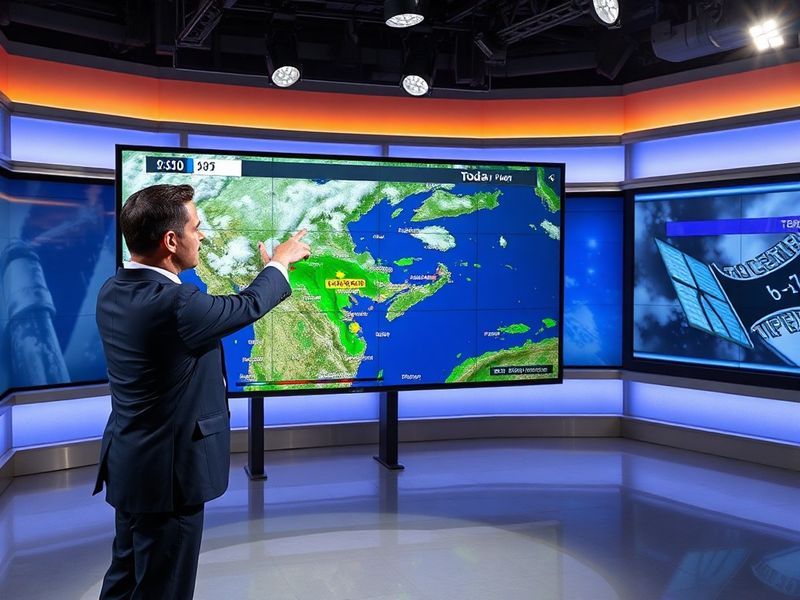
How Today’s Weather Forecast Impacts Different Regions Worldwide
“`html
What Today’s Weather Forecast Means Across the Globe
The daily weather forecast remains one of the most universally consulted pieces of information. Whether planning a commute, scheduling outdoor events, or simply deciding what to wear, millions rely on these predictions. Yet the accuracy and cultural significance of weather forecasting vary dramatically around the world. From monsoon warnings in South Asia to heat advisories in North America, today’s forecast carries different meanings depending on geography, infrastructure, and tradition.
Meteorology has evolved far beyond basic observation. Modern forecasting blends satellite data, supercomputing models, and AI-driven analytics. Yet even with these advancements, local knowledge often proves just as vital—especially in regions where weather extremes shape daily life. Understanding today’s forecast requires more than just checking a temperature reading; it demands a grasp of how weather intersects with culture, economy, and survival.
How Weather Forecasts Are Made Today
Behind every weather app notification lies a complex network of observation systems. Ground stations, weather balloons, radar arrays, and geostationary satellites feed data into global models maintained by organizations like the National Oceanic and Atmospheric Administration (NOAA) and the European Centre for Medium-Range Weather Forecasts (ECMWF). These models simulate atmospheric behavior using equations that account for temperature, pressure, humidity, and wind patterns.
Artificial intelligence now plays a growing role in refining forecasts. Machine learning algorithms analyze historical weather patterns to improve short-term predictions, particularly for severe storms. For example, NOAA’s “Rapid Refresh” system updates every hour, providing hyper-local forecasts crucial for aviation and emergency response. Yet even the most advanced models struggle with microclimates—small-scale variations influenced by terrain, urban heat islands, or coastal breezes.
In developing nations, access to real-time data remains limited. Many rely on traditional knowledge passed down through generations. Inuit communities in the Arctic use sea ice patterns to predict storms, while farmers in the Sahel track cloud formations to anticipate droughts. The fusion of indigenous wisdom with modern science is reshaping how weather is understood globally.
Extreme Weather: A Global Divide
Today’s weather forecast carries urgent warnings in some regions while offering reassurance in others. The contrast reveals stark inequalities in climate resilience. In South Asia, monsoon season brings both life-giving rains and devastating floods. In Bangladesh, where 80% of the population is exposed to flooding, the government issues daily bulletins translated into regional dialects. These warnings save lives but require trust in the system—a trust not always present.
Meanwhile, in Northern Europe, summer heatwaves have become increasingly common. Helsinki recently recorded temperatures above 34°C (93°F), a rarity in a city accustomed to mild summers. Health officials now issue advisories encouraging residents to check on elderly neighbors, reflecting how climate change is rewriting traditional expectations. In contrast, parts of the United States face brutal cold snaps despite overall warming trends. Texas’s 2021 winter storm exposed vulnerabilities in energy infrastructure, proving that even wealthy nations can be caught off guard.
The psychological impact of extreme weather is often overlooked. Studies show that repeated exposure to unpredictable conditions increases anxiety, particularly among young people. In Australia, where bushfires have become an annual crisis, mental health professionals report a rise in climate-related distress. This phenomenon has led to new terminology: “eco-anxiety” describes the chronic fear of environmental doom.
Cultural Responses to Weather
Weather is deeply embedded in cultural identity. In Japan, the cherry blossom forecast (sakura zensen) dictates the timing of festivals and travel plans. The annual announcement of bloom dates, tracked by the Japan Meteorological Agency, draws national attention. Similarly, in India, the monsoon’s arrival is celebrated as a symbol of renewal, with festivals like Teej marking its onset. These traditions highlight how weather forecasts transcend mere utility—they shape collective memory and national pride.
In contrast, some cultures view weather as a divine message. Inuit elders interpret unusual wind patterns as signs of impending danger, while Aboriginal Australians read the stars and clouds to predict rain. These practices, though not scientifically validated, offer a reminder that weather is more than data points on a map. It is a narrative woven into the fabric of human experience.
Weather and the Digital Divide
The way people access weather forecasts reveals global disparities. In the United States and Europe, smartphone apps provide minute-by-minute updates with radar animations. Yet in rural Africa or remote Pacific islands, forecasts may arrive via SMS or radio broadcasts in local languages. The digital divide means that life-saving information doesn’t always reach those who need it most.
Efforts to bridge this gap are ongoing. The World Meteorological Organization (WMO) supports initiatives like the Severe Weather Forecasting Demonstration Project, which trains meteorologists in developing nations. Low-cost weather stations, such as those developed by the University of Reading, now allow communities to collect and share data without expensive infrastructure. These grassroots networks are proving vital in regions where government resources are scarce.
Meanwhile, social media has transformed how weather alerts spread. During Hurricane Ian in 2022, Floridians relied on Twitter threads and Facebook groups to share real-time updates when official channels lagged. This shift underscores a paradox: while technology enables hyper-accurate forecasts, human networks often fill the gaps in communication.
The Future of Weather Forecasting
Looking ahead, forecasting faces both promise and peril. Climate change is intensifying weather variability, making long-term predictions increasingly difficult. Yet new tools offer hope. High-resolution satellite imagery, such as that provided by NASA’s GOES-16, now captures storms in unprecedented detail. Quantum computing may soon process atmospheric data at speeds currently unimaginable, allowing for forecasts weeks—or even months—ahead.
On the ground, community-based approaches are gaining traction. In Kenya, the Red Cross trains volunteers to use SMS-based reporting to track floods in real time. In the Philippines, a project called “Project NOAH” combines citizen science with government data to improve disaster preparedness. These models prioritize accessibility, ensuring that forecasts serve everyone, not just the tech-savvy.
Yet technology alone cannot solve the challenges ahead. Political will and international cooperation are essential. The WMO’s Early Warnings for All initiative aims to protect every person on Earth from hazardous weather by 2027. Achieving this goal will require investment in infrastructure, education, and trust—three pillars often overlooked in the race for innovation.
“Weather forecasts are no longer just about knowing tomorrow’s temperature. They are about survival, culture, and our shared future on a changing planet.” — Dr. Sarah Perkins-Kirkpatrick, Climate Scientist
Beyond the Forecast: What Comes Next
Today’s weather forecast is more than a daily ritual; it’s a window into broader societal shifts. As climate change accelerates, the line between weather and climate blurs. A single heatwave or storm is no longer an anomaly but a symptom of a larger transformation. This reality demands a rethinking of how we prepare, respond, and adapt.
For policymakers, it means investing in resilient infrastructure and equitable warning systems. For scientists, it means refining models to account for unprecedented events. For individuals, it means recognizing that weather is not just a backdrop to our lives but a force that shapes them. Whether you’re a farmer in Kenya, a commuter in Tokyo, or a student in New York, today’s forecast carries a message: the weather is changing, and so must we.
As we move forward, the most effective solutions will blend cutting-edge science with age-old wisdom. The future of weather forecasting lies not in technology alone, but in our ability to listen—to the data, to each other, and to the planet itself.