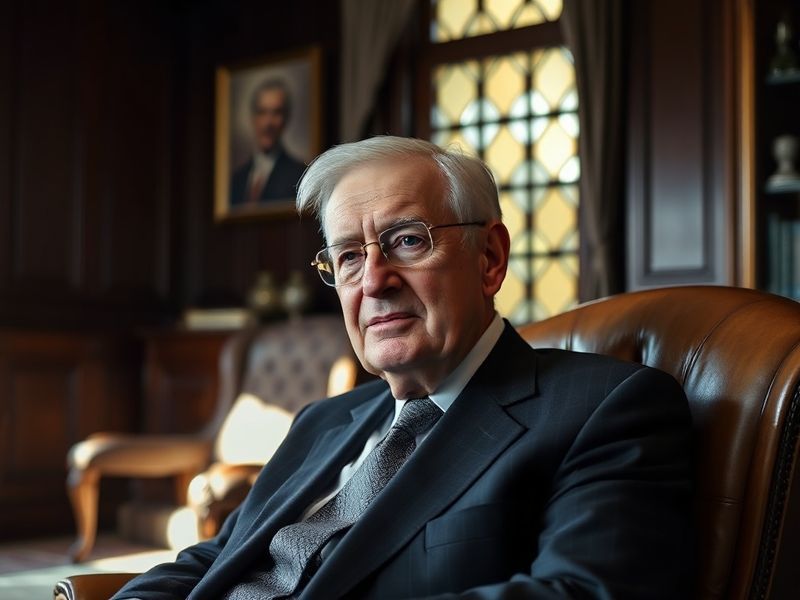
Lord George Robertson: A Life of Public Service and Global Influence
Lord George Robertson, Baron Robertson of Port Ellen, KT, GCMG, FRSA, FRSE, has spent decades at the intersection of British and international politics. His career spans military leadership, high-level diplomacy, and a pivotal role at NATO, where he shaped the alliance’s response to post-Cold War challenges. Beyond politics, Robertson’s influence extends into economic policy, corporate governance, and public discourse, making him a figure whose impact transcends national boundaries.
Born in Port Ellen on the Isle of Islay in 1946, Robertson’s early life was shaped by the rugged landscapes of Scotland and the values of public service instilled in his family. His father, a local councillor and trade unionist, played a key role in his political awakening. Robertson’s ascent from a small island community to the corridors of global power offers a compelling narrative about the role of persistence, adaptability, and strategic vision in shaping modern leadership.
From Local Politics to Westminster
Robertson’s political career began in earnest when he joined the Labour Party in the 1960s. His early involvement in local politics on the Isle of Islay provided a foundation for his future ambitions. By 1978, he had won a seat in the House of Commons, representing Hamilton, a constituency in South Lanarkshire. His rapid rise within Labour’s ranks reflected both his political acumen and his ability to connect with constituents across ideological divides.
During his time in Parliament, Robertson served in several junior ministerial roles, including as a Defence Minister under Prime Minister James Callaghan. These early experiences gave him firsthand insight into the complexities of national security and international relations—issues that would later define his career. His tenure in government coincided with a period of significant geopolitical upheaval, including the Soviet invasion of Afghanistan and the Iran-Iraq War, both of which tested Britain’s defence policies.
The 1980s and early 1990s were transformative for Robertson. As Labour’s shadow Defence Secretary, he played a critical role in reshaping the party’s stance on nuclear deterrence and military intervention. His pragmatic approach helped bridge divides between Labour’s left wing and more centrist factions, positioning him as a key figure in the party’s eventual return to power under Tony Blair in 1997.
The NATO Era: Steering the Alliance Through Turbulent Times
In 1999, Robertson achieved one of the most significant milestones of his career when he was appointed Secretary-General of NATO. His tenure began amid a rapidly shifting global landscape, marked by the aftermath of the Cold War, the expansion of the European Union, and the emergence of new security threats. Robertson’s leadership during this period was defined by his ability to balance the alliance’s traditional focus on collective defence with the need to adapt to modern challenges.
One of Robertson’s most notable achievements was overseeing NATO’s expansion into Eastern Europe. The alliance’s decision to admit former Warsaw Pact members such as Poland, Hungary, and the Czech Republic was a historic move that redefined Europe’s security architecture. Robertson argued forcefully for enlargement, framing it as essential to stabilising the continent and preventing the resurgence of regional conflicts. Critics, however, warned that such moves could provoke Russia, a concern that would later prove prescient.
Robertson’s tenure also coincided with NATO’s first major military intervention outside its traditional area of operations. In 1999, the alliance launched airstrikes against Serbia in response to the Kosovo War, a conflict that tested NATO’s unity and resolve. Robertson’s diplomatic skills were instrumental in maintaining cohesion among member states, many of whom were divided over the use of force. His ability to articulate a clear moral and strategic rationale for intervention helped solidify public support for the mission.
By the time he left NATO in 2003, Robertson had cemented his legacy as one of the alliance’s most effective leaders. His tenure was marked not only by institutional expansion but also by a clear-eyed assessment of NATO’s role in a post-9/11 world. He recognised early on that terrorism and asymmetric warfare would become defining challenges for the alliance, a foresight that influenced NATO’s subsequent strategies.
Post-NATO: Corporate Leadership and Public Intellectual
After departing NATO, Robertson transitioned into a new phase of his career, leveraging his global reputation in the private and non-profit sectors. He served as Chairman of the British arm of oil giant BP, a role that placed him at the centre of debates about energy security, climate change, and corporate responsibility. His tenure at BP was notable for his efforts to align the company’s operations with evolving environmental standards, a rare move for an industry often criticised for its lagging sustainability practices.
Robertson’s post-political career also included roles at prestigious think tanks and academic institutions. He became a senior advisor to the RAND Corporation, a global policy think tank, where he contributed to research on defence and international relations. His writings and public appearances have consistently reflected a deep commitment to multilateralism and the rule of law, themes that resonate in an era marked by rising nationalism and protectionism.
Beyond his professional roles, Robertson has remained a prominent voice in public discourse. He has been a vocal advocate for stronger transatlantic ties, often warning against the dangers of isolationism and the erosion of democratic norms. His speeches and op-eds frequently address the challenges posed by authoritarian regimes, the need for robust defence spending, and the importance of international cooperation in addressing global crises.
Legacy and Influence: A Global Perspective
Lord George Robertson’s career offers a case study in the evolving nature of global leadership. His ability to navigate the complexities of post-Cold War politics, adapt to new security paradigms, and transition seamlessly between public and private sectors underscores the importance of versatility in modern governance. Robertson’s legacy is not merely one of institutional leadership but also of intellectual rigour and moral clarity.
From his roots in a remote Scottish community to his role as a key architect of NATO’s modern identity, Robertson’s journey reflects broader trends in 20th and 21st-century politics. His emphasis on collective security, democratic values, and pragmatic diplomacy stands in contrast to the unilateralist tendencies that have gained traction in recent years. In an era where global institutions face unprecedented challenges, Robertson’s career serves as a reminder of the enduring relevance of multilateralism.
Robertson’s influence extends beyond his formal roles. His mentorship of younger politicians and diplomats, his contributions to academic research, and his public advocacy have shaped the next generation of leaders. His life story also highlights the importance of regional identity in shaping national and international policy, a theme that resonates in discussions about devolution, local governance, and the balance between global integration and local autonomy.
Key Takeaways from Lord George Robertson’s Career
Robertson’s career offers several lessons for those interested in public service and global leadership:
- Adaptability: Robertson’s ability to pivot from domestic politics to international diplomacy demonstrates the importance of flexibility in navigating changing political landscapes.
- Strategic Vision: His early recognition of the threats posed by terrorism and authoritarianism highlights the need for forward-thinking leadership in addressing emerging challenges.
- Diplomatic Skill: Robertson’s success in maintaining NATO’s unity during crises underscores the critical role of negotiation and consensus-building in multilateral organisations.
- Moral Clarity: His willingness to advocate for intervention in Kosovo, despite the risks, reflects a commitment to upholding human rights and democratic values.
- Legacy of Multilateralism: Robertson’s career serves as a testament to the enduring relevance of international cooperation in an era of rising nationalism.
As the world grapples with new geopolitical tensions, the rise of authoritarian regimes, and the existential threat of climate change, Robertson’s career offers a blueprint for navigating these challenges. His emphasis on collective action, institutional strength, and moral responsibility remains a guiding principle for policymakers and citizens alike.
Conclusion: The Enduring Relevance of Lord George Robertson
Lord George Robertson’s life and career are a testament to the power of principled leadership in an increasingly complex world. From his early days in Scottish politics to his transformative role at NATO and his continued advocacy for global cooperation, Robertson has consistently demonstrated the importance of vision, adaptability, and moral clarity. His legacy challenges us to consider how best to uphold democratic values and collective security in an era of uncertainty.
As new generations of leaders emerge, Robertson’s career serves as both an inspiration and a cautionary tale. His achievements highlight the potential for individual leaders to shape the course of history, while his challenges remind us of the persistent threats to global stability. In a world where the rules-based international order is under strain, Robertson’s career offers a compelling argument for the enduring necessity of multilateralism and cooperation.
For those interested in exploring the intersections of politics, diplomacy, and global governance, Lord George Robertson’s story is a vital case study. It reminds us that leadership is not merely about holding power but about using it wisely, ethically, and with a view toward the long-term well-being of the global community.