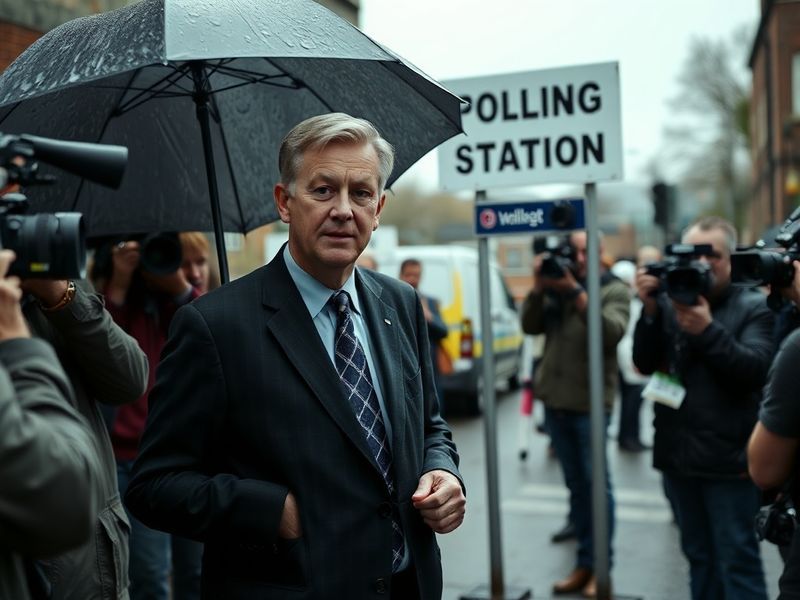
Nigel Farage’s return to the political spotlight during the May elections marked a significant moment for both the UK and broader European politics. The Reform UK leader, known for his Eurosceptic stance and populist rhetoric, sought to capitalize on growing discontent with traditional parties. His campaign focused on immigration, economic stagnation, and dissatisfaction with Westminster’s handling of key issues. While his party did not secure a majority, the results underscored the shifting sands of British politics and the enduring appeal of anti-establishment messaging.
Farage’s political journey has been one of persistence. After initially stepping back from frontline politics, his decision to re-enter the fray reflected a strategic calculation. The May elections, though local in scope, served as a referendum on the Conservative Party’s decade-long rule and Labour’s perceived complacency. Farage’s presence forced mainstream parties to address issues they had long avoided, particularly around immigration and national sovereignty. His ability to dominate headlines highlighted the fragmentation of the political landscape.
The Campaign Strategy: Farage’s Populist Appeal
Farage’s campaign relied on a blend of nostalgia and grievance. He framed the May elections as a chance to reject the status quo, positioning Reform UK as the only party willing to challenge the political elite. His rallies drew crowds eager for a platform that promised to prioritize British interests over globalist agendas. The strategy mirrored the playbook of far-right movements across Europe, where anti-immigration and anti-EU sentiments resonate with disaffected voters.
Key to Farage’s approach was his use of social media and direct messaging. Unlike traditional politicians, he bypassed mainstream outlets, instead leveraging platforms like X (formerly Twitter) and Telegram to amplify his message. This tactic not only amplified his reach but also allowed him to control the narrative, bypassing what he often described as a “corrupt media.” The strategy paid dividends in energizing his base, even if it alienated critics who accused him of spreading divisive rhetoric.
- Focus on immigration: Farage made controlling borders a central theme, arguing that the government had failed to address the issue.
- Economic frustration: He tapped into voter anger over stagnant wages, high taxes, and the cost-of-living crisis.
- Anti-establishment rhetoric: Farage positioned himself as an outsider, despite his decades in politics, framing himself as a voice for the “forgotten majority.”
Reform UK’s Performance: A Mixed Bag
The May elections produced mixed results for Reform UK. While the party failed to secure any council majorities, it outperformed expectations in several key areas. Farage’s candidates gained traction in areas with high levels of disillusionment, particularly in the North of England and coastal towns. The results suggested that Farage’s message resonated with voters frustrated by years of political stagnation. However, the party’s inability to translate this into significant gains highlighted the challenges of breaking through in a first-past-the-post system.
Analysts noted that Reform UK’s performance mirrored the rise of similar movements across Europe. In France, Marine Le Pen’s National Rally has capitalized on similar themes, while in Germany, the AfD continues to gain ground. Farage’s ability to tap into this zeitgeist demonstrated the growing appeal of populist, nationalist politics. Yet, the party’s limited success also underscored the difficulties of translating protest votes into tangible power.
The local election results revealed a fragmented political landscape. The Conservative Party, reeling from years of internal divisions and policy failures, suffered heavy losses. Labour, while making gains, struggled to inspire enthusiasm, reflecting a broader trend of voter apathy. Farage’s presence on the ballot forced both parties to confront uncomfortable truths about their declining support.
A Global Perspective: Farage and the Rise of the Far-Right
Farage’s resurgence is part of a broader trend sweeping across Europe and beyond. Populist leaders have capitalized on economic uncertainty, cultural anxieties, and a sense of alienation from traditional politics. In the Netherlands, Geert Wilders’ victory in recent elections signaled a shift toward anti-immigration policies. Similarly, in Italy, Giorgia Meloni’s government has embraced a nationalist agenda, challenging the EU’s consensus on migration and fiscal policy.
Farage’s alignment with these movements highlights the interconnected nature of modern political struggles. His long-standing opposition to the EU and advocacy for a hardline Brexit stance have made him a figurehead for Eurosceptics. However, his re-entry into politics also reflects the challenges of maintaining relevance in an era where populist movements constantly evolve. The question now is whether Farage can sustain this momentum or if his moment has already passed.
The cultural context of Farage’s campaign cannot be overlooked. In an era where trust in institutions is eroding, his message of defiance resonates with voters who feel ignored by elites. This dynamic is not unique to the UK; it is a global phenomenon, from the rise of Javier Milei in Argentina to the continued influence of Donald Trump in the United States. Farage’s ability to channel this frustration has cemented his place as a pivotal figure in contemporary politics.
What’s Next for Farage and Reform UK?
The road ahead for Farage and Reform UK is fraught with challenges. While the May elections provided a platform for his message, the path to national representation remains unclear. The next general election looms large, and Farage will need to prove that his party can compete beyond protest votes. His strategy of targeting traditional Conservative voters has already forced the party to harden its stance on immigration and economic policy.
However, the risks are significant. Farage’s confrontational style and history of controversial remarks have alienated many voters. His alignment with figures like Donald Trump and Hungary’s Viktor Orbán could further polarize his support base. Yet, the potential rewards are substantial. A strong showing in the next election could position Reform UK as a kingmaker, forcing mainstream parties to adopt elements of its agenda.
For now, Farage remains a polarizing figure, both celebrated by his supporters and reviled by his critics. His return to politics has injected a dose of unpredictability into the UK’s political scene. Whether this translates into lasting change remains to be seen. One thing is certain: the era of Farage’s political irrelevance is over.
As Europe grapples with economic instability, migration crises, and the fallout from geopolitical conflicts, figures like Farage offer a stark alternative to the status quo. The May elections may have been local, but their implications are far-reaching. They signal a political realignment that shows no signs of slowing down.