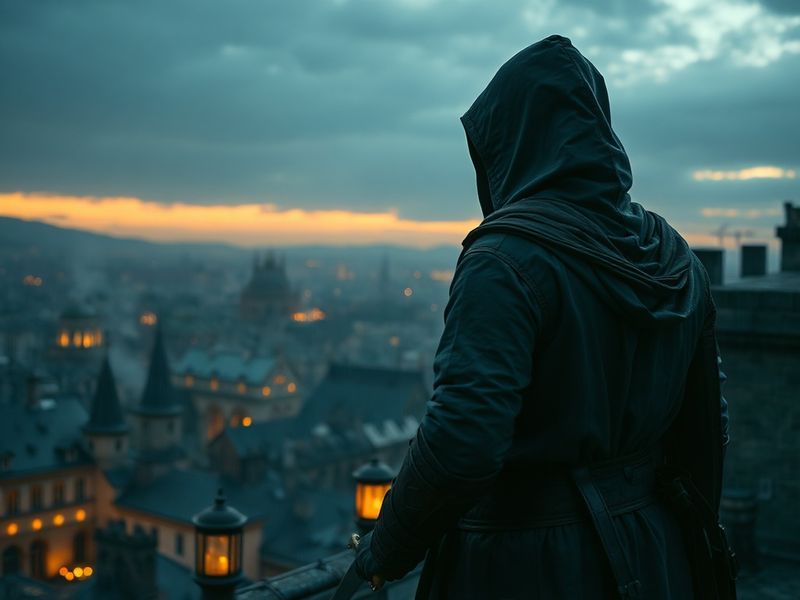
Assassin’s Creed at 20: How Ubisoft’s Franchise Redefined Gaming
“`html
Assassin’s Creed at 20: How Ubisoft’s Franchise Redefined Gaming
Two decades after its debut, Ubisoft’s Assassin’s Creed remains one of gaming’s most ambitious and enduring franchises. What began as a historical action-adventure series has evolved into a multimedia empire spanning games, books, comics, and even a film. Its journey reflects broader trends in the gaming industry, from narrative experimentation to technological innovation.
The series’ longevity is no accident. Ubisoft Montreal took a calculated risk in 2007 by blending parkour mechanics, open-world exploration, and meticulously researched historical settings. The result was a franchise that appealed to both casual players and history enthusiasts alike. Today, Assassin’s Creed stands as a testament to how a single IP can adapt across generations of gamers.
The Birth of an Icon: Origins in 2007
Ubisoft’s initial pitch for Assassin’s Creed was unconventional. The developers wanted to create a game that felt like a living history lesson, blending real-world locations with a fictional narrative. The first game, set during the Third Crusade, introduced players to Altaïr Ibn-La’Ahad, a master Assassin navigating the political intrigues of Acre and Jerusalem.
The game’s most revolutionary feature wasn’t its combat system or historical fidelity—it was its parkour mechanics. The ability to freely climb virtually any surface in the game world was a revelation in 2007. Players could scale minarets, leap between rooftops, and descend into crowded markets, all while evading guards in a seamless blend of exploration and stealth.
Critics hailed the game for its immersive world, though some noted repetitive mission structures. Yet its greatest strength was its ability to transport players to another era. The attention to architectural detail in Middle Eastern cities wasn’t just impressive for its time—it set a new standard for historical accuracy in games.
From Renaissance Italy to Victorian London: The Evolution of a Formula
With Assassin’s Creed II in 2009, Ubisoft doubled down on what worked while expanding the scope. Ezio Auditore da Firenze, the charismatic protagonist, became one of gaming’s most beloved characters. Florence, Venice, and Rome felt alive in ways few virtual worlds had before. The game’s blend of family drama, political intrigue, and historical figures like Leonardo da Vinci made it a cultural touchstone.
The series continued to refine its formula with each entry. Assassin’s Creed: Brotherhood introduced a persistent online mode where players could leave messages for each other in the game world. Revelations delved deeper into Altaïr’s story, while Assassin’s Creed III took players to colonial America, introducing naval combat and wilderness survival elements. Each iteration built upon the last, though not without occasional missteps.
By the time Assassin’s Creed: Syndicate arrived in 2015, the series was experimenting with dual protagonists—Jacob and Evie Frye—in Victorian London. The game’s emphasis on social reform and industrial revolution-era London showcased Ubisoft’s growing ambition to weave real historical events into its fictional narrative.
Key Innovations in the Early Series
- Parkour Mechanics: The series’ signature climbing system evolved from rigid animations in early entries to fluid, natural movement.
- Historical Sandbox: Each game featured meticulously recreated cities, complete with accurate architecture and cultural landmarks.
- Narrative Depth: The modern-day storyline, initially a framing device, became a compelling mystery in its own right by Assassin’s Creed III.
- Multiplayer Experiments: Brotherhood and Revelations tested online integration, though these features were later abandoned.
Beyond Games: How Assassin’s Creed Became a Cultural Phenomenon
The franchise’s influence extends far beyond the gaming world. Ubisoft has leveraged the Assassin’s Creed brand across multiple media, creating a multimedia ecosystem that few gaming IPs can match. The 2016 film adaptation, starring Michael Fassbender, may have underperformed at the box office, but it introduced the franchise to millions of new fans.
Books and comics have expanded the lore significantly. The Assassin’s Creed: Renaissance novel series explored Ezio’s early years, while the Bloodlines comic delved into the aftermath of Assassin’s Creed III. These adaptations often filled gaps in the games’ storytelling, offering deeper character development and historical context.
The franchise has also made inroads into education. Ubisoft has partnered with schools and museums to create educational programs using Assassin’s Creed as a tool for teaching history. In 2020, the company launched Discovery Tour: Ancient Egypt, a mode that allows players to explore historical sites without combat. This initiative highlights how games can be used as interactive learning tools, bridging the gap between entertainment and education.
The Modern Era: Challenges and Reinvention
In recent years, Assassin’s Creed has faced challenges common to long-running franchises. Critics and players alike have noted formulaic storytelling in recent entries like Odyssey and Valhalla. The shift to RPG mechanics in these games polarized the fanbase—some praised the deeper role-playing elements, while others missed the series’ traditional stealth-action focus.
Ubisoft has responded with a mix of innovation and caution. Assassin’s Creed: Mirage, released in 2023, marked a return to the series’ roots. Set in ninth-century Baghdad, the game emphasized stealth, parkour, and assassination over the sprawling open worlds of its predecessors. The move was seen as a deliberate attempt to reconnect with the franchise’s core identity.
The future of Assassin’s Creed may lie in its ability to balance tradition with innovation. Upcoming titles are rumored to explore new settings, including ancient Greece and the Viking age. Meanwhile, Ubisoft continues to experiment with live-service models, though the franchise’s single-player roots remain its strongest asset.
What Comes Next for the Franchise?
- More Historical Settings: Rumors suggest future games may explore ancient China, Mesoamerica, or even mythological Greece.
- VR Experiments: Ubisoft has hinted at potential VR adaptations, which could revolutionize the parkour mechanics.
- Expanded Lore: The modern-day storyline remains unresolved. Fans speculate a conclusion may be in development.
- New Protagonists: After Ezio and Altaïr, the series has struggled to introduce a character as memorable. The next protagonist could redefine the franchise.
Why Assassin’s Creed Matters in the Gaming Landscape
Assassin’s Creed is more than just a successful game franchise—it’s a cultural artifact that reflects the evolution of interactive entertainment. Its ability to blend history, action, and storytelling has influenced countless other games, from open-world RPGs to narrative-driven adventures. The series’ impact can be seen in franchises like Ghost of Tsushima and Horizon Zero Dawn, which owe much to Ubisoft’s pioneering work.
From a global perspective, Assassin’s Creed has also played a role in shaping perceptions of history. By immersing players in different eras, the games have sparked interest in historical periods that might otherwise be overlooked. The Discovery Tour mode, in particular, has been praised for its educational value, demonstrating how games can complement traditional learning methods.
Yet the franchise’s greatest achievement may be its resilience. In an industry where trends come and go, Assassin’s Creed has endured for 20 years by constantly reinventing itself. Whether through technological innovation, narrative experimentation, or multimedia expansion, Ubisoft has ensured that the Assassins remain relevant across generations.
As gaming continues to evolve, Assassin’s Creed stands as a reminder of the medium’s potential. It’s a franchise that has entertained millions, educated countless players, and pushed the boundaries of what games can achieve. For that alone, it deserves its place in gaming history.