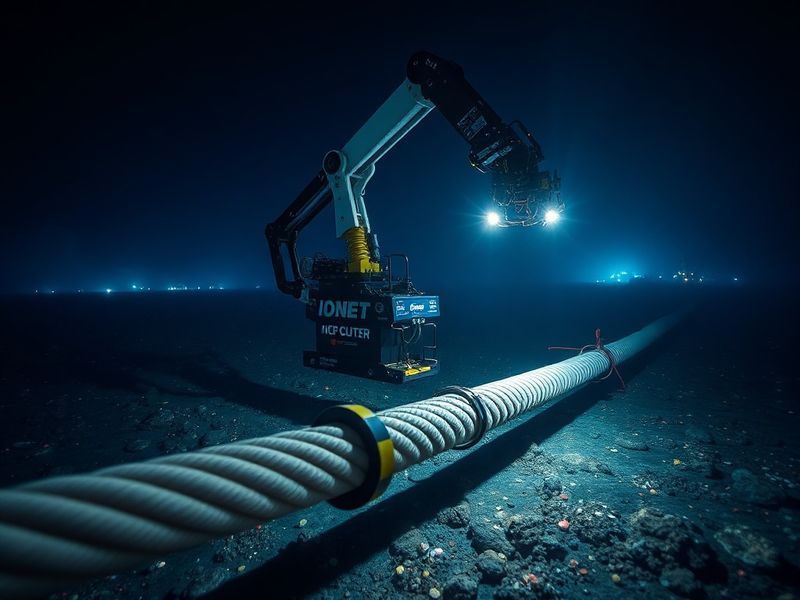
In the shadows of the world’s oceans, a new concern is emerging—one that doesn’t involve naval fleets or surface patrols but rather the unseen infrastructure that powers global communications. China’s development of advanced deep-sea cable-cutting technology has sent ripples through the cybersecurity and maritime communities. These cables, which carry over 99% of international internet traffic, are critical arteries of the modern world. Disrupting them could have consequences far beyond what most governments are prepared to handle.
While the technology itself remains shrouded in secrecy, reports from industry insiders and defense analysts suggest that Beijing has made significant strides in creating tools capable of severing these cables with precision. The implications are vast, touching on geopolitics, cybersecurity, and the fragility of global connectivity. This isn’t just about espionage or sabotage—it’s about the potential to isolate nations, disrupt economies, and create an environment where information warfare becomes a tangible threat.
The Technology Behind the Threat
Deep-sea cable-cutting tools are not new, but China’s approach appears to be uniquely sophisticated. Traditional methods involved crude grappling hooks or explosive charges, which often caused collateral damage to the seafloor. Modern iterations, however, seem designed for stealth and precision. According to a 2023 report from Dave’s Locker Technology section, these new tools may utilize robotic submersibles equipped with high-definition cameras, AI-driven navigation, and cutting mechanisms tailored to specific cable types.
One key innovation is the ability to operate at extreme depths without detection. Modern fiber-optic cables are buried under sediment in shallow waters for protection, but deeper sections are often left exposed. A cable-cutting device capable of reaching depths of 6,000 meters could target critical transoceanic links with minimal risk of being spotted by surface vessels or satellite surveillance.
- Robotic Precision: Autonomous underwater vehicles (AUVs) equipped with robotic arms can navigate to precise locations using pre-loaded GPS coordinates or real-time adjustments.
- AI-Assisted Targeting: Machine learning algorithms may analyze cable routes to identify the most vulnerable points, reducing the time and effort required for manual intervention.
- Stealth Operations: These devices are designed to operate silently, without the acoustic signatures that would alert naval patrol ships or underwater listening stations.
The technology isn’t just theoretical. In 2022, a series of unexplained cable disruptions in the South China Sea coincided with military exercises conducted by the People’s Liberation Army Navy. While no direct evidence linked the incidents to China, the timing raised eyebrows among cybersecurity experts. The cables in question were part of a network servicing Southeast Asian countries, and their failure occurred in a region where China has been aggressively expanding its influence.
Geopolitical Implications: Who Holds the Power?
The dominance of undersea cables in global communications is an often-overlooked facet of modern geopolitics. Nine out of ten internet connections between continents rely on these cables, making them a potential chokepoint in any future conflict. China’s growing assertiveness in the South China Sea and its ambitious global infrastructure projects, such as the Belt and Road Initiative, suggest a long-term strategy that could extend to maritime sabotage.
Analysts at the Center for Strategic and International Studies (CSIS) have warned that China’s investment in submarine cable-laying ships and deep-sea repair technologies could easily be repurposed for offensive operations. Unlike traditional naval blockades, which are overt and escalatory, cable cutting offers a deniable method of disruption. A sudden cable failure could be attributed to natural causes, such as ship anchors or seismic activity, leaving adversaries scrambling to determine the true source of the outage.
The United States and its allies have begun to take notice. The U.S. Department of Defense has reportedly accelerated funding for alternative communication networks, including satellite-based systems and quantum encryption technologies. Meanwhile, NATO has included undersea cable protection in its latest maritime security doctrine, acknowledging that the next major conflict may not begin with missiles but with the snipping of a few critical wires.
- Economic Disruption: Financial markets, cloud computing services, and international trade rely on real-time data transmission. A prolonged cable outage could cost billions in lost transactions and productivity.
- Military Vulnerability: Armed forces depend on secure communications for command-and-control operations. Cutting military-grade cables could blind a nation’s intelligence and defense systems.
- Information Warfare: In an era where misinformation spreads rapidly, severing cables could create information vacuums, allowing adversaries to control the narrative by controlling the flow of data.
Defending the Silent Highways of the Internet
Protecting undersea cables is a daunting challenge. Unlike data centers or satellite networks, these cables span thousands of miles across international waters, making them nearly impossible to guard comprehensively. Traditional methods, such as patrolling with ships or deploying underwater sensors, are costly and limited in scope. Instead, experts are exploring a mix of technological and policy-based solutions.
One approach is redundancy. By diversifying cable routes and investing in multiple pathways, nations can reduce their vulnerability to single-point failures. For example, the Hawaiki Submarine Cable, which connects Australia, New Zealand, and the U.S., was designed with multiple landing points to mitigate the risk of disruption. Similarly, Europe’s plan to build a new fiber-optic ring around the continent aims to create a self-healing network that can reroute traffic automatically in the event of a break.
Another strategy involves improving detection capabilities. Advances in sonar and distributed acoustic sensing (DAS) technology allow operators to monitor cable integrity in real time. Fiber-optic cables themselves can act as sensors, detecting vibrations caused by nearby activities. While these systems aren’t foolproof, they provide an early warning mechanism that could help identify potential threats before they escalate.
On the policy front, international agreements may be necessary to establish norms around undersea cable protection. The United Nations Convention on the Law of the Sea (UNCLOS) already provides a framework for resolving disputes over maritime resources, but it lacks specific provisions for cyber and physical threats to cables. A new treaty or amendment could mandate transparency in cable-laying activities, require regular inspections, and establish protocols for rapid repairs in the event of sabotage.
The Road Ahead: A Fragile Balance
The rise of China’s deep-sea cable-cutting technology is a stark reminder of how interconnected yet vulnerable our global systems have become. In an era where cyber warfare and hybrid conflicts dominate the headlines, the threat to undersea cables represents a blind spot that could have catastrophic consequences. Unlike traditional military threats, this danger operates in the silent depths, far from the prying eyes of satellites and surveillance drones.
For now, the technology remains a closely guarded secret, and its full capabilities are unknown. What is clear, however, is that the stakes are higher than ever. Nations must act swiftly to shore up their defenses, not just by investing in new technologies but by fostering international cooperation to ensure that the silent highways of the internet remain open and secure.
The alternative—a world where a few cuts beneath the waves can plunge entire regions into darkness—is a future no one should be willing to accept. The time to prepare is now, before the first cable falls.