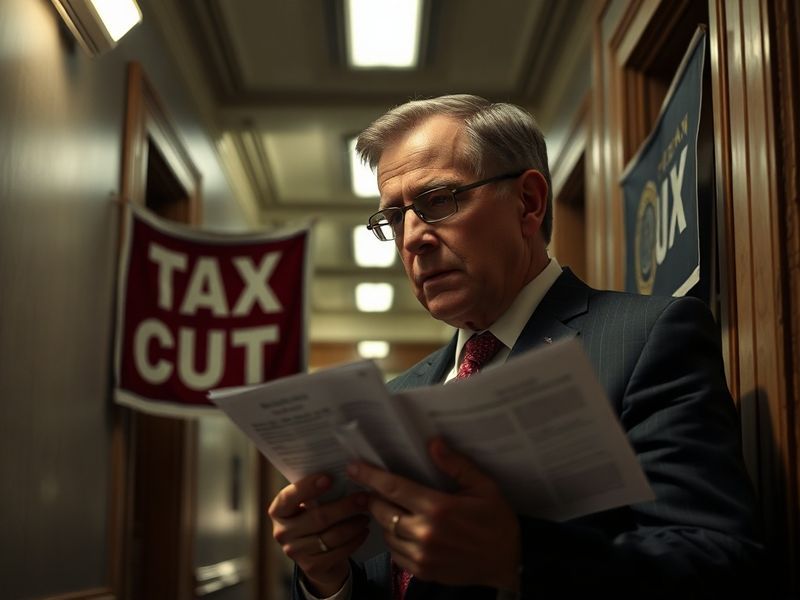
The Republican Party’s longstanding commitment to tax cuts has hit a rough patch. Once a cornerstone of their economic message, tax reductions now face skepticism from voters and lawmakers alike. The political landscape has shifted dramatically since the 2017 Tax Cuts and Jobs Act, with public opinion fracturing and economic realities complicating the narrative.
Polling data consistently shows declining support for the GOP’s tax policies. A Politics analysis from late 2023 revealed that only 32% of Americans believe the 2017 tax cuts benefited them personally. This erosion of public confidence comes despite the legislation being one of the party’s most significant legislative achievements in recent decades.
Several factors contribute to this struggle. Rising inflation has made voters more sensitive to any policies that might exacerbate economic pressures. Additionally, the benefits of the tax cuts were disproportionately concentrated among higher-income earners and corporations, a fact that has become increasingly difficult to ignore in public discourse.
Legislative Challenges and Internal Divisions
The GOP’s ability to push new tax proposals has been hamstrung by internal disagreements. The party remains split between traditional supply-side economists who advocate for further reductions and newer members who question the political viability of such moves. This division was evident during the 2022 midterms when several Republican candidates distanced themselves from the tax cut message.
The House Republican Study Committee proposed a new tax package in early 2023, but the plan faced immediate criticism from both sides of the aisle. Democrats argued it would primarily benefit the wealthy, while some conservative commentators questioned whether it went far enough to address current economic concerns. The proposal ultimately stalled in committee, highlighting the party’s inability to coalesce around a unified message.
These internal struggles have real consequences. The lack of a cohesive tax agenda makes it difficult for Republicans to present a clear alternative to Democratic economic policies. In an era where economic messaging often determines electoral success, this vacuum leaves the party at a disadvantage.
Public Perception and Economic Reality
The disconnect between Republican messaging and public sentiment extends beyond simple polling numbers. Focus groups conducted by various political organizations consistently show that voters remain confused about how the tax cuts actually affected them. Many middle-class families report not seeing the promised benefits, while corporations that benefited from reduced rates face criticism over stock buybacks and executive compensation.
A recent study by the Finance desk at a major university found that 64% of respondents couldn’t identify any specific ways the tax cuts had improved their financial situation. This lack of tangible impact has made it increasingly difficult for Republicans to make a compelling case for further reductions.
The political optics have also turned against the party. High-profile corporate earnings announcements often accompany stock buybacks funded by tax savings, creating visuals that resonate negatively with voters. These images of corporate profits flowing to shareholders rather than workers have become a staple of Democratic attack ads, further complicating the GOP’s messaging.
Key Points of Public Skepticism
- Perceived Corporate Welfare: The concentration of benefits among large corporations has led to accusations of the tax cuts being a giveaway to Wall Street rather than Main Street.
- Inflation Concerns: Voters struggling with rising prices view tax cuts as potentially inflationary, despite economic theory suggesting otherwise.
- Lack of Wage Growth: Despite corporate tax reductions, average wage growth has remained stagnant, undermining claims that benefits would trickle down to workers.
- Complexity of Benefits: The byzantine nature of the tax code changes has made it difficult for average Americans to understand how they might have benefited.
Strategic Missteps and Messaging Failures
The GOP’s struggle extends beyond policy substance to fundamental communication challenges. The party’s traditional approach to tax cuts has relied heavily on supply-side economics arguments that resonate less in today’s economic climate. Framing tax reductions as investments in future growth feels increasingly disconnected from voters’ immediate financial concerns.
Several prominent Republicans have attempted to reframe the debate around competitiveness and global tax policy. Senate Minority Leader Mitch McConnell’s 2023 push to make the corporate tax cuts permanent was framed in terms of keeping American businesses competitive with foreign rivals. While this represents a strategic pivot, it has struggled to gain traction with voters who remain focused on domestic economic pressures.
The party’s messaging has also suffered from a lack of specificity. When pressed for details about who would benefit from proposed tax changes, Republican lawmakers often resort to vague promises about economic growth. This contrasts sharply with Democratic proposals that frequently include specific tax increases on the wealthy to fund social programs.
The Path Forward for Republican Tax Policy
Despite these challenges, the GOP shows no signs of abandoning its commitment to tax reductions. The question remains whether the party can adapt its approach to resonate with contemporary voters. Several potential strategies have emerged, each with its own set of challenges and opportunities.
One approach gaining traction among some conservatives involves refocusing tax cuts on middle-class families rather than corporations. Senator Mitt Romney’s proposed Family Security Act represents an attempt to shift the debate toward direct benefits for households rather than abstract economic growth arguments. However, this represents a significant departure from traditional Republican priorities and may face resistance from the party’s base.
Another strategy involves emphasizing tax simplification rather than rate reductions. House Ways and Means Committee Chairman Jason Smith has floated the idea of consolidating various tax credits and deductions into a simpler system. While this approach might appeal to voters frustrated with the complexity of the tax code, it risks diluting the party’s traditional focus on economic stimulus through rate reductions.
The most likely path forward may involve a combination of these approaches, coupled with a renewed emphasis on state-level tax policies. Several Republican-controlled states have implemented successful tax cut packages that have gained bipartisan support. Learning from these state-level experiments could provide a template for federal policy that resonates more effectively with voters.
Whatever direction the party ultimately chooses, one thing remains clear: the old playbook of tax cuts as a political panacea no longer works. The GOP must develop a more nuanced and voter-focused approach if it hopes to reclaim the initiative on tax policy.
Potential Republican Tax Strategies Moving Forward
- Middle-Class Focus: Redirect benefits toward individual taxpayers through expanded credits and deductions rather than corporate rate reductions.
- State-Level Learning: Study successful tax policies implemented at the state level and adapt them for federal implementation.
- Tax Simplification: Consolidate existing tax provisions to make the system more transparent and user-friendly.
- Competitiveness Framing: Emphasize how tax policies support American businesses competing in global markets rather than abstract growth arguments.
The Republican Party’s struggle to highlight tax cuts reflects broader challenges in contemporary American politics. As economic priorities shift and voter expectations evolve, traditional policy approaches must adapt or risk irrelevance. The GOP’s ability to navigate this new landscape will determine not only its tax policy future but its broader political viability in the coming years.
For further analysis of Republican policy struggles, explore our Analysis section. For the latest in political developments, visit our News coverage.