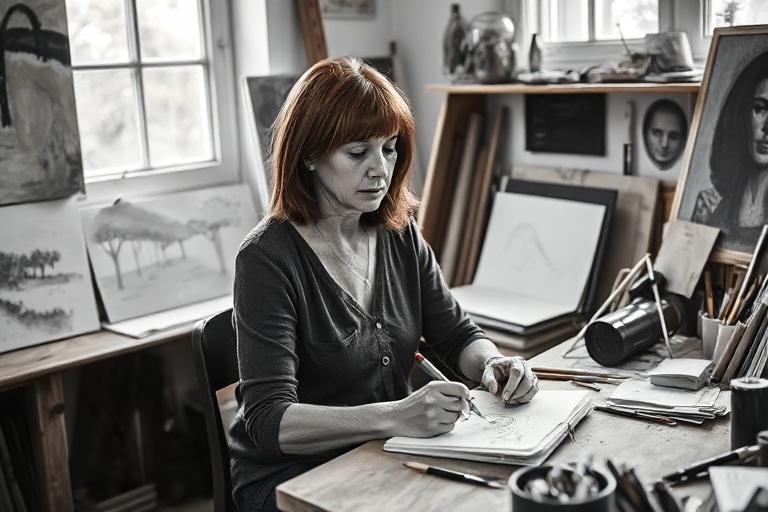
Rachel Millward isn’t just another name in the art world—she’s a force of transformation. As the founder of Bureau Varia, a nomadic curatorial office, and the artistic director of Art Basel Cities, Millward has spent over a decade redefining how contemporary art engages with communities across the globe. Her work bridges institutional prestige with grassroots energy, especially in cities where art infrastructure is still developing.
Born in the UK and now based between London and Rotterdam, Millward’s career reflects a deep commitment to cultural exchange. She doesn’t just curate exhibitions; she builds ecosystems. Whether in Medellín, Colombia, where she launched a city-wide festival, or in Sharjah, UAE, where she contributed to the 2023 Biennial, Millward treats each project as a site-specific intervention. Her approach is rooted in listening—long before the first artwork is installed.
From Liverpool to the World: A Career Built on Listening
Millward’s journey began in the post-industrial landscapes of Northern England. After studying Art History at the University of Liverpool, she cut her teeth in gallery education and artist support programs. Unlike many curators who focus solely on aesthetics, Millward prioritized access. She worked with marginalized artists, ran workshops in underserved neighborhoods, and began to see curation as a form of social practice.
In 2013, she launched Bureau Varia, a platform designed to be “mobile, adaptable, and responsive.” The name itself signals her philosophy: “Varia” refers to the Latin word for “varied,” but also nods to “vary,” as in change. Her exhibitions aren’t static; they evolve with their environments. One of her early projects, “Public Works” in Liverpool, transformed vacant storefronts into artist studios and exhibition spaces, proving that art could reanimate dead urban spaces.
By 2017, her reputation grew when she was appointed Director of Liverpool Biennial’s International Program. Under her leadership, the biennial expanded beyond traditional venues, partnering with community centers, universities, and even a former shipyard. She introduced “Neighborhoods,” a decentralized model that sent artists and curators into residential areas to create site-responsive works. This wasn’t just inclusion—it was redefinition.
Key Principles in Millward’s Curatorial Practice
- Context over canon: She rejects the idea that art must be understood through a Eurocentric lens. In Sharjah, she showcased artists from the Global South whose work addressed climate migration—a theme often overlooked in Western art discourse.
- Collaboration over control: Millward frequently co-curates with local artists and cultural workers. In Medellín, she worked with over 40 grassroots organizations to produce “Ciudad Mía”, a festival that used art to reimagine public space after decades of conflict.
- Sustainability as strategy: Her projects often reuse materials, support local economies, and leave behind lasting infrastructure—like artist studios or community archives.
Art Basel Cities: Bridging Markets and Communities
In 2022, Millward joined Art Basel Cities, a program that brings the fair’s global network to mid-sized cities. Her first major project was in Bogotá, Colombia, where she curated “Territorios en Disputa” (“Territories in Dispute”), an exhibition exploring land, memory, and conflict in Colombia’s post-peace accord era.
The show didn’t just hang on walls—it activated the city. Artists like Diana Al-Halabi created interventions in public parks, while others worked with victims of forced displacement to co-author new narratives. Millward described it as “art as a form of truth commission.”
This approach resonated in a city where art and politics are deeply intertwined. Bogotá’s art scene thrives in independent spaces, often in defiance of state neglect. Millward built on that energy, partnering with local collectives like Casa Ensamble and La Usurpadora. The result wasn’t just another international art event—it was a model for how global institutions can support local movements without co-opting them.
Cultural Diplomacy in a Fractured World
Millward’s work takes on added significance in an era when cultural diplomacy is increasingly weaponized. While some institutions use art as soft power—exhibiting national prestige—Millward treats it as a tool for repair. In 2021, she co-curated “The Sea is a Country” in Marseille, France, a city with deep colonial legacies and a growing North African diaspora.
The exhibition featured artists like Bouchra Khalili and Kader Attia, whose works addressed migration and memory. But the real innovation was the programming: film screenings in working-class neighborhoods, artist talks in Arabic and French, and a partnership with a local youth center. Millward called it “a curatorial act of decolonization.”
Her philosophy extends beyond individual projects. She’s a vocal advocate for fair pay in the art world, especially for artists from the Global South. In 2023, she co-signed an open letter demanding that Western institutions stop exploiting unpaid labor under the guise of “exposure.” “Exposure doesn’t pay rent,” she said in a rare interview with The Guardian. “And neither does a plane ticket.”
The Future: Art as Infrastructure
Looking ahead, Millward is focused on what she calls “art as infrastructure.” She’s developing a new initiative in Cape Town, South Africa, where she’ll work with local architects and artists to design temporary cultural hubs in areas slated for gentrification. The goal isn’t just to create art—it’s to create the conditions for art to thrive.
She’s also expanding Bureau Varia into a collective, bringing together curators from Lagos, Beirut, and Jakarta to co-produce projects. The idea is to decentralize power—not just geographically, but conceptually. “We need to stop thinking of curation as a service,” she says. “It’s a relationship.”
What’s Next for Millward?
- Cape Town Project: A year-long program using art to resist displacement in post-apartheid urban renewal zones.
- Bureau Varia Collective: A network of independent curators from the Global South, launching its first project in 2025.
- Art Basel Cities Istanbul: Scheduled for 2026, focusing on art and migration in a city where 40% of residents are transplants.
Millward’s work reminds us that art isn’t just something to be seen—it’s something to be lived. In a world of borders and barriers, she’s using curation to build bridges. Not the kind that connect institutions to markets, but the kind that connect people to power, to land, to each other.
Rachel Millward doesn’t just shape exhibitions. She shapes possibilities.