Assassin’s Creed IV: Black Flag – A Pirate Odyssey That Redefined Open-World Design
When Assassin’s Creed IV: Black Flag launched in October 2013, it didn’t just expand the series—it redefined what a pirate adventure could look like in digital space. Set in the early 18th century during the Golden Age of Piracy, the game transported players to the Caribbean, a region rich in history, conflict, and legend. More than a sequel, Black Flag became a cultural touchstone, blending historical authenticity with swashbuckling fantasy in a way few open-world games had managed before.
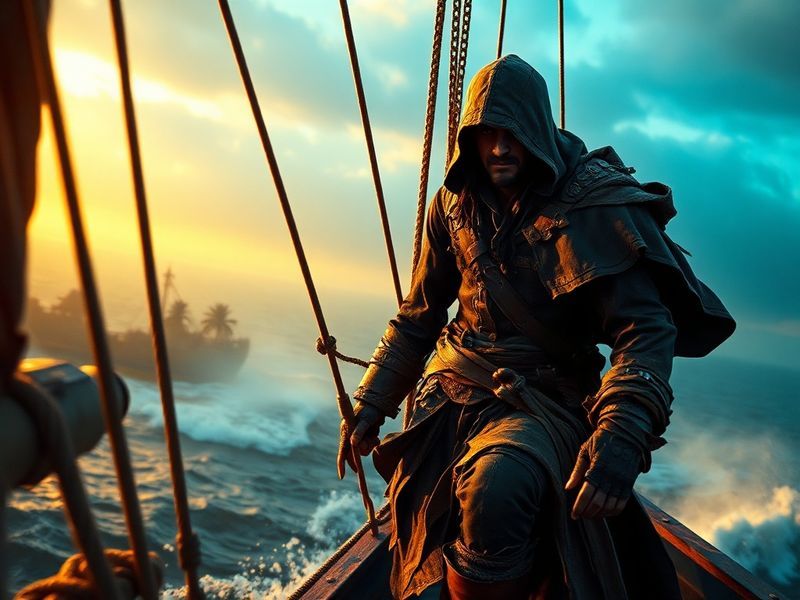
At its core, the game follows Edward Kenway, a charismatic but morally ambiguous Welsh pirate who stumbles into the ancient conflict between Assassins and Templars. What begins as a quest for wealth and freedom spirals into a deeper struggle over the fate of the New World. This narrative shift—from Ezio Auditore’s Renaissance idealism to Edward’s opportunistic pragmatism—gave the series a new emotional texture, one that resonated with players tired of traditional hero narratives.
The game’s development was shaped by a global team at Ubisoft Montreal, with contributions from studios in Singapore, Shanghai, and Chengdu. This international collaboration helped infuse the world with diverse cultural influences, from the Spanish forts of Havana to the bustling trade hubs of Kingston and Nassau. Even the music—composed by Brian Tyler and featuring sea shanties performed in languages like French, Spanish, and English—echoed the multicultural reality of Caribbean piracy.
The Caribbean as a Living, Breathing World
Black Flag wasn’t just a map to explore—it was a living ecosystem. The Caribbean Sea wasn’t a static barrier but a dynamic challenge, with storms, hurricanes, and whirlpools that forced players to adapt. Ship navigation wasn’t a simple minigame; it was a rhythm of wind management, sail control, and combat positioning. This attention to detail elevated naval combat into one of the most satisfying mechanics in the series.
The world was also densely populated with human activity. Fishermen cast nets near shore. Merchants haggled in ports. Guards patrolled forts, and townsfolk went about their daily lives. These small details weren’t just window dressing—they made the world feel authentic. The team studied historical accounts, including logs from real pirates like Blackbeard and Calico Jack, to inform everything from architecture to dialogue.
Ubisoft didn’t just build a sandbox; it built a stage where players could improvise their own pirate legends. Want to raid a Spanish galleon? Go ahead. Prefer to smuggle goods past blockades? That’s an option too. The game’s emergent gameplay—players inventing their own stories within the system—was a testament to its design philosophy: freedom over linearity.
The Legacy of Edward Kenway: A Pirate Antihero for a New Generation
Edward Kenway is often remembered as the most human protagonist in the Assassin’s Creed saga. Unlike Altaïr or Ezio, who were disciplined and ideological, Edward was selfish, impulsive, and driven by immediate gain. His journey from a greedy opportunist to a reluctant hero mirrored the player’s own progression through the story. This moral ambiguity made him relatable in an era when gaming audiences increasingly craved complex characters.
The game’s narrative structure reinforced this evolution. Early missions are filled with betrayal, deception, and violence—classic pirate tropes—but as Edward becomes entangled in the Assassin-Templar war, his choices begin to matter beyond personal survival. His friendship with Mary Read and Anne Bonny, two of history’s most notorious female pirates, also added depth to the story, challenging players to reconsider gender roles in a male-dominated world.
Historically, the Golden Age of Piracy (roughly 1650–1730) saw a surge in multicultural crews, where escaped slaves, indigenous people, and European outcasts found temporary freedom on the high seas. Black Flag subtly acknowledged this reality through side characters like the freed African sailor, Adéwalé, who later became the protagonist of Assassin’s Creed Freedom Cry, a standalone DLC. This expansion explored themes of emancipation and resistance, adding a layer of social commentary rarely seen in mainstream gaming.
It’s worth noting how Black Flag influenced later entries in the franchise. The naval combat system returned in Assassin’s Creed Rogue and Origins, while the focus on historical immersion set a new standard for the series. Even games like Sea of Thieves and Assassin’s Creed Odyssey owe a debt to the freedom and authenticity that Black Flag pioneered.
Cultural Impact: More Than Just a Game
The influence of Black Flag extended far beyond gaming. It reignited global interest in pirate history, inspiring documentaries, books, and even travel itineraries for Caribbean heritage tourism. Fans began tracing real-life pirate routes, visiting ports like Nassau’s Pirate Republic Museum or Port Royal in Jamaica, which had sunk into the sea in 1692 but was immortalized in the game.
In education, teachers began using the game to discuss 18th-century economics, naval warfare, and colonialism. Some universities even incorporated it into courses on digital storytelling and interactive media. The game’s blend of fact and fiction made it a powerful tool for engaging students in historical inquiry.
Merchandising also flourished. From replica pirate coats to rum-flavored “Assassin’s Brew” (a real drink collaboration with a distillery), the game’s aesthetic seeped into pop culture. Cosplay communities thrived, with Edward Kenway’s signature coat and tricorn hat becoming iconic symbols at conventions worldwide.
The game’s soundtrack, featuring sea shanties and orchestral swells, found a second life on streaming platforms. Fans created cover versions, remixes, and even full orchestral performances, proving that music from a video game could transcend its medium. Tracks like “He’s a Pirate” became anthems, played at sports events and pirate-themed parties alike.
Why Black Flag Still Sails Strong a Decade Later
A decade after its release, Assassin’s Creed IV: Black Flag remains one of the most beloved entries in the series. Its success can be attributed to a rare alchemy of design choices: a compelling protagonist, a living open world, and a narrative that balanced personal drama with historical weight. It wasn’t just a game about pirates—it was a game about freedom, identity, and the cost of ambition.
Ubisoft’s decision to focus on naval exploration rather than land-based parkour was visionary. The ocean became a character itself, a vast and unpredictable frontier. This emphasis on verticality (sailing above and diving below the waves) gave the game a spatial depth rarely matched in open-world titles.
Moreover, the game’s lack of a traditional “endgame grind” made it feel purer. There were no microtransactions, no forced multiplayer—just a world to explore and a story to uncover at your own pace. In an era of monetized live-service games, this purity feels almost revolutionary.
Looking back, Black Flag wasn’t just a product of its time—it helped shape the future of open-world design. Its DNA lives on in games like The Legend of Zelda: Breath of the Wild, where environmental storytelling and emergent gameplay take center stage. It proved that a game could be both a blockbuster and a work of art.
For new players discovering it today, Black Flag offers more than nostalgia. It offers a reminder of what made early 2010s open-world games so special: ambition, attention to detail, and a deep respect for the player’s imagination.