Vietnam War Explained: Origins, Impact, and Lasting Legacy
“`html
Vietnam War: Origins, Impact, and Legacy in Modern History
The Vietnam War remains one of the most complex and divisive conflicts of the 20th century. Spanning nearly two decades, from 1955 to 1975, it reshaped global politics, influenced American society, and left an indelible mark on Southeast Asia. Unlike conventional wars, Vietnam was a guerrilla conflict fueled by ideological battles, colonial legacies, and Cold War tensions. Understanding its origins requires examining the post-World War II era, when Vietnam sought independence from French colonial rule, only to be drawn into a larger struggle between communism and capitalism.
The war’s legacy persists in political discourse, military strategy, and cultural memory. For many, it symbolizes the limits of American power abroad. For others, it represents a fight against colonialism and oppression. The human cost was staggering—millions of Vietnamese civilians perished, alongside tens of thousands of American and allied soldiers. Decades later, the war’s lessons continue to shape foreign policy debates, from military interventions to humanitarian crises.
The Roots of Conflict: Colonialism and Cold War Tensions
Vietnam’s struggle began long before U.S. involvement. Under French colonial rule for nearly a century, Vietnam’s people faced economic exploitation and political repression. The rise of Ho Chi Minh and his communist Viet Minh movement in the 1940s challenged this dominance. After World War II, Vietnam declared independence in 1945, but France refused to relinquish control, sparking the First Indochina War in 1946.
The conflict took a dramatic turn in 1954 when Vietnamese forces defeated the French at the Battle of Dien Bien Phu. The Geneva Accords that followed temporarily divided Vietnam along the 17th parallel—communist North Vietnam, led by Ho Chi Minh, and anti-communist South Vietnam, backed by the U.S. and Western allies. This division was meant to be temporary, but Cold War hostilities ensured it would harden into permanent division.
By the early 1960s, the U.S. had shifted from providing military advisors to committing combat troops. The domino theory—a belief that if one nation fell to communism, others would follow—drove American intervention. Yet, as historian George Herring noted, “The U.S. entered Vietnam with little understanding of the country’s history or the depth of nationalist sentiment.” This miscalculation would define the war’s escalation.
The War’s Escalation: Strategies, Tactics, and Turning Points
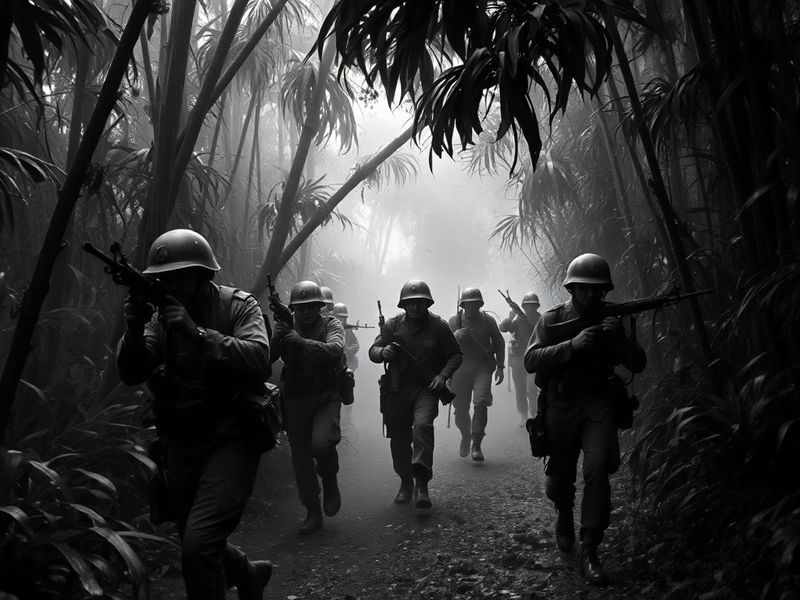
The Vietnam War evolved from a counterinsurgency effort into a full-scale military confrontation. The U.S. deployed over 500,000 troops by 1968, relying on superior firepower, aerial bombing campaigns like Operation Rolling Thunder, and search-and-destroy missions. Yet, the North Vietnamese Army (NVA) and Viet Cong guerrillas adapted with hit-and-run tactics, tunnel networks, and support from local villagers.
Key turning points revealed the war’s intractable nature:
- 1964 Gulf of Tonkin Incident: After alleged North Vietnamese attacks on U.S. ships, Congress passed the Gulf of Tonkin Resolution, giving President Lyndon B. Johnson broad war powers. This marked the official start of large-scale U.S. involvement.
- 1968 Tet Offensive: A massive surprise attack by North Vietnamese and Viet Cong forces during the lunar New Year shattered American confidence. Though militarily a U.S. victory, the offensive exposed the war’s unwinnable nature to the public.
- 1970 Cambodian Incursion: President Richard Nixon’s secret bombing and ground invasion of Cambodia widened the war, sparking global protests and deepening anti-war sentiment.
- 1973 Paris Peace Accords: After years of stalemate, the U.S. withdrew troops, but fighting continued until North Vietnam’s final offensive in 1975.
Media coverage played a unique role in shaping public perception. Graphic images from the battlefield, including the 1968 My Lai massacre and the 1972 napalm-girl photograph, turned global opinion against the war. The Pentagon Papers leak in 1971 further revealed government deceit, fueling distrust in institutions.
Human Cost and Civilian Suffering
While military casualties are often quantified, the war’s civilian toll is harder to measure. Estimates suggest 1.5 to 2 million Vietnamese civilians died, alongside 58,000 American soldiers and 250,000 South Vietnamese troops. Agent Orange, a toxic herbicide used to defoliate jungles, caused long-term health issues for generations, including birth defects and cancers. Unexploded ordnance, including landmines and cluster bombs, continues to maim civilians decades later.
Refugee crises added another layer of devastation. The fall of Saigon in 1975 triggered a mass exodus of South Vietnamese who fled by boat, facing piracy and storms. Over 800,000 Vietnamese refugees resettled worldwide, reshaping diaspora communities in the U.S., France, and Australia. Meanwhile, the communist victory led to re-education camps for former South Vietnamese officials and a harsh crackdown on dissent.
Environmental damage was equally severe. Defoliation campaigns destroyed 20% of Vietnam’s forests, while napalm and white phosphorus caused long-term ecological harm. Today, Vietnam’s Agent Orange victims continue to fight for compensation and recognition, with U.S. veterans and activists advocating for expanded aid programs.
Legacy and Lessons for Modern Conflicts
The Vietnam War’s legacy extends beyond military history. It redefined America’s role in the world, leading to the War Powers Act of 1973, which limited presidential authority to deploy troops without congressional approval. The “Vietnam Syndrome”—a reluctance to intervene abroad—shaped foreign policy for decades, though it was later challenged by interventions in the Balkans, Afghanistan, and Iraq.
In Vietnam, the war’s end brought reunification under communist rule, but economic stagnation followed. Since the 1990s, however, Vietnam has transformed into one of Southeast Asia’s fastest-growing economies, balancing trade with both Western nations and China. The “American War,” as it’s known locally, remains a sensitive topic, with museums and memorials in Hanoi and Ho Chi Minh City emphasizing the struggle against foreign aggression.
For historians and policymakers, Vietnam offers critical lessons. It demonstrated the dangers of underestimating an enemy’s resolve, the importance of understanding local cultures, and the ethical dilemmas of modern warfare. As historian Marilyn Young argued, “Vietnam was not just a war but a crisis of American identity—a moment when the nation questioned its purpose and values.”
Today, Vietnam serves as a case study in post-conflict reconciliation. While U.S.-Vietnam relations have improved, with trade agreements and military cooperation, the war’s wounds remain raw for many. Museums like the War Remnants Museum in Ho Chi Minh City starkly depict its horrors, while American veterans return to visit memorials, some seeking closure.
The war’s impact on popular culture endures as well. Films like Apocalypse Now and Platoon captured its surrealism and brutality, while documentaries such as Ken Burns’ The Vietnam War revisited its complexities. Music from the era—ranging from protest folk songs to psychedelic rock—reflects the era’s divisions. Even fashion, with its anti-war slogans and military surplus styles, became a form of protest.
As the last American troops left in 1973, few could have predicted the war’s lasting imprint. It forced nations to reconsider the limits of power, the cost of ideology, and the human face of conflict. For future generations, Vietnam remains a cautionary tale—a reminder that war’s consequences extend far beyond the battlefield.
For those interested in further reading, explore Dave’s Locker History archives for in-depth analyses of 20th-century conflicts, or visit Dave’s Locker Analysis section for expert perspectives on geopolitical issues.