china news
“`html
China’s Evolving Role in Global Trade and Diplomacy
China’s influence on the world stage continues to expand, reshaping trade flows, technological standards, and diplomatic alliances. While Western media often frames China’s rise through the lens of competition, the reality is far more nuanced. The country’s economic policies, technological advancements, and strategic partnerships are redefining global power dynamics in ways that demand closer examination.
Trade remains the cornerstone of China’s global engagement. The Belt and Road Initiative (BRI), launched in 2013, has transformed from a visionary infrastructure project into a sprawling network of investments spanning Asia, Africa, Europe, and beyond. More than 150 countries have now signed agreements under the BRI, reflecting China’s ambition to position itself as the primary architect of 21st-century connectivity. Critics argue that the initiative fosters dependency in developing nations, while supporters highlight the tangible infrastructure improvements in regions long neglected by traditional aid models.
Technological Dominance and Global Supply Chains
The technological rivalry between China and Western nations has intensified over the past decade. Huawei’s global expansion, despite U.S. sanctions, demonstrated China’s ability to challenge Silicon Valley’s dominance in telecommunications. Similarly, Chinese electric vehicle (EV) manufacturers like BYD and NIO are disrupting traditional automotive supply chains, pushing legacy automakers to accelerate their own electrification efforts.
This technological push is not confined to hardware. China’s investments in artificial intelligence, quantum computing, and 5G infrastructure position it as a leader in the industries of the future. The country’s Made in China 2025 plan outlines a clear strategy to dominate high-tech manufacturing, prompting concerns in Washington and Brussels about over-reliance on Chinese components. The global semiconductor shortage of 2020-2021 further exposed vulnerabilities in supply chains, underscoring the need for diversification.
Yet, this dominance comes with risks. The U.S. government’s export controls on advanced semiconductors to Chinese firms highlight the fragility of technological decoupling. Meanwhile, European nations are grappling with the balance between economic engagement and security concerns, particularly in critical infrastructure sectors.
Diplomatic Realignments in a Multipolar World
China’s diplomatic strategy has evolved from isolation in the 20th century to assertive engagement in the 21st. The country’s relationship with Russia has deepened, driven by mutual opposition to Western dominance in global institutions. Their partnership extends beyond trade to include military cooperation, energy deals, and joint opposition to NATO expansion. This axis challenges the post-Cold War order, particularly in regions like Central Asia and the Arctic.
In the Global South, China has positioned itself as an alternative to traditional Western donors. African nations, in particular, have benefited from Chinese loans for infrastructure projects, though some have faced debt sustainability issues. Latin America and the Caribbean have also seen increased Chinese investment, particularly in energy and mining sectors. This outreach has led to accusations of neo-colonialism, but it has also provided countries with new avenues for development.
China’s role in international organizations, such as the United Nations and the World Health Organization, further illustrates its growing influence. Its veto power in the UN Security Council allows it to shape resolutions on issues ranging from climate change to peacekeeping. Meanwhile, its leadership in the BRICS bloc signals a challenge to the dominance of Western-led financial institutions like the IMF and World Bank.
The Cultural Soft Power Paradox
While China’s economic and technological rise is well-documented, its cultural influence remains a work in progress. The global popularity of Chinese cinema, particularly films like Crouching Tiger, Hidden Dragon and The Wandering Earth, has introduced Western audiences to new narratives. K-pop’s influence from neighboring South Korea often overshadows China’s own music industry, but artists like Kris Wu and Lay Zhang have carved out significant followings in Asia and beyond.
Cuisine is one area where China has made undeniable inroads. From the rise of bubble tea to the global expansion of hot pot chains, Chinese food has become a staple in many Western cities. However, this cultural export is often simplified, reducing the diversity of China’s culinary traditions to a handful of dishes. Similarly, the global success of Chinese period dramas on streaming platforms reflects a growing appetite for historical storytelling, though their reach remains limited compared to Western content.
The Chinese government has invested heavily in promoting its cultural narrative abroad through Confucius Institutes and media outlets like CGTN. Yet, these efforts are often overshadowed by controversies, such as allegations of censorship or political interference. The paradox of China’s soft power lies in its ability to attract global audiences while simultaneously alienating them through rigid control of information.
China’s Environmental and Social Challenges
China’s rapid industrialization has come at a significant environmental cost. The country is the world’s largest emitter of greenhouse gases, though it has also become a leader in renewable energy investment. Solar panel manufacturing, wind turbine production, and electric vehicle adoption have positioned China as a key player in the global green transition. However, air pollution in major cities and water scarcity in rural regions remain pressing issues.
The government’s response has been a mix of top-down policies and grassroots innovation. The 2060 carbon neutrality pledge, announced by President Xi Jinping in 2020, set an ambitious target for decarbonization. Yet, the pace of implementation varies widely, with local governments often prioritizing economic growth over environmental regulations. Socially, China faces challenges such as an aging population, a shrinking workforce, and rising inequality between urban and rural areas.
The country’s one-child policy, enforced from 1980 to 2015, has left a demographic imbalance that will shape its economy for decades. The subsequent two-child and three-child policies have failed to reverse the trend, raising concerns about future labor shortages and pension system strain. Meanwhile, the hukou system, which ties social benefits to residency permits, continues to exacerbate urban-rural divides.
The Future of U.S.-China Relations
The relationship between the U.S. and China is the most consequential bilateral dynamic of the 21st century. Trade tensions, military posturing in the South China Sea, and technological decoupling have created a climate of mutual suspicion. The Biden administration has maintained tariffs on Chinese goods while seeking cooperation on climate change and global health, illustrating the complexity of the relationship.
For multinational corporations, navigating this landscape requires strategic flexibility. Supply chains are being regionalized, with companies diversifying production to countries like Vietnam, India, and Mexico to reduce reliance on China. Yet, the sheer scale of China’s market—with over 1.4 billion consumers—means that most businesses cannot afford to disengage entirely.
The outcome of the 2024 U.S. presidential election could further strain or stabilize relations. A return to Trump-era tariffs would likely escalate tensions, while a more conciliatory approach could open avenues for dialogue. Regardless of the political climate, the U.S. and China will remain locked in competition, cooperation, and confrontation in equal measure.
Conclusion: A Multipolar World in Flux
China’s global footprint is undeniable, but its long-term trajectory remains uncertain. The country’s ability to balance economic growth with environmental sustainability, technological innovation with societal stability, and global engagement with domestic control will determine its role in the coming decades. For the rest of the world, the challenge lies in engaging with China without surrendering agency to its agenda.
As nations recalibrate their strategies, one thing is clear: the world of the 21st century will be shaped by how China navigates its contradictions—between openness and control, ambition and caution, power and pragmatism. The answers to these questions will define not just China’s future, but the future of global governance itself.
—
METADATA
{
“title”: “China’s Global Influence: Trade, Tech, and Diplomatic Shifts Explained”,
“metaDescription”: “Explore how China’s trade policies, tech dominance, and diplomatic strategies are reshaping global power dynamics in the 21st century.”,
“categories”: [“News”, “Analysis”, “Politics”],
“tags”: [“China trade”, “Belt and Road Initiative”, “US-China relations”, “Chinese tech”, “global diplomacy”],
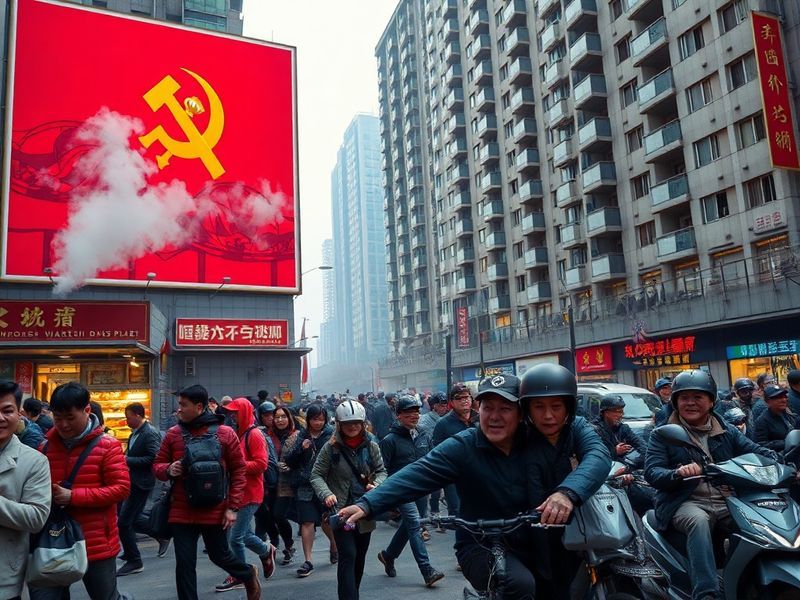
“imageDescription”: “A split-image visual: on the left, a high-speed train in motion against a futuristic cityscape; on the right, a traditional Chinese pagoda juxtaposed with a modern skyscraper. The setting is a bustling metropolis blending old and new architecture, with a global network of trade routes subtly overlaid in the background. The mood is dynamic yet contemplative, symbolizing China’s dual identity as both an ancient civilization and a modern superpower.”
}
—END METADATA—
“`