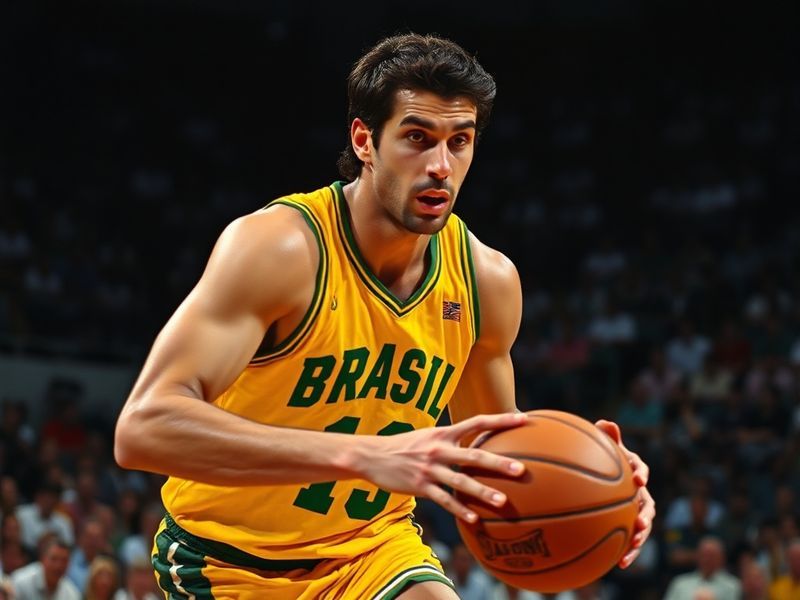
Oscar Schmidt remains one of basketball’s most improbable legends—a player who never suited up in the NBA yet dominated the global game for nearly three decades. Born in 1958 in Natal, Brazil, Schmidt carved out a career that blurred the lines between myth and reality, rewriting record books while playing in leagues far from the spotlight of American sports. His story is one of relentless skill, adaptability, and an unshakable belief in his own abilities, even when the world’s best leagues overlooked him.
Schmidt’s impact extended far beyond the court. He became a symbol of perseverance for athletes outside the NBA’s traditional pipeline, proving that greatness could be achieved anywhere with the right combination of talent and determination. His career spanned four decades, multiple continents, and countless clutch performances that left fans and opponents in awe.
The Career That Defied Convention
Schmidt’s professional journey began in 1974 with Sírio in Brazil, but it was his move to Italy in 1978 that truly launched his international career. Playing for teams like Caserta and later Pavia, he adapted seamlessly to European basketball, dominating the Italian league with scoring averages that often neared 40 points per game. His lethal combination of shooting range, footwork, and mid-range mastery made him nearly unstoppable.
Despite his dominance, Schmidt’s NBA dreams never materialized. The league’s scouts and executives often cited concerns about his athleticism and defense, yet those who faced him in international competitions knew the truth. In 1984, he led Brazil to a fourth-place finish at the Los Angeles Olympics, averaging over 30 points per game while shooting an astonishing 60% from the field. His performance was a masterclass in scoring efficiency, leaving American fans and analysts wondering what might have been.
By the time Schmidt retired in 2003, he had amassed the most points in basketball history—over 49,000 across club and international play. His scoring titles, Olympic records, and longevity redefined what was possible for a player outside the NBA ecosystem. Even today, his name remains synonymous with pure offensive brilliance.
Key Highlights from a Legendary Career
- Olympic Dominance: Schmidt led Brazil in four Olympic Games, peaking with 33.5 points per game in 1988. His 1984 performance against the U.S. team, where he scored 46 points, remains one of the most iconic moments in Olympic basketball history.
- European Supremacy: In Italy’s Serie A, Schmidt averaged 34.5 points per game over 12 seasons, winning multiple scoring titles and cementing his status as one of Europe’s greatest imports.
- International Records: He holds the record for most points scored in FIBA competitions (7,485) and remains the all-time leading scorer in Olympic basketball history (1,093 points).
- Cultural Icon: Schmidt transcended basketball in Brazil, becoming a national hero whose influence extended to music, media, and philanthropy. His 1990s commercials and public appearances made him a household name.
Why Schmidt’s Legacy Matters Beyond the Scoreboard
Schmidt’s career challenges the conventional wisdom that NBA pedigree is the only path to greatness. His success in Europe, where he faced elite competition nightly, underscored the depth of global basketball talent during the 1980s and 1990s. While the NBA remained the pinnacle of the sport, Schmidt’s dominance proved that the game’s highest level wasn’t confined to one league or country.
His story also highlights the importance of adaptability. Schmidt thrived in a style of basketball that prioritized fundamentals and precision over athleticism. His ability to read defenses, exploit mismatches, and deliver in clutch moments set him apart from contemporaries who relied solely on physical tools. In an era where positionless basketball is celebrated, Schmidt’s versatility feels eerily prescient.
Beyond statistics, Schmidt’s legacy is tied to his influence on Brazilian basketball. He inspired generations of players to aim for the global stage, paving the way for stars like Anderson Varejão and Leandrinho Barbosa. His impact on the sport’s development in South America cannot be overstated, as he helped elevate the profile of international leagues long before the NBA’s globalization.
The What-Ifs and Enduring Mystique
It’s impossible to ignore the counterfactuals in Schmidt’s career. What if he had been drafted by an NBA team? Could he have adjusted to the physicality of the league and become a franchise cornerstone? While we’ll never know, his absence from the NBA only amplifies his legend. He wasn’t just a player who couldn’t crack the league; he was a player who chose a different path and thrived on his own terms.
Schmidt’s career also raises broader questions about how we evaluate greatness in sports. If the NBA is the gold standard, how do we measure the achievements of those who excel elsewhere? His records in FIBA and European competitions stand as a testament to his skill, but they also highlight the fragmented nature of basketball’s global hierarchy. Today, with the NBA’s international reach, Schmidt’s career serves as a reminder of a time when the sport’s landscape was far more decentralized.
Even in retirement, Schmidt remains involved in basketball. He has coached, mentored young players, and served as an ambassador for the game in Brazil. His presence at major tournaments and clinics keeps his legacy alive, ensuring that new generations of fans discover the story of a man who defied expectations at every turn.
A Legacy That Transcends Basketball
Oscar Schmidt’s impact extends beyond the court. In Brazil, he became a cultural icon, appearing in films, hosting television shows, and even releasing music. His charisma and marketability made him one of the country’s most recognizable figures, bridging the gap between sports and mainstream culture. For many Brazilians, Schmidt wasn’t just a basketball player—he was a symbol of national pride.
His humanitarian efforts further cemented his status as a role model. Schmidt has been involved in numerous charitable initiatives, focusing on education and youth development in Brazil. His foundation has provided resources for underprivileged children, ensuring that his legacy includes more than just points and trophies.
As basketball continues to evolve, Schmidt’s career offers timeless lessons. For aspiring players, his story is a reminder that greatness can be achieved through hard work, adaptability, and self-belief. For fans, it’s a celebration of the beauty and unpredictability of the game. And for the sport itself, it’s a tribute to the players who, despite the odds, left an indelible mark on basketball history.
Oscar Schmidt didn’t just play the game—he redefined what it meant to be a basketball legend.
For more on basketball’s global impact and legendary careers, explore our Sports and Entertainment categories.