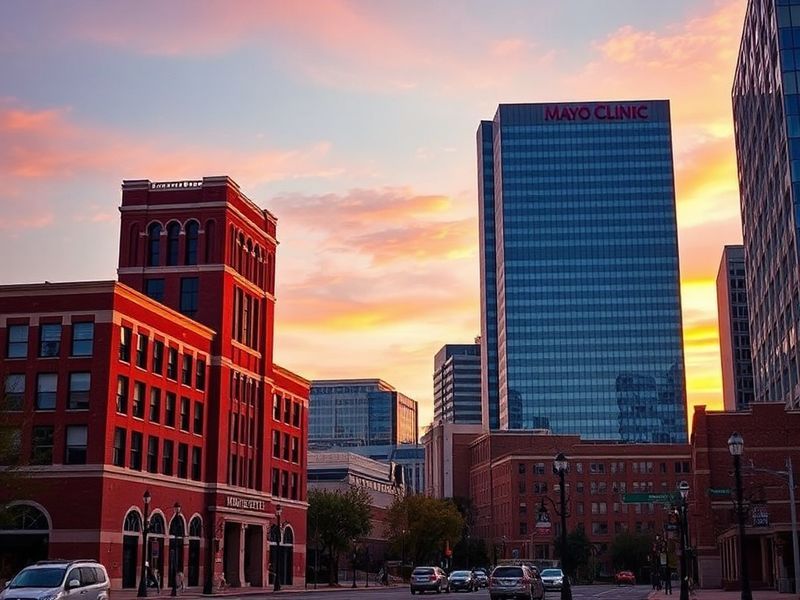
Nestled along the banks of the Zumbro River in southeastern Minnesota, Rochester stands as a testament to the unexpected fusion of cutting-edge medicine and Midwestern hospitality. With a population of just over 120,000, this city punches far above its weight in both economic influence and cultural significance. Unlike many similarly sized American municipalities, Rochester’s identity is inextricably tied to one institution: the Mayo Clinic. Yet, the city’s evolution reveals a far more complex narrative—one of adaptation, resilience, and a quiet determination to redefine what a modern regional hub can be.
Its story begins not in boardrooms or laboratories, but in the tragic loss of a young woman. In 1883, Mother Alfred Moes, founder of the Sisters of Saint Francis, convinced Dr. William Worrall Mayo to treat her order’s ailing patients in Rochester. When a tornado struck the following year, killing 37 and injuring hundreds, Mother Alfred proposed building a hospital if Dr. Mayo and his sons would staff it. That hospital, St. Marys, became the seed from which the Mayo Clinic would grow. Within decades, it transformed from a local charity into a global medical destination, drawing patients from every continent and shaping the city’s destiny in ways few could have predicted.
The Mayo Effect: How a Single Institution Reshaped a Community
The Mayo Clinic’s influence on Rochester transcends the clinical. It is woven into the city’s economic fabric, its educational systems, and even its architectural identity. Unlike corporate healthcare giants, the Clinic operates as a not-for-profit, reinvesting surplus into research, education, and community programs. This model has made it a global benchmark for patient-centered care, but it has also created a unique civic ecosystem where public and private interests align with uncommon harmony.
The Clinic’s presence has spurred a cascade of development. The city’s downtown has seen a renaissance, with historic buildings repurposed into modern offices, boutique hotels, and cultural venues. The Mayo Civic Center hosts everything from NHL drafts to international conferences, while the nearby Destination Medical Center (DMC) initiative—a $5.6 billion public-private partnership—aims to cement Rochester as a global health and bioscience hub by 2030. The DMC isn’t just expanding the Clinic’s footprint; it’s reimagining the city itself as a living laboratory for urban innovation.
Yet this growth has not come without tension. Critics argue that the Clinic’s dominance can overshadow other sectors, making Rochester vulnerable to economic shocks tied to healthcare policy shifts. The city’s cost of living has risen, and housing shortages have emerged as a growing concern. Balancing prosperity with inclusivity remains an ongoing challenge—one that demands creative solutions from local leaders.
Beyond Medicine: Culture, Education, and a Quiet Global Presence
Rochester may be known for medicine, but its cultural pulse is far more diverse than many realize. The city hosts the Rochester International Film Festival, the oldest running festival of its kind in the United States. The Mayo Clinic Symphony Orchestra, founded in 1946, performs regularly and collaborates with visiting artists from around the world. Meanwhile, the Plummer House—a 1903 Prairie-style mansion—serves as a museum and testament to the city’s architectural heritage.
Education also plays a pivotal role. The University of Minnesota Rochester (UMR), established in 2006, focuses on health sciences and liberal arts, catering to a student body drawn by the Clinic’s reputation. UMR’s presence has diversified the city’s demographics, introducing a younger, more international cohort that has invigorated local businesses and arts scenes. Rochester’s public schools, too, have gained recognition for innovation, particularly in STEM education.
From a global perspective, Rochester’s story reflects broader trends in medical tourism and regional development. Cities like Hyderabad in India, Basel in Switzerland, and Singapore have similarly leveraged world-class healthcare to drive urban growth. Yet Rochester stands out for its lack of overt commercialization. There are no flashy billboards advertising cosmetic procedures or VIP concierge services. Instead, the city’s appeal lies in its authenticity—a place where innovation is tempered by community values and where visitors often remark on the warmth of its residents.
A City in Motion: Transportation, Sustainability, and the Future
Rochester’s growth has forced a reckoning with infrastructure. The city sits at the intersection of two major highways—I-90 and U.S. Highway 52—and is served by the Rochester International Airport, which offers direct flights to key hubs like Chicago and Minneapolis. Yet, as the population swells, so do the demands on its transit systems. The recent launch of the Rochester Public Transit system’s “Zip Line” micro-transit service aims to improve mobility in underserved areas, while plans for expanded bike lanes and pedestrian trails reflect a broader commitment to sustainable urban design.
Sustainability isn’t just a buzzword here. The DMC initiative includes strict environmental standards, and the city has invested in renewable energy projects. The Mayo Clinic itself has pledged to be carbon-neutral by 2030, a goal that aligns with Minnesota’s broader climate ambitions. These efforts position Rochester as a case study for how mid-sized cities can pursue growth without sacrificing ecological responsibility.
Looking ahead, Rochester faces both opportunities and dilemmas. The aging Baby Boomer population presents both a healthcare challenge and an economic opportunity, particularly in senior care and assistive technologies. Meanwhile, the rise of telemedicine and AI-driven diagnostics could further decentralize healthcare, potentially reducing the Clinic’s geographic monopoly. Yet, for all its advancements, Rochester remains rooted in a tradition of human-centered care—a value that may prove increasingly vital in an era of algorithm-driven medicine.
The Human Element: Stories from Rochester
To understand Rochester is to listen to its people. Take Maria, a nurse at the Mayo Clinic who moved from the Philippines in 2010. She speaks of the Clinic’s rigorous training programs as transformative, not just professionally but personally. “I came for the job,” she says, “but I stayed for the community. There’s a kindness here that you don’t find in big cities.”
Or consider Javier, a small business owner who runs a taqueria downtown. His restaurant, “Tacos Chapultepec,” caters to the Clinic’s international staff and patients, offering a taste of home for those far from it. “People come here from all over the world,” he explains. “They’re nervous, tired, or just homesick. A plate of tacos can be a small comfort.”
These individual stories underscore a broader truth: Rochester’s strength lies not in its institutions alone, but in the people who animate them. It’s a city where global ambitions coexist with neighborly kindness, where cutting-edge science is tempered by Midwestern values, and where the future is being written one patient, one student, and one small business at a time.
Why Rochester Matters in a Changing World
In an era defined by polarization and rapid change, Rochester offers a counter-narrative. It proves that a city doesn’t need to be a coastal metropolis or a tech hub to matter on the global stage. Instead, it can carve its path by leveraging its unique assets—whether that’s a century-old medical tradition, a commitment to sustainability, or a community that refuses to be defined by any single industry.
The lessons from Rochester extend beyond its borders. For policymakers, it’s a model of how public-private partnerships can drive equitable growth. For healthcare professionals, it’s a reminder of the power of patient-first care. For urban planners, it’s an example of how to balance development with livability. And for anyone who’s ever felt out of place in a big city, Rochester offers a quiet promise: that innovation and humanity are not mutually exclusive.
As the world grows more complex, places like Rochester remind us that progress doesn’t always roar. Sometimes, it hums—steady, purposeful, and quietly transformative.
For those curious to explore further, the Travel section on Dave’s Locker offers insights into other underrated gems across the Midwest, while our Health category delves into the latest innovations shaping medicine and wellness globally.