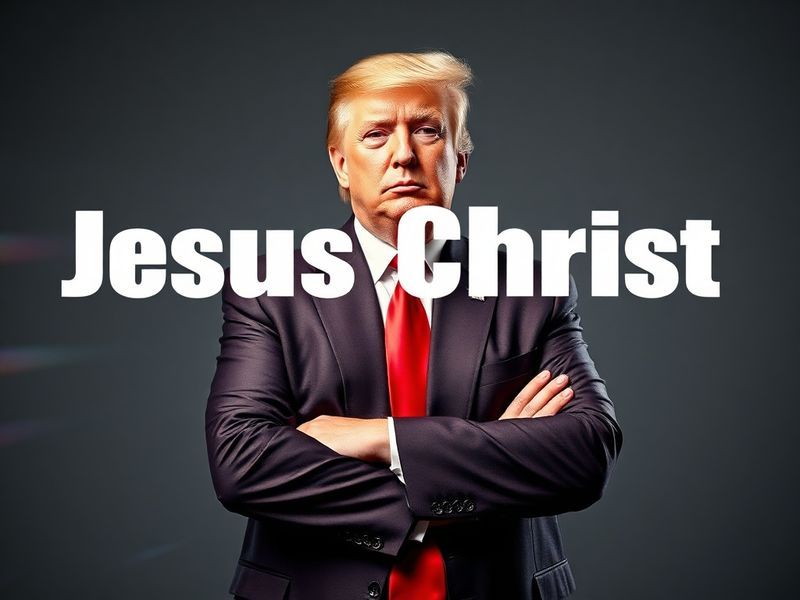
The “Trump Jesus” meme emerged in 2016 as a bizarre yet brilliant fusion of political commentary and religious imagery. It features a photograph of former U.S. President Donald Trump with his arms outstretched, superimposed with a digital crown of thorns. The image quickly transcended its original context, becoming a ubiquitous symbol of satire across digital platforms.
The meme’s power lies in its ability to blend sacrilege with political dissent, a combination that resonates deeply in an era where traditional institutions face increasing scrutiny. While some view it as blasphemous, others see it as a form of cultural critique—one that challenges authority through humor and irreverence. Its global spread highlights how internet culture has evolved into a tool for social and political expression.
The Origins of a Controversial Image
The “Trump Jesus” meme traces its roots to a 2009 photograph of Trump at a charity event, where he struck a pose reminiscent of crucifixion imagery. The meme’s modern iteration gained traction during Trump’s 2016 presidential campaign, when social media users began superimposing religious iconography onto his photographs.
The most recognizable version of the meme uses a digitally altered crown of thorns, transforming Trump’s head into a Christ-like figure. This juxtaposition serves as a visual pun—mocking both the former president’s self-proclaimed piety and his political ambitions. The meme’s simplicity made it easy to replicate, leading to countless variations across platforms like Twitter, Instagram, and Reddit.
What started as a niche internet joke soon became a global phenomenon. By 2017, the “Trump Jesus” meme had spread to mainstream media, appearing in news articles, late-night comedy segments, and even protest signs. Its adaptability allowed it to evolve beyond its original political context, taking on new meanings in different cultural settings.
A Global Symbol of Satire and Subversion
The “Trump Jesus” meme is more than just a political statement—it reflects a broader trend in digital culture where humor and irreverence challenge authority. In countries with strong religious traditions, the meme’s sacrilegious undertones spark debates about the limits of free speech and the role of satire in public discourse.
In Latin America, for example, the meme has been repurposed to critique authoritarian leaders, using the same visual language to mock figures like Brazil’s Jair Bolsonaro and Mexico’s Andrés Manuel López Obrador. Similarly, in Europe, the meme has been adapted to target populist politicians, blending religious imagery with political dissent in countries like Italy and Poland.
This global adaptation demonstrates the meme’s versatility. Whether used in the United States to mock Trump’s evangelical support or in the Philippines to criticize Rodrigo Duterte’s authoritarian rule, the “Trump Jesus” meme serves as a universal tool for dissent. Its power lies in its ability to make complex political critiques accessible through humor and visual simplicity.
How the Meme Spread Across Cultures
The “Trump Jesus” meme’s international appeal can be attributed to several factors:
- Visual Universality: The image’s reliance on a single, instantly recognizable photograph makes it easy to adapt across languages and cultures.
- Religious Symbolism: Christianity’s global reach ensures that the meme’s religious undertones resonate in diverse regions, even where secularism is on the rise.
- Political Flexibility: The meme’s ambiguity allows it to be repurposed for various political agendas, from anti-authoritarian protests to critiques of religious hypocrisy.
- Digital Proliferation: Social media algorithms favor visually striking content, accelerating the meme’s spread across platforms like Twitter, Instagram, and TikTok.
In India, for instance, the meme has been used to mock Narendra Modi’s nationalist rhetoric, while in South Africa, it has been repurposed to critique corruption in government. This adaptability ensures that the “Trump Jesus” meme remains relevant long after its initial creation.
The Ethics of Religious Satire in Digital Culture
The “Trump Jesus” meme raises important questions about the ethics of religious satire in the digital age. While some argue that humor is a necessary tool for holding power accountable, others view the meme as disrespectful to Christian beliefs. These debates reflect broader tensions between free speech and religious sensitivity in online spaces.
In predominantly Christian countries, the meme has sparked backlash from religious groups who view it as blasphemous. However, proponents argue that satire has long been a part of religious and political discourse, from medieval carnivals to modern-day cartoons. The question remains: where should the line be drawn between critique and disrespect?
This debate is not unique to the “Trump Jesus” meme. Similar controversies have arisen around other forms of religious satire, such as the “Charlie Hebdo” cartoons in France or the “South Park” episodes mocking Scientology. The internet’s global reach amplifies these discussions, forcing societies to confront their attitudes toward blasphemy and free expression.
The Role of Memes in Political Activism
Memes like “Trump Jesus” are more than just jokes—they are a form of political activism. In an era where traditional media struggles to engage younger audiences, memes offer a way to distill complex ideas into digestible, shareable formats. The “Trump Jesus” meme, in particular, exemplifies how internet culture can challenge power structures through humor.
During the 2020 U.S. presidential election, for example, the meme resurfaced as a tool for voter mobilization. Activists used it to critique Trump’s handling of the COVID-19 pandemic, blending political dissent with religious imagery to create a powerful visual message. Similarly, in Belarus, protesters adapted the meme to mock Alexander Lukashenko’s authoritarian rule, demonstrating its potential as a tool for resistance.
This evolution reflects a broader shift in how activism operates in the digital age. Memes allow marginalized voices to bypass traditional gatekeepers, reaching global audiences with minimal resources. The “Trump Jesus” meme is a prime example of how internet culture can amplify political messages, turning satire into a form of social commentary.
Conclusion: The Enduring Legacy of a Meme
The “Trump Jesus” meme may have originated as a fleeting internet joke, but its cultural impact is undeniable. It has transcended its political origins to become a global symbol of satire, subversion, and digital activism. Whether used to critique leaders, challenge religious norms, or simply entertain, the meme’s adaptability ensures its continued relevance.
As digital culture evolves, so too will the ways in which we use humor to confront power. The “Trump Jesus” meme is a reminder that in the age of the internet, even the most controversial ideas can spread—and that satire remains one of the most powerful tools for social change.
For more on internet culture and political satire, explore Entertainment and Politics on Dave’s Locker.