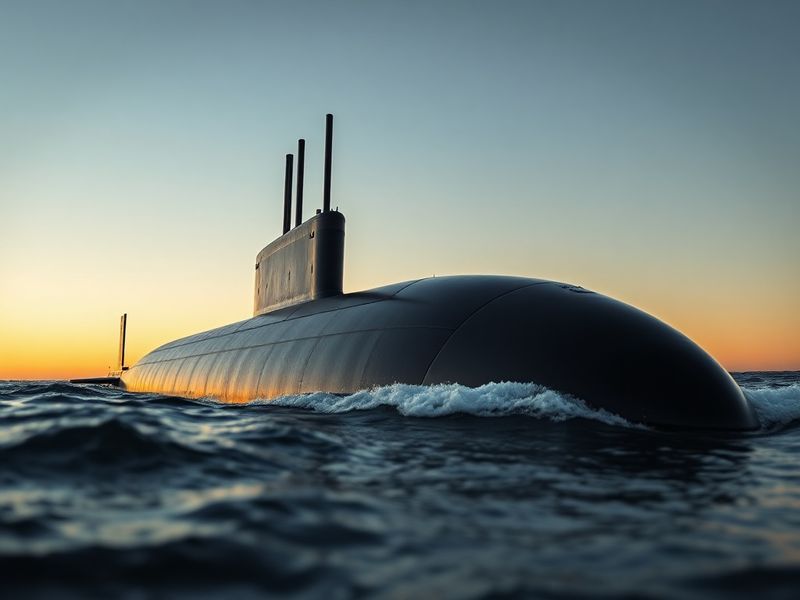
The ocean’s darkest depths have long been the domain of mystery, but beneath the waves, a different kind of mystery unfolds. Nuclear submarines represent one of humanity’s most advanced technological achievements, blending stealth, power, and endurance into vessels that operate beyond the reach of most detection methods. These silent guardians patrol the world’s oceans, carrying capabilities that shift global power balances.
Unlike their diesel-electric counterparts, nuclear submarines derive their propulsion from onboard nuclear reactors. This grants them virtually unlimited range and endurance, limited only by crew stamina and supply needs. The absence of a need to surface frequently or snorkel for air makes them nearly undetectable—a critical advantage in modern naval warfare and strategic deterrence.
The Technology Behind Silent Dominance
At the heart of every nuclear submarine lies its propulsion system. A pressurized water reactor heats water to create steam, which drives turbines connected to the propeller shafts. This process is continuous, silent, and produces no exhaust fumes, allowing submarines to operate submerged for months at a time. The U.S. Navy’s Ohio-class ballistic missile submarines, for example, can circumnavigate the globe without surfacing.
Beyond propulsion, modern nuclear submarines rely on advanced sonar systems, digital signal processing, and low-noise propulsion designs to remain undetected. The Russian Borei-class and American Columbia-class submarines incorporate stealth coatings and hull designs that minimize acoustic signatures. These features make them among the quietest vessels ever built—quieter even than the surrounding ocean in some frequency ranges.
The integration of nuclear power has also enabled the development of scientific submarines, such as the U.S. Navy’s NR-1, designed for deep-sea research. These vessels can operate at extreme depths while carrying sensors, manipulator arms, and laboratories. Their dual-use nature highlights how military technology often drives civilian innovation.
A Global Chessboard Beneath the Waves
Six nations currently operate nuclear-powered submarines: the United States, Russia, China, the United Kingdom, France, and India. Each deploys these vessels for different strategic purposes, reflecting their unique geopolitical priorities.
- United States: Maintains a fleet of 14 Ohio-class ballistic missile submarines (SSBNs) and 3 Seawolf-class and 19 Virginia-class attack submarines (SSNs). These serve as the backbone of America’s nuclear triad and global power projection.
- Russia: Relies heavily on its Borei-class SSBNs and Yasen-class SSNs to maintain a credible second-strike capability and assert presence in the Arctic.
- China: Has rapidly expanded its submarine force, including the Type 094 SSBN and the Type 093B attack submarine, signaling ambitions to project power across the Indo-Pacific.
- United Kingdom: Operates four Vanguard-class SSBNs and is developing the Dreadnought-class to replace them by the 2030s.
- France: Fields six Triomphant-class SSBNs and six Barracuda-class SSNs, ensuring an independent nuclear deterrent.
- India: Launched its first indigenously built nuclear submarine, INS Arihant, in 2016, joining an exclusive club and asserting regional leadership.
This distribution reflects more than just naval capability—it mirrors global power structures. The Arctic, in particular, has become a flashpoint for submarine activity as melting ice opens new routes and resources. Russia’s Northern Fleet, home to its most advanced submarines, operates from bases like Murmansk and Gadzhiyevo, while U.S. and U.K. submarines frequently patrol under the polar ice cap.
Stealth, Deterrence, and the Ethics of Invisibility
The operational invisibility of nuclear submarines raises profound ethical and strategic questions. On one hand, their stealth contributes to strategic stability. By ensuring a survivable second-strike capability, they help prevent nuclear war through mutual assured destruction (MAD). The presence of even a single SSBN at sea can deter aggression.
On the other hand, the opacity of submarine operations fuels mistrust. Unlike aircraft carriers or missile silos, submarines cannot be directly inspected. Their patrols are shrouded in secrecy, and incidents—such as the 2009 collision between a U.S. submarine and a British HMS Astute in 2016—rarely come to light until years later.
In 2021, a Chinese submarine was detected near Australia’s northwest coast, prompting diplomatic protests. Such events underscore how submarine activity, even when lawful, can escalate tensions. The lack of transparency in submarine operations makes them a persistent source of geopolitical tension, particularly in contested regions like the South China Sea and the Taiwan Strait.
The Future: AI, Hypersonics, and the Next Generation
The next decade will see nuclear submarines evolve in response to emerging threats and technological advances. Artificial intelligence is being integrated into sonar processing, navigation, and even decision-support systems. The U.S. Navy’s Columbia-class program, set to replace the Ohio-class starting in 2031, includes AI-driven predictive maintenance and stealth enhancements.
Hypersonic missile technology is another game-changer. The Russian Poseidon torpedo, a nuclear-powered, autonomous underwater vehicle capable of delivering a 100-megaton warhead, represents a new class of strategic weapon. Similarly, China is developing the Wu-14 hypersonic glide vehicle for submarine launch, threatening to erode missile defense systems.
As these capabilities grow, so does the cost. The Columbia-class alone is projected to cost over $128 billion for 12 submarines. Such investments reflect a belief that undersea dominance is essential to national security in the 21st century. Yet, they also divert resources from other pressing needs, including climate adaptation and public health.
Meanwhile, environmental concerns persist. While nuclear submarines emit no carbon dioxide during operation, their reactors produce radioactive waste. Decommissioning older vessels, such as the U.S. Los Angeles-class submarines, presents ongoing challenges in waste disposal and hull recycling.
A Silent Force Shaping the Century
Nuclear submarines remain the ultimate silent sentinels of the modern world. They do not fire the first shot in a conflict, nor do they seek headlines. Yet their presence underpins global security architectures, deters aggression, and shapes naval doctrine across oceans.
As nations race to modernize their fleets and deploy new technologies, the submarine domain grows increasingly contested. The Arctic is emerging as a new frontier, while cyber threats to submarine communications and AI-driven surveillance systems add layers of complexity.
One thing is certain: the age of the nuclear submarine is far from over. If anything, it is evolving. These vessels will continue to glide silently through the deep, carrying not just crews, but the weight of global stability. In an era of drones, satellites, and cyber warfare, the submarine endures—not because it is flashy, but because it cannot be seen.
And that may be its greatest strength.