<!DOCTYPE html>
<html lang="en">
<head>
    <meta charset="UTF-8">
    <meta name="viewport" content="width=device-width, initial-scale=1.0">
    <title>Live Premier League Table: Real-Time Insights for Fans</title>
</head>
<body>
    <article>
        <h1>Live Premier League Table: The Real-Time Pulse of English Football</h1>

        <p>The Premier League’s live table is more than just numbers on a screen—it’s a dynamic reflection of every tackle, goal, and managerial decision unfolding during a match. For fans, broadcasters, and analysts alike, this real-time data transforms how we experience the world’s most-watched football league. Unlike traditional standings updated post-match, live tables provide immediate context, revealing the shifting tides of competition as they happen.</p>

        <p>With the rise of advanced tracking systems and data analytics, live Premier League tables have become a staple for supporters craving deeper engagement. These tables don’t just show positions; they highlight performance metrics like expected goals (xG), possession percentages, and shot accuracy, offering a richer narrative than final scores alone. For clubs, they serve as a tactical tool, while pundits use them to dissect trends in real time. The accessibility of live data has also democratized football analysis, allowing casual fans to engage with the game on a professional level.</p>

        <h2>The Technology Behind Live Premier League Tables</h2>

        <p>Behind the scenes, live Premier League tables rely on a sophisticated blend of hardware and software. Optical tracking cameras, such as those used by <a href="https://www.daveslocker.net/sports">Sports Data Providers</a>, capture player movements up to 25 times per second, feeding data into algorithms that calculate metrics like pass completion rates and pressure applied during defensive phases. These systems are often integrated with broadcast feeds, ensuring accuracy even in fast-paced scenarios.</p>

        <p>For fans, the user experience is shaped by platforms that aggregate this data. Websites and apps pull from multiple sources—Opta, StatsBomb, and even AI-driven analytics—to present live tables with minimal latency. The challenge lies in balancing speed with precision: a delay of just a few seconds can render the data useless for in-game analysis. To mitigate this, some providers use edge computing, processing data closer to the source (e.g., stadium servers) to reduce lag.</p>

        <h3>Key Features of Modern Live Tables</h3>
        <ul>
            <li><strong>Real-Time Position Shifts:</strong> Tables update dynamically as goals are scored or penalties awarded, reflecting the latest standings without waiting for final whistle.</li>
            <li><strong>Advanced Metrics:</strong> Beyond points, users can view team and player performance indicators like xG, expected assists (xA), and defensive actions.</li>
            <li><strong>Customizable Filters:</strong> Fans can sort tables by home/away form, recent form, or even head-to-head records between specific teams.</li>
            <li><strong>Integration with Broadcasts:</strong> Broadcasters like Sky Sports and BT Sport overlay live stats on-screen, enhancing viewer engagement during matches.</li>
            <li><strong>Historical Comparisons:</strong> Some platforms allow users to compare current seasons with past campaigns, highlighting trends like a team’s mid-season collapse or surge.</li>
        </ul>

        <h2>Why Live Tables Matter Beyond the Scoreboard</h2>

        <p>Live Premier League tables aren’t just for bragging rights—they influence decisions that ripple through the sport. Clubs use this data to assess player performance mid-season, sometimes leading to managerial changes or transfer targets. For instance, a team consistently underperforming in xG metrics despite winning games might prompt a tactical overhaul, while a striker with high xA numbers could attract interest from rivals.</p>

        <p>The broader implications extend to broadcasting and sponsorship. Networks pay premium fees for live data rights, knowing that real-time stats keep viewers glued to screens. Sponsors, too, leverage this engagement; betting companies and fantasy football platforms thrive on the granularity of live tables, offering micro-betting options or player-swap suggestions based on minute-by-minute trends. Even the Premier League’s commercial partners, like Nike and EA Sports, use this data to refine marketing strategies, tying campaigns to performance narratives (e.g., “Support the Team Leading the xG Charts”).</p>

        <h2>The Fan Experience: From Pub to Podium</h2>

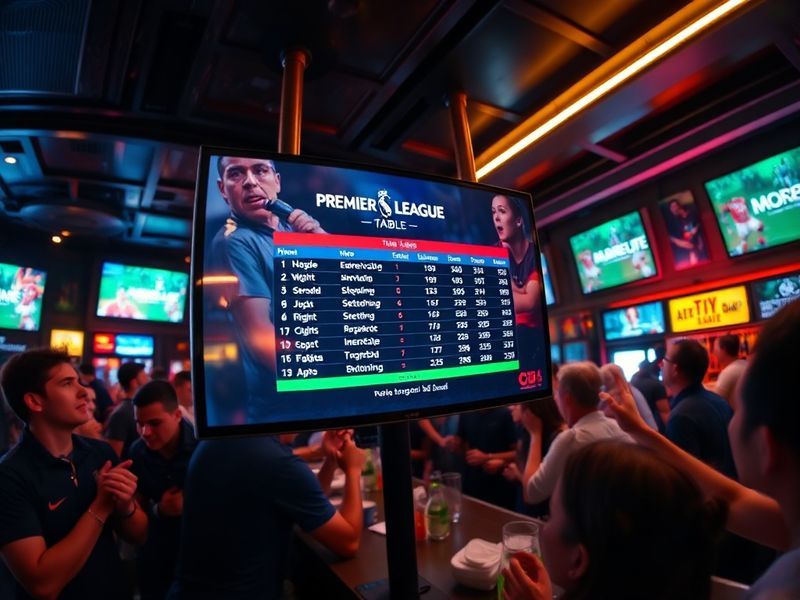
        <p>For supporters, live tables have redefined how they consume matches. Gone are the days of waiting for Monday morning newspapers to see how their team fared. Now, fans track their side’s ascent or decline during live matches, often while watching at home or in pubs equipped with large screens displaying real-time stats. Social media amplifies this, with hashtags like #PLTableTrends trending during key fixtures as fans debate every fluctuation.</p>

        <p>Fantasy football has particularly benefited from this evolution. Platforms like Fantasy Premier League (FPL) sync with live data, auto-updating points based on assists, clean sheets, and bonus points. This has turned casual players into data-savvy managers, poring over live tables to make last-minute transfers. The result? A more invested fanbase, where every pass and clearance carries weight beyond the 90 minutes.</p>

        <p>Yet, the reliance on live data isn’t without drawbacks. Over-analysis can detract from the raw emotion of football, reducing the sport to a spreadsheet. Critics argue that the obsession with metrics strips away the unpredictability that makes the game thrilling—after all, a last-minute winner or a red card can render even the most advanced stats obsolete. There’s also the issue of accessibility; while live tables are widely available in the UK and Europe, fans in regions with slower internet speeds may experience delays, creating an uneven experience.</p>

        <h2>Looking Ahead: The Future of Live Tables</h2>

        <p>The next frontier for live Premier League tables lies in augmented reality (AR) and virtual reality (VR). Imagine wearing AR glasses during a match, where live stats float above the pitch in real time, or using VR to “step into” a live table, comparing your fantasy team’s performance against the actual league standings. Companies like Hawk-Eye Innovations, already a staple in goal-line technology, are exploring such integrations, though widespread adoption may be years away.</p>

        <p>Another potential shift is the democratization of data collection. Currently, most live tables rely on proprietary systems owned by a handful of companies. Open-source alternatives, where fans or smaller clubs contribute to collective databases, could emerge, challenging the dominance of established providers. This would level the playing field, giving even non-Premier League teams access to high-quality analytics.</p>

        <p>For now, live Premier League tables remain a cornerstone of modern football fandom. They bridge the gap between the visceral thrill of the game and the analytical rigor of data science, offering a dual lens through which to view the sport. Whether you’re a manager, a pundit, or a fan in the stands, these tables provide a window into the heartbeat of the Premier League—one that beats in real time.</p>

        <h3>Final Thoughts</h3>
        <p>As technology advances, live tables will only grow more sophisticated, but their core purpose remains unchanged: to deepen our connection to the game. The Premier League’s allure lies in its unpredictability, yet within that chaos, data offers a thread of clarity. For clubs, it’s a tool for survival; for fans, a source of endless debate; and for the league itself, a way to stay relevant in an era where engagement is measured in milliseconds. The live table isn’t just a feature—it’s a revolution in how we experience football.</p>
    </article>

    <!-- Metadata Section -->