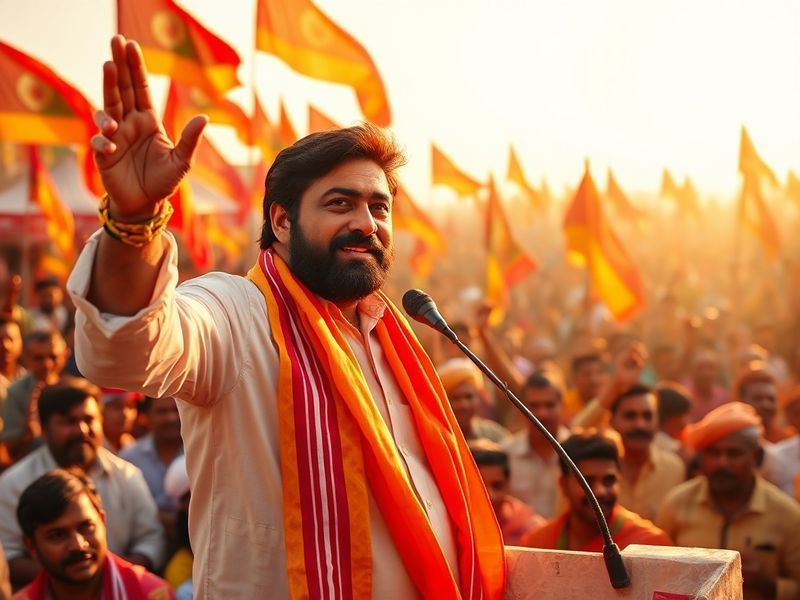
Pawan Kalyan’s journey from a mass-market action hero to one of India’s most influential political strategists is more than a career arc—it’s a cultural tectonic shift in Andhra Pradesh’s public imagination. While his name once evoked images of high-octane stunts and stylized villainy, today it triggers debates about governance, identity, and the future of India’s youngest state. His rise isn’t just a regional phenomenon; it reflects broader global trends where celebrity and politics increasingly intersect, reshaping democratic engagement in unexpected ways.
The actor-turned-politician has cultivated a rare dual identity: a charismatic screen persona that commands millions of fans, and a real-world leader who commands serious policy influence. His political party, Janasena Party, emerged in 2014 not as a traditional cadre-based formation, but as a movement built on social media virality and youth mobilization—an approach that resonates with global patterns seen in movements from Brazil to the Philippines, where populist leaders harness media spectacle to consolidate power.
From Celluloid Hero to Real-World Leader
Born into the illustrious Konidela family—son of Telugu cinema legend Krishna and brother of megastar Chiranjeevi—Pawan Kalyan’s entry into politics in 2014 was both anticipated and audacious. He launched the Janasena Party with a manifesto that blended anti-corruption rhetoric with aspirational messaging aimed at young voters disillusioned by established parties. His political debut came not with a rally, but with a 15-minute video released online, a strategy that mirrored the viral campaigning techniques later perfected by figures like Donald Trump and Volodymyr Zelensky.
Pawan’s screen roles often mirrored his off-screen persona: a rebellious outsider fighting systemic corruption. In films like Gabbar Singh and Attarintiki Daredi, he played characters who challenged entrenched power structures—narratives that foreshadowed his real-life political ambitions. This thematic continuity between art and activism helped build a loyal base that sees him not as a politician, but as a cultural icon with a mandate to reform.
His political ideology, though fluid, centers on youth empowerment, regional pride, and anti-elitism. This positioning has drawn comparisons to global political movements that blend entertainment, identity politics, and anti-establishment sentiment. Like figures in other media-saturated democracies, Pawan’s appeal lies in his ability to embody both the everyman and the outsider—a duality that resonates in an era of declining trust in traditional institutions.
The Janasena Phenomenon: A New Model of Political Mobilization
The Janasena Party’s growth reflects a broader transformation in how politics is conducted in the digital age. Unlike traditional parties that rely on grassroots networks and ideological dogma, Janasena leverages social media, celebrity endorsements, and viral content to reach voters directly. In 2024, Pawan’s party won 21 seats in the Andhra Pradesh assembly, signaling a tectonic shift in state politics and positioning him as a kingmaker in regional governance.
Key elements of Janasena’s mobilization strategy include:
- Celebrity Capital: Pawan’s star power translates into instant media attention, enabling rapid message dissemination and crowd mobilization.
- Digital-First Campaigning: The party’s social media presence—especially on platforms like Instagram and YouTube—outpaces traditional campaign methods in reach and engagement.
- Youth-Centric Messaging: Policies focus on employment, education, and digital infrastructure, aligning with the aspirations of India’s largest demographic.
- Cultural Symbolism: Pawan’s films and public persona reinforce a narrative of regional pride and resistance to centralized authority.
This model has drawn international attention from political scientists studying the intersection of media, celebrity, and democracy. In countries like the United States and Brazil, similar dynamics have reshaped electoral politics, often blurring the line between governance and performance. Pawan’s rise underscores how cultural capital can become political capital—especially in regions where traditional party systems have eroded.
Regional Identity and the Politics of Recognition
Pawan Kalyan’s political project is deeply rooted in Telugu identity. His emphasis on “Jai Andhra” sentiment and regional autonomy reflects a broader global trend where subnational identities are asserting themselves against centralized power. In India, this dynamic is particularly pronounced in states like Andhra Pradesh, where linguistic and cultural pride have long fueled political movements.
His opposition to the bifurcation of Andhra Pradesh in 2014—when the state was split to create Telangana—was framed not just as a political stance, but as a defense of cultural integrity. This positioning resonated with millions who saw Hyderabad’s separation as a loss of regional identity. Pawan’s subsequent advocacy for Andhra Pradesh’s development, particularly through infrastructure and industrial projects, has reinforced his image as a leader committed to regional revival.
This focus on identity politics aligns with global patterns where cultural recognition often precedes economic or political demands. From Catalonia in Spain to Quebec in Canada, movements for autonomy frequently hinge on narratives of historical grievance and cultural distinctiveness. Pawan’s ability to channel this sentiment into a political platform has made him a symbol of regional resilience in an increasingly centralized political landscape.
Global Echoes: Celebrity, Power, and Democratic Erosion
Pawan Kalyan’s political journey invites comparison with other celebrity leaders who have crossed from entertainment to governance. In the Philippines, actor-turned-president Joseph Estrada leveraged his screen image to win mass appeal, while in the United States, reality TV star Donald Trump used media savvy to redefine political communication. Like these figures, Pawan blends populist messaging with a performative leadership style that prioritizes visibility over deliberation.
Yet Pawan’s case is distinct in its cultural specificity. His appeal is not just about anti-establishment rhetoric, but about reimagining governance through a regional lens. His policies—focused on education, digital inclusion, and youth employment—reflect a generation’s aspirations rather than a nationalist or ideological agenda. This pragmatic approach has allowed him to navigate complex coalitions, including alliances with both left-leaning and right-leaning parties.
His political evolution also reflects a broader global shift: the erosion of traditional party structures in favor of personality-driven movements. In India, this trend is visible across parties, from Narendra Modi’s Bharatiya Janata Party to Arvind Kejriwal’s Aam Aadmi Party. Pawan’s rise is part of this larger transformation, where charisma often outweighs ideology in shaping electoral outcomes.
Challenges and the Road Ahead
Despite his growing influence, Pawan Kalyan faces significant challenges. The Janasena Party’s rapid ascent has raised questions about its long-term sustainability. Can a party built on charisma and social media maintain coherence when faced with governance realities? The test will come in policy execution—especially in delivering on promises like job creation and infrastructure development.
There are also concerns about the concentration of power in a single personality. While Pawan’s leadership has energized youth, critics argue that his top-down approach risks sidelining democratic processes within the party. The absence of robust internal mechanisms for debate and dissent could undermine the movement’s long-term credibility.
Yet, Pawan’s ability to adapt and reinvent himself—from action star to political strategist—suggests resilience. His recent alliances with national parties indicate an ambition to expand beyond Andhra Pradesh, positioning him as a potential kingmaker in national politics. Whether this trajectory will lead to consolidation of power or fragmentation remains an open question.
What is clear is that Pawan Kalyan has redefined the possibilities of political leadership in India. By merging cinema, culture, and governance, he has created a model that resonates with a generation seeking authenticity and agency. His story is not just about one man’s ambition, but about how identity, media, and power intersect in the 21st century.
As Andhra Pradesh charts its future, Pawan’s role will be pivotal. Whether he becomes a transformative leader or a fleeting phenomenon, his journey offers a compelling case study in the evolving landscape of democracy—a landscape where the line between actor and architect is increasingly blurred.