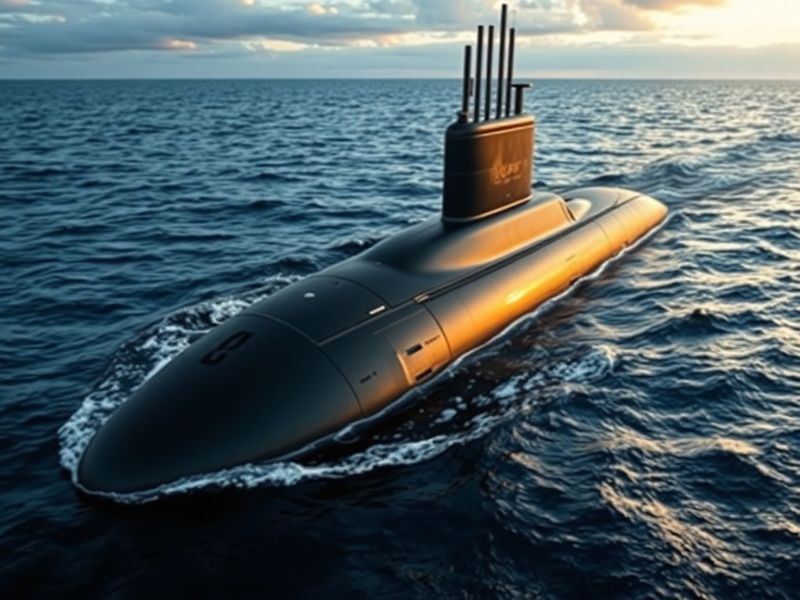
nuclear submarine
“`html
Nuclear Submarines: Silent Titans of the Deep
The nuclear submarine remains one of the most formidable and strategically vital assets in modern naval warfare. Unlike their diesel-electric counterparts, these vessels combine near-limitless endurance with unmatched stealth and firepower. Their presence reshapes global military doctrine, deterrence strategies, and even geopolitical power balances. Yet their operations often unfold beneath the surface—literally and figuratively—leaving many to wonder: what makes these underwater behemoths so uniquely powerful?
At their core, nuclear submarines are defined by their propulsion systems. Powered by nuclear reactors, these vessels can operate submerged for months without surfacing for fuel. This capability grants them a level of operational independence that diesel-electric submarines simply cannot match. The nuclear reactor generates heat, which produces steam to drive turbines, enabling speeds in excess of 30 knots—far faster than conventional submarines. This combination of speed, range, and stealth creates a platform that is nearly untouchable in modern naval conflict.
The Anatomy of a Nuclear Submarine
Nuclear submarines are marvels of engineering, blending cutting-edge technology with rugged survivability. Their design prioritizes both stealth and endurance, with features that set them apart from all other naval vessels.
At the heart of every nuclear submarine lies the reactor compartment. Here, a compact nuclear reactor—often using highly enriched uranium—generates immense heat through controlled fission. This heat converts water into steam, which drives turbines connected to the submarine’s propulsion system. The reactor requires no external air, making it ideal for underwater operations. Refueling occurs only after decades of use, a stark contrast to the frequent resupply needs of diesel submarines.
Surrounding the reactor are multiple layers of shielding designed to protect the crew from radiation. The submarine’s hull, typically made of high-tensile steel or, in some cases, titanium, must withstand crushing pressures at operational depths exceeding 800 feet. Life support systems maintain breathable air, temperature, and humidity within tight parameters, allowing crews to live in close quarters for extended patrols.
The submarine’s sensor suite is another critical component. Advanced sonar arrays, both passive and active, detect underwater sounds and echoes with remarkable precision. These systems can distinguish between a school of fish and a distant submarine with surprising accuracy. Modern nuclear submarines also carry inertial navigation systems that rely on gyroscopes and accelerometers, allowing them to navigate without surfacing for GPS fixes—a vital capability when evading detection.
Key Features of Nuclear Submarines
- Unlimited Range: Nuclear propulsion eliminates the need for refueling, enabling patrols lasting up to six months.
- High Speed: Capable of sustained underwater speeds exceeding 30 knots, far outpacing conventional submarines.
- Stealth Operations: Quiet reactor designs and advanced sound-dampening materials reduce detectability.
- Heavy Armament: Equipped with torpedoes, cruise missiles, and in some cases, ballistic missiles with nuclear warheads.
- Endurance: Life support systems and food stores allow crews to remain submerged and operational for extended periods.
Global Players and Strategic Roles
A handful of nations possess nuclear submarine fleets, each serving distinct strategic purposes. The United States, Russia, China, the United Kingdom, and France lead in both technology and deployment, with India and Australia emerging as newer entrants in this exclusive domain.
The U.S. Navy operates the most advanced nuclear submarine fleet in the world. The Ohio-class ballistic missile submarines (SSBNs) form the backbone of America’s nuclear triad, carrying up to 20 Trident II D5 missiles with multiple independently targetable warheads. These submarines patrol silently beneath the oceans, ensuring a second-strike capability that deters large-scale nuclear conflict. Meanwhile, the Virginia-class attack submarines (SSNs) focus on intelligence gathering, anti-submarine warfare, and precision strikes against land and sea targets.
Russia maintains a formidable fleet centered on the Borei-class SSBNs and the Yasen-class SSNs. The Borei-class, with its advanced missile systems, reinforces Russia’s nuclear deterrent, while the Yasen-class combines stealth and firepower, designed to counter U.S. naval dominance. China, too, has rapidly expanded its submarine force with the Type 094 SSBNs and the increasingly quiet Type 093 attack submarines, signaling its ambition to project power across the Indo-Pacific.
Each nation deploys nuclear submarines for different strategic goals. The U.S. and Russia emphasize nuclear deterrence and blue-water dominance. The U.K. focuses on a continuous at-sea deterrent with its Vanguard-class SSBNs. France blends nuclear deterrence with expeditionary capabilities. China’s submarine fleet reflects its growing maritime ambitions, from securing sea lanes to challenging U.S. naval superiority in the Pacific.
Implications for Warfare and Diplomacy
The presence of nuclear submarines introduces profound implications for global security. Their stealth and destructive potential make them central to nuclear deterrence strategies. The concept of “second-strike capability”—the ability to retaliate after a first nuclear attack—relies heavily on the invulnerability of SSBNs. This mutual assured destruction (MAD) framework has, for decades, prevented large-scale nuclear war between major powers.
Yet the proliferation of nuclear submarines also raises concerns. As more nations acquire or develop these platforms, the risk of miscalculation or escalation increases. The South China Sea, for instance, has become a flashpoint where submarine patrols intersect with territorial disputes. The U.S. routinely conducts freedom of navigation operations in the region, often shadowed by Chinese attack submarines—a reminder that beneath the waves, technological prowess can quickly translate into geopolitical leverage.
Technological advancements continue to reshape the submarine landscape. Quieter reactor designs, improved sonar, and even unmanned underwater vehicles (UUVs) are being integrated into modern fleets. Some analysts predict that artificial intelligence could soon play a role in submarine operations, from optimizing patrol routes to automating sensor analysis—though such developments raise ethical and operational questions about human oversight in life-or-death decisions.
Environmental and safety concerns also persist. While reactor accidents are rare, the consequences could be catastrophic. The 2000 Kursk disaster, in which a Russian submarine sank during an exercise, killing all 118 crew members, serves as a grim reminder of the risks. Modern submarines incorporate multiple safety redundancies, but the inherent dangers of operating nuclear reactors in extreme environments cannot be eliminated entirely.
The Future of Underwater Dominance
As geopolitical tensions rise and technological innovation accelerates, the role of nuclear submarines is poised to evolve. The U.S. is developing the Columbia-class SSBNs to replace the Ohio-class, with construction underway and deployment expected in the 2030s. These submarines will feature improved stealth, longer service lives, and upgraded missile systems. Similarly, the U.K. is building the Dreadnought-class SSBNs to maintain its nuclear deterrent into the latter half of the century.
China’s submarine ambitions are equally ambitious. Reports suggest the development of a next-generation nuclear-powered aircraft carrier and a new class of ballistic missile submarines that could carry hypersonic missiles—capabilities that would significantly alter the strategic balance in Asia. Meanwhile, Russia is reportedly working on fifth-generation submarines with even greater stealth and automation.
Beyond military applications, nuclear submarines may find new roles in scientific research, deep-sea exploration, and even space analog missions. Projects like NASA’s Neptune concept, which envisions nuclear-powered submarines for exploring the oceans of Europa, hint at civilian applications for this technology. The same engineering principles that enable silent underwater travel could one day unlock secrets of distant worlds.
Yet the primary function of nuclear submarines remains unchanged: to project power, deter aggression, and secure national interests in an increasingly contested global commons. Their silent patrols beneath the ocean’s surface are a reminder that in the realm of modern warfare, invisibility is power—and nuclear submarines are its ultimate expression.
As nations invest billions in these silent titans, one thing is clear: the race to dominate the deep is far from over. The submarines of tomorrow will be faster, quieter, and more lethal than ever before. And in an age of rising tensions and rapid technological change, their strategic value has never been greater.
For those who operate them, nuclear submarines are more than machines—they are sovereign territory, mobile fortresses, and guardians of national survival. For the rest of the world, they remain unseen, unheard, and ever-watchful guardians of the abyss.
To explore more about modern naval technology and its impact on global security, visit our Technology and Politics sections.
—
METADATA
{
“title”: “Nuclear Submarines: The Silent Force Reshaping Global Power”,
“metaDescription”: “Explore how nuclear submarines drive military strategy, deterrence, and geopolitical influence in the modern world.”,
“categories”: [“Technology”, “Politics”],
“tags”: [“nuclear submarines”, “SSBN”, “naval warfare”, “nuclear deterrence”, “geopolitics”],
“imageDescription”: “A sleek, modern nuclear submarine gliding silently beneath the ocean surface, its dark hull barely visible in deep blue waters, with a faint bioluminescent glow highlighting its streamlined form. The scene conveys stealth, power, and technological sophistication, evoking a sense of quiet dominance and global strategic importance.”
}
—END METADATA—
“`